
People to People Ambassadors
Visit to Indian Libraries and Cultural Sites
November 2 – 11, 2014
“When libraries open, democracy opens.”
Dr. Nardiri Khatter, Deputy Librarian, University of Rajasthan
Between November 2 and 11, 2014, eight delegates from People to People Ambassadors visited the Golden Triangle in India: New Delhi, Jaipur, and Agra. This exciting trip included visits to the key cultural sites in the areas, visits to local libraries by the professional librarians, and an additional set of cultural sites for the librarians traveling companions.
The Delegates
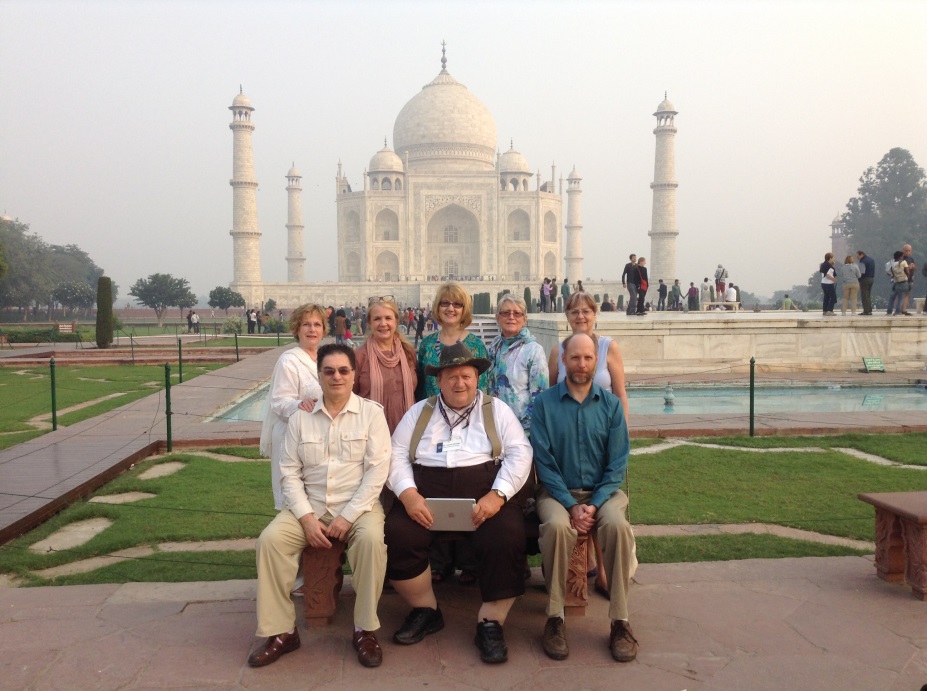
Back row, left to right: Karen Watson, Pru Fallon, Betty Luscher, Joan Thompson, Nancy Bolt
From row, left to right: Robert Hubsher, James Morgan, Greg Thompson
Nancy Bolt
Nancy Bolt was State Librarian in Colorado for 18 years. She left in 2005 to re-establish her library consulting business. She is currently President of Nancy Bolt and Associates. She specializes in strategic planning, program development and evaluation, the future of library services, and staff development. She was Co-Project Director for the development and implementation of the American Library Association (ALA) Library Support Staff Certification (LSSC) Program. Nancy has been active in international library work for 20 years. She has been Chair of the ALA International Relations and currently she serves as Secretary of the IFLA Standing Committee on Library Services to People with Special Needs.
Betty Luscher
Betty Luscher has worked at the Corona Public Library in Corona, California since receiving her M.L.I.S. from San Jose State University in 1996. She was Technical Services Supervisor for 9 years before moving to her current position of Youth & Outreach Services Supervisor in 2012. Every month Betty recruits close to 50 teen & adult volunteers through an orientation and brief interviews. Through the Adult Reading Assistance Program, Betty pairs volunteers with functionally illiterate people who need to improve their reading skills. In 2012 she received a grant to overhaul the library’s Spanish-language collection. She is a member of ALA and the International Relations Round Table of ALA.
Robert Hubsher
Robert Hubsher is the Executive Director of the Ramapo Catskill Library System (RCLS), a cooperative public library system serving 47 libraries in four New York counties. Passionate about intellectual freedom, privacy, and information fluency, he has recently been accepted as an Ambassador for Privacy by Design (PhD) an organization that addresses the effects of information technologies and large-scaled networked data systems. As CEO and Chief Librarian of the Cornwall Public Library, ON, Canada, Robert managed the construction and renovation of the new library building and automated services. With his partner in PLAN22 Archibrarians, Karen Watson, he advises librarians during all the stages of their library building projects.
James Morgan
James E. Morgan is a retired librarian with thirty years’ experience in correctional libraries in Arizona, Nevada, and California. His last position was at the California Youth Authority in Stockton, California. He worked at the Arizona State Library as the Institutional Library Development Consultant where he developed a training program for Institutional Consultants in 11 western states. James is a past chairman of the Library Services to Prisoners Section of the American Library Association and created five programs for prison librarians at ALA conferences. He also chaired the Membership Advisory Group on Library Service to the Developmentally Disabled, and was a past member of the Bibliotherapy Forum of ALA.
Prudence Fallon
Prudence Fallon is the Adult Services and Reference Librarian for Tiverton Library Services in Tiverton, Rhode Island. Her duties include adult collection development, programming and reference work for the Essex Public Library and coordinating community service workers and volunteers, book clubs, proctoring, updating the website, computer trouble-shooting and more. She is currently working to facilitate a move to a brand new, larger library in the spring. She works with Ocean State Libraries where she is lead purchaser of e-books for the state and on the Digitization and Adult Services Committee and Reference Working Group. Prudence previously worked in the corporate field for 25 years in Communications, Marketing, Procurement, Research & Development and Consumer Affairs for Ocean Spray Cranberries.
Greg Thompson
Greg Thompson works at the Carmel Mountain Library, a Branch of the San Diego Public Library in San Diego, California. He works as a Library Aide at the library where he helps maintain the library collection and helps library use find the materials they want. He is currently working on his Master’s in Library Science.
Karen Watson
Karen Watson is an Architect. She is particularly interested in coaching librarians to effectively communicate their libraries’ needs to architects. With 35 years’ experience in construction, specification writing, strategic planning, construction safety, interior fit up and residential, commercial and institutional building design, she wants to contribute to the success of the next generation of librarians as they build the future of libraries. She and her partner Robert Hubsher are authors of “Making the Case for Your Library Building Project – Library Development Guide #5″, for the Southern Ontario Library Service (SOLS). She developed and presents webinars to the SOLS Advanced Public Library Leadership (APLL) Institute.
Joan Thompson
Joan is a counselor and coordinates programs for low income community college students at San Diego Miramar College. She has served at Miramar for 35 years. Her interest in libraries stems from childhood where weekly trips to the local library were a special time. As an educator, she values reading and learning as a way out of poverty.
NOTES FROM THE PROFESSIONAL VISITS
As part of our visit, the professional delegates participated in two conferences and visited three libraries. The conferences were held at the National Institute of Science, Technology, and Development Studies (NISTADS) and DELNET.
NISTADS
Our first professional day began with a visit to NISTADS, an organization devoted to studying various aspects of the interaction among science, society, and the state. The NISTADS sponsored conference, Library Information Systems and Services: Challenges and Opportunities, had nine speakers in about 3 hours. In introducing the conference, Dr. P. Banerjee raised issues faced by Indian libraries: increasing digitizataion; the multitude of languages spoken in India; low-level literacy, particularly in rural areas; and lack of local library use.
Three of our delegates made presentations. Team leader Nancy Bolt discussed Predicting the Future: Eight Emerging Trends in Library Service: the changing role of libraries; the format expansion of library collections; the need to support community economic development; the library as an educational center for all ages; continually arriving new techbnology; the need for new library staff skills; the library as a community hub; and the need to recruit people to advocate for library service.
Nancy Bolt

Nancy Bolt
Betty Luscher
Betty Luscher
Robert Hubsher
Robert Hubsher
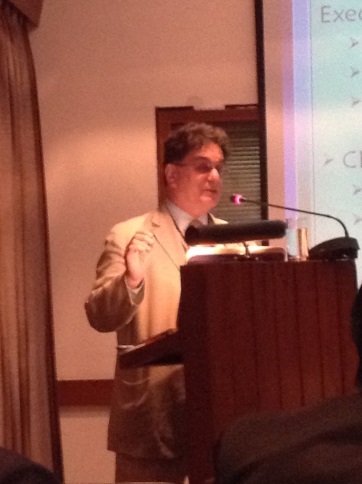
Delegate Robert Hubsher spoke on Intellectual Freedom and Privacy in Libraries: Challenges in the Ditigal Age. He began his presentation by acknowledging the impact that Indian philosopher and librarian, Dr. S. R. Ranganthan, had on his career and on the development of Indian public libraries. He discusses this in more depth his the attached narrative.
Hubster went on to define intellectual freedom, privacy, and confidentialty. Hubsher praised the role of libraries in protecting these three principles on behalf of their users and asked who controlls the data collected by vendors in integrated library systems (ILS) that is stored in a digital cloud? The issue of privacy and confidentiality is particularly sensitive in the arena of social media. After his presentation, one Indian attendee described Robert as courageous in his defense of these principles.
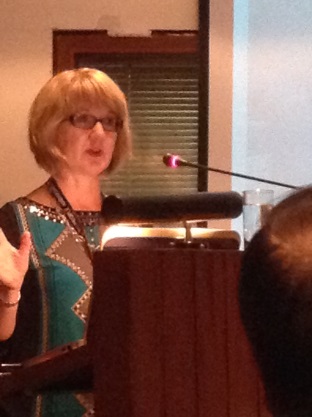
Betty Luscher, discussed the history of the Corona Public Library in Corona, California and what it faces in the future in Profile of a U.S. Public Library: Its History, Challenge, and Successes. Betty described how the community has grown and the struggles of the library to keep up. From 1993 to today, Corona’s population has increased over 5 times. Staffing rose along with economic & population growth, but now is back to the same level as in 1990, at 40 employees. Meanwhile the book budget had dropped from $97,000 to $71,282. Despite this the library has purchased books, online resources, and audio-visual materials thanks to fees, donations, fund-raising events and grants. The library has both a Friends group and a Foundation that raise funds to support the library. Betty described the multi-source funding of the library and the popular services it offers. The library will be changing again because of a recent merger with the city’s Recreation Department.
For the Indian conference contributers, there were several highlights. Mr. H. R. Meena described the services of the New Delhi Public Library (NDPL) which were remarkably similar to the services of large public libraries in the US. A disappointment of the trip was that our schedule did not permit a trip to this library, particulalry after we heard Mr. Meena’s description. Through it’s 24 braches and 25 deposit collections, NDPL provides free public library service to the residents of New Delhi including print and AV materials; digitization of rare books, reference, children’s programs, 120 computers (less than would be in a US public library of this size), book mobiles for rural areas, and services to the incarcerated in prisons. They also offer an impressive array of cultural programs such as dance and music programs, creative writing, film, and exhibitions as well as training of library staff. As is true in US libraries, usage is up but budget cuts reduce the number of staff.
Professor B K Sen from the India National Science Academy discussed the explosion of research and the difficult of getting access to this information by researches, estimating that Indian libraries only have access to 2% of the research available. Subscription costs to databases, even those that include papers done by Indian researchers, prohibit easy access. Mr. G. Mahesh from the National Knowledge Research Center echoed the issues of increasing cost and stagnating budgets and the lack of access to current research.
Dr. Anup Das from Jawaharlal Nehru University discussed “Open Access to Scholarly Research: Implications for Research Libraries.” His presentation was really a list of helpful hints to be recognized as a scholarly researcher such as: create a unique personal ID; create your own website to share your research; participate in academic social networking; share your published work in Open Access Repositories; and create a profile in Google Scholar Citations and track when and where you are cited.
In the Q&A that followed the presentations the discussion focused on the difficulty of accessing information and data because of the hardware migration, the disappearance of digital documents, the lack of preservation and that “India contributes to intellectual content but can’t afford to subscribe to the databases that have this content.” Dr. Bannerjee also commented that the projected growth of technology is fast but that Indian government bureaucracy is not always able to make decisions quickly. The US delegates quickly concurred.
DELNET
DELNET, created in 1988, is the Indian Developing Network, so named because it strives to be continuously developing its services for its users. Dr. Sangetta Kaul, DELNET’s Deputy Director, made a presentation about the services of DELNET followed by a conference similar to the one at NISTADS. At this conference, all the U S delegates were surprised to learn that we were expected to give our presentations again, only a shortened version, which we really didn’t have time to shorten. However, we did our best.
DELNET serves as the interlibrary loan hub for Indian libraries. It currently has 20 million records from 4700 member libraries (including some in the United States) and a 95% fill rate for requests. Most of the member libraries are academic libraries. Membership costs $150 and the only transaction fee is the postal charges. They work in 21 languages and use Koha as their ILS, providing support for local libraries that also use Koha. They consider DELNET to be “the most effective library sharing network in South Asia” with a “common goal to provide information to the public.”
In addition to ILL using a union catalog of books, DELNET also subscribes to e-books, DVDs, and full text databases with a goal of providing the requested resources within three days maximum waiting time. They do limited reference work and provide training to their members.
Dr. H. K.Kaul, Director of DELNET, opened the conference on “The Future of Librarianship” by commenting that information growth is phenomenal particularly in the digital arena. Libraries are no longer the depository of all documents. Publishers are not selling content, they are leasing it. The growth of MOOCs is decreasing the use of libraries as students get information online from content providers who want to bypass libraries and deliver information to users directly. Online education is transforming education; what is the role of libraries? Administrators ask why have a library if students can get the information directly. Library education needs to respond by helping libraries to be subject specialists and to determine what students really need.
Professor P. B. Mangla, the Tagore National Fellow from the Indian Ministry of Culture, discussed the history of public libraries in India. Robert Hubsher describes Dr. Mangla’s presentation in his attached narrative.
Dr. Gayas Makhdumi, University Librarian at Jamia Millia Islamia, suggested that librarians involve “the taxpayer” in planning library services and ask users what they want from libraries. He advocated for the Indian Minister of Education to establish a national e-library with free and open access to every student and that library collaboration with students and teachers is “essential.” Dr. Makhdumi asked how libraries can transform themselves to be more useful to their users. “Good customer service can produce advocates” and libraries should work toward this goal.
Indian Institute of Health Management Research
Dr. Marthur, Associate Professor and Library Director, described the history of IIHMR, which started as a research institute in 1984. The institute specializes in training managers and researchers in health services. IIHMR offers a two-year diploma in hospital and health management. They have recently begun a program in pharmaceutical management as well. They also work with the World Health Organization to do training and have a cooperative agreement with Johns Hopkins University to offer a joint degree in health management. 70% of the placement of their graduates is in rural areas. Dr. Marthur indicated that getting rural residents to use government health programs is a challenge. Many prefer to try to “self-heal” or go to use local “medical quacks” until they are very sick and then go to a “real” doctor. One goal of IIHMR is to work with local community and women’s groups to do village education and teach health and hygiene. He did not feel that rural public libraries were used enough to be useful in this effort. As in other Indian services, the multitude of languages is a challenge. He commented “go three kilometers in India and the water and language changes.”
IIHMR graduates go into three areas after graduation:
- Hard core research and evaluation of health management programs
- Implementing a program, project management
- Study for their PhD and publish
The library that supports IIHMR is a member of DELNET and has 28,000 books, journals, textbooks, case studies, newsletters, conference proceedings, and reports from all over the world. The library receives over 130 nnational and international professional and research journals.
Nancy Bolt with librarians at DELNET
University of Rajasthan
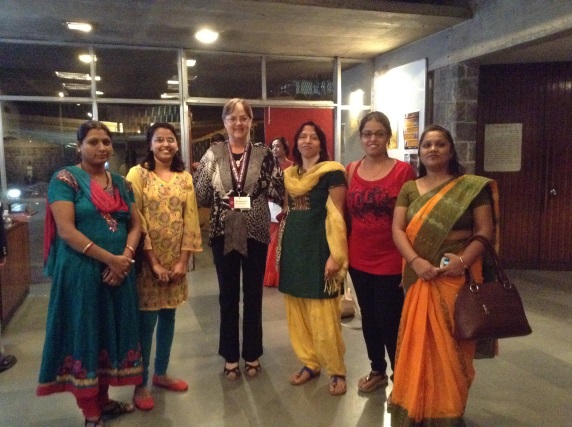
Nancy Bolt with librarians at DELNET
At the University of Rajasthan we met with Professor N. D. Marthur, Director of the central library and Dr. Nardiri Khatter, Deputy Librarian. Dr. Khatter began with her own list of the four major problems facing Indian academic libraries: reduced funding, declining use, lack of modernization, and keeping up with digital collections. The library has open staff positions without the permission from the university administration to fill them. “The library is starving for funding,” Dr. Khatter said.
Still the library does its best to meet the needs of the students. Officially the library is open from 9am to 9pm, however, the students wanted longer hours so the library is now open 24 hours, without formal permission to do so. The library has an advisory council made up of faculty members who make recommendations to the university administration about purchases and new library services. The library has 500,000 items including books, journals, government documents, maps, braille, microform, and a rare collection from Mount Abu, the home of British envoys during the British domination. It also has a fine arts collection representing the different cultures of India. Its annual circulation is 24,126; the annual budget $26,315; a staff of 35; and 10 computers for students. In our tour of the library we saw the small computer room which had multiple students around each computer.
Still, Dr. Khatter related their hopeful plans for the future: strengthen the infrastructure, add RFID, renovate the building, add more e-books, add more computers, and hire more trained staff.
Computer room at the university
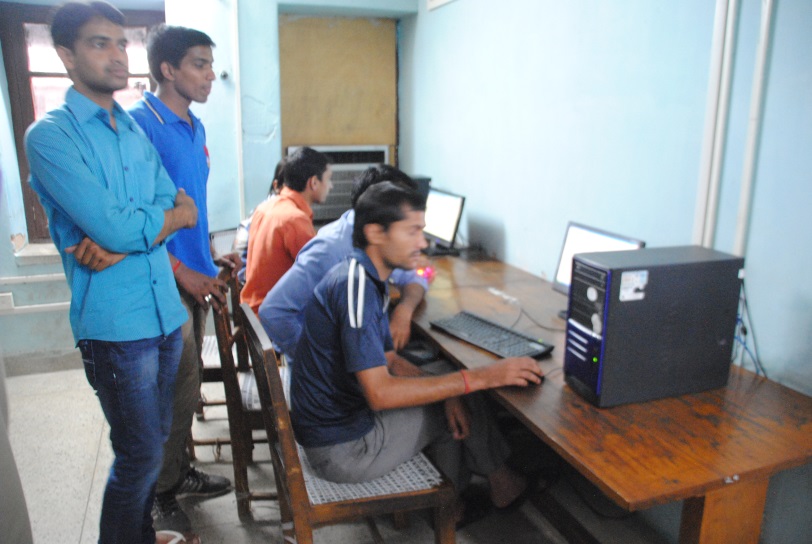
Computer room at the university
Public Library of Jaipur
The Jaipur Public Library was an unusual facility. We were ushered into the Community Meeting room to meet with the library director, Mr. Saharan. This meeting room was large, clean, and bright, with microphones and soft executive chairs. The library rents out this room for the use of local government and businesses. The library itself is very different with dusty shelves and books. The library seems to serve primarily as a study location for young people studying to improve their opportunities in life. The library rents out study rooms so researchers or students can reserve a spot to store their research and study materials. A large study room was filled with young people – segregated with the young men on one side of a wall and the young women on the other. Mr. Saharan said the library has 95,000 books and 3000 “members.”
A national India Foundation, Raja Rammohun Roy, provides TV equipment, donated books, and furniture. The books did not seem relevant to rural India and were not processed or shelved to be available for the public.
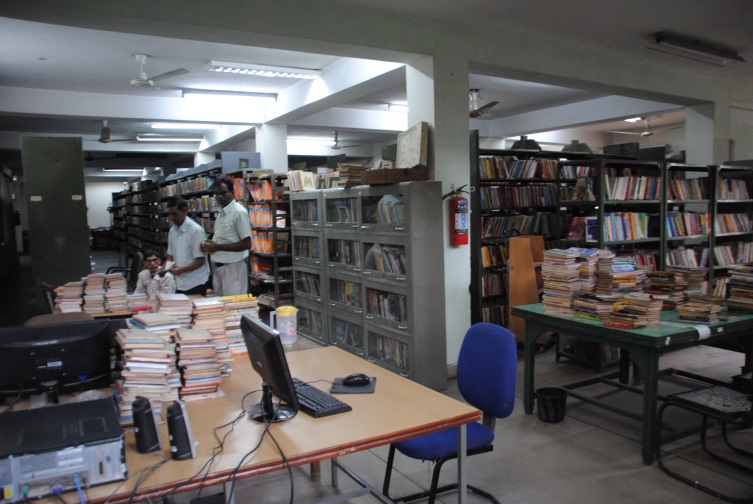
Public Library
Commonalities between US and India Libraries
By Nancy Bolt
While in India, the People to People delegation met with many Indian librarians and heard several presentations about Indian libraries. The US delegates also share information about the current status of US libraries. We were able to determine many similarities about the issues faced by libraries in both countries. This provides a foundation for continued possible cooperation between Indian and US libraries.
Commonalities
- Many libraries in both countries are dealing with “increasing costs and stagnating budgets” that result in staff cuts as described by Mr. Mahesh, Principle Scientist and Coordinator at CSIR-NKRC.
- All speakers discussed the expediential growth of technology and the difficulty that libraries have in keeping current. More and more documents are digitized and libraries must find ways to access what is available. In addition, as hardware changes, content and data is lost if it cannot migrate to a new platform.
- Speakers discussed the movement from owning content to leasing online content. The India speakers mentioned creating content that appears in databases they do not have the resources to subscribe to. In addition, in leased content, if a library ceases to subscribe, all the previously available content is no longer accessible to users.
- All libraries were concerned about maintaining their relevance today’s world as people seek information on their own; publishers reach out to buyers individually bypassing libraries; and the difficulty of accessing all the digitization now published.
- In order to provide quality service, the libraries in both countries participate in networks like DELNET and cooperative networks in the United States such as Ramapo Catskill Library System.
- Advocacy for the role and relevance of libraries is crucial. NGOs, other community partners, and uses can advocate for the value of library services and need to be encouraged to advocate for the library. Libraries can promote advocacy by asking library users and local NGOs what services they would like and attempting to deliver them.
- A multitude of languages in both countries provide challenges for libraries to serve the library user. The problem includes availability of materials in multiple languages and the ability of staff to communicate with users. In India, this is particularly a problem in rural areas. In the US, it is more a problem in urban areas where immigrants settle.
- Public library services in the New Delhi Public Library seem very similar to modern public library services in the US with the major difference that US libraries are able to provide more computers for public use. Libraries in both countries struggle with sufficient bandwidth. Libraries in both countries also are offering more cultural and outreach activities, becoming a “place” for people in communities to congregate and receive services beyond traditional books.
- Education is changing radically with more and more online education in both countries. MOOCs are popular in urban India as well as the US. The role of libraries in serving students in such dispersed areas is unclear. Libraries need to find a way to provide library services in the far-flung educational environment.
- Bureaucracy in both countries can sometimes be a barrier to library development and the initiation of new services that users request.
- Library staff must acquire new skills to respond to new demands and challenges. Library education must respond to this need with new curricula.
Dr. Gayas Makhdumi, University Librarian at Delhi University Library summed up the challenge when he said: “Libraries have to change, can they?”
Impressions of Indian Libraries
By James Morgan
- Libraries in India are very strong proponents of advocacy. They use every opportunity they can find to let the public know they are out there, and they try to compete for the public’s attention.
- South Africa and India have a problem with multiple languages in their respective countries. There are approximately seven different languages spoken in South Africa. But in India there are at least 1,700 different languages spoken. This presents a problem for libraries that try to collect literature from all over the country.
- We saw a wide cross section of libraries on our trip. The public library in Jaipur and the Rajasthan University library were housed in old buildings that were completely inadequate. The buildings were a barrier to the provision of quality of good service. The difference between them is that the University library wanted to build a new facility and the public library seemed to not care about the condition of their building.
- Indian libraries are concerned about funding, just like libraries in the United States are. Support for library service at the national level is fragmented. There is no national library grant program in India like there has been in the United States.





 International Library and Cultural Exchange Interest Group