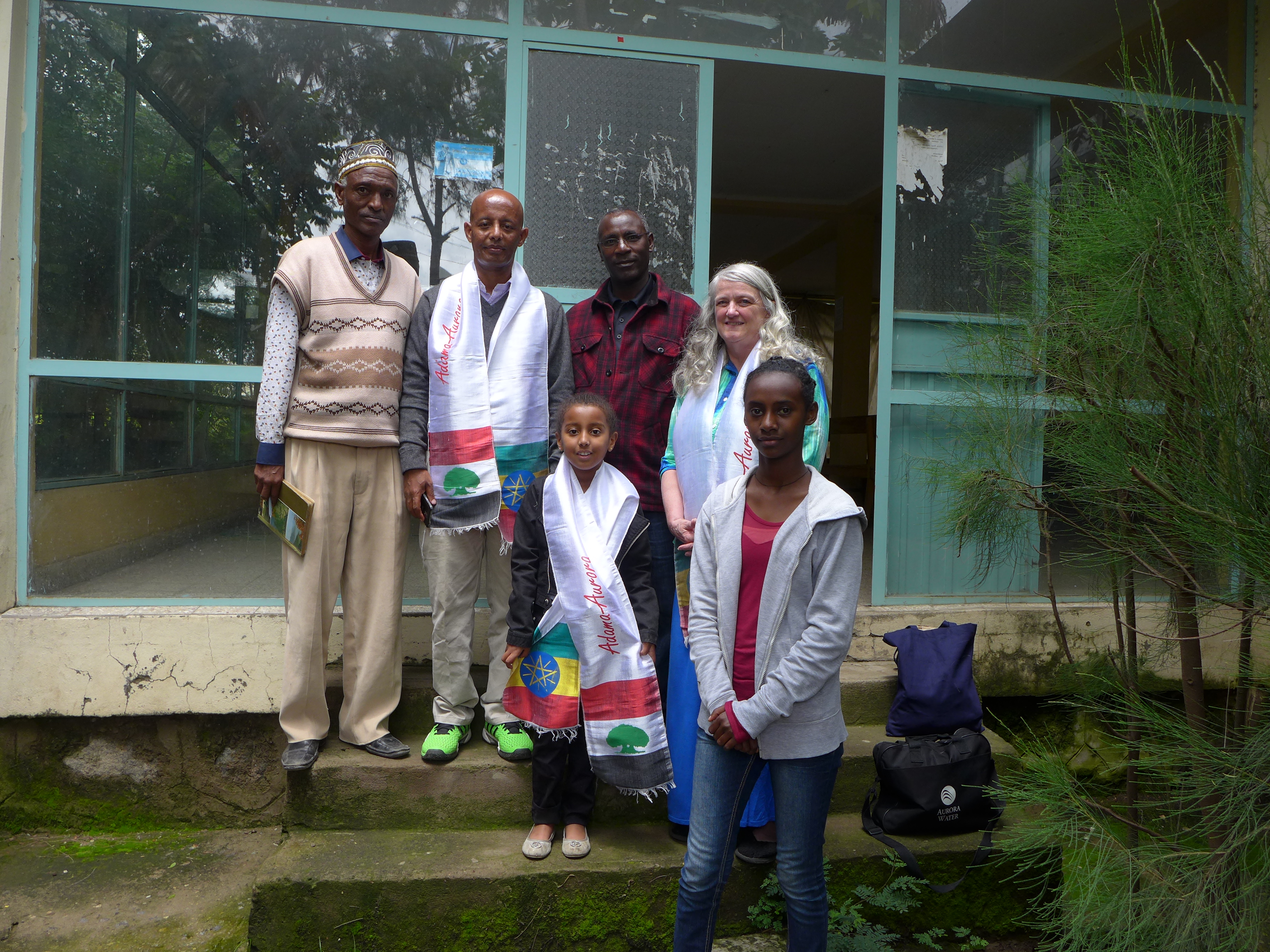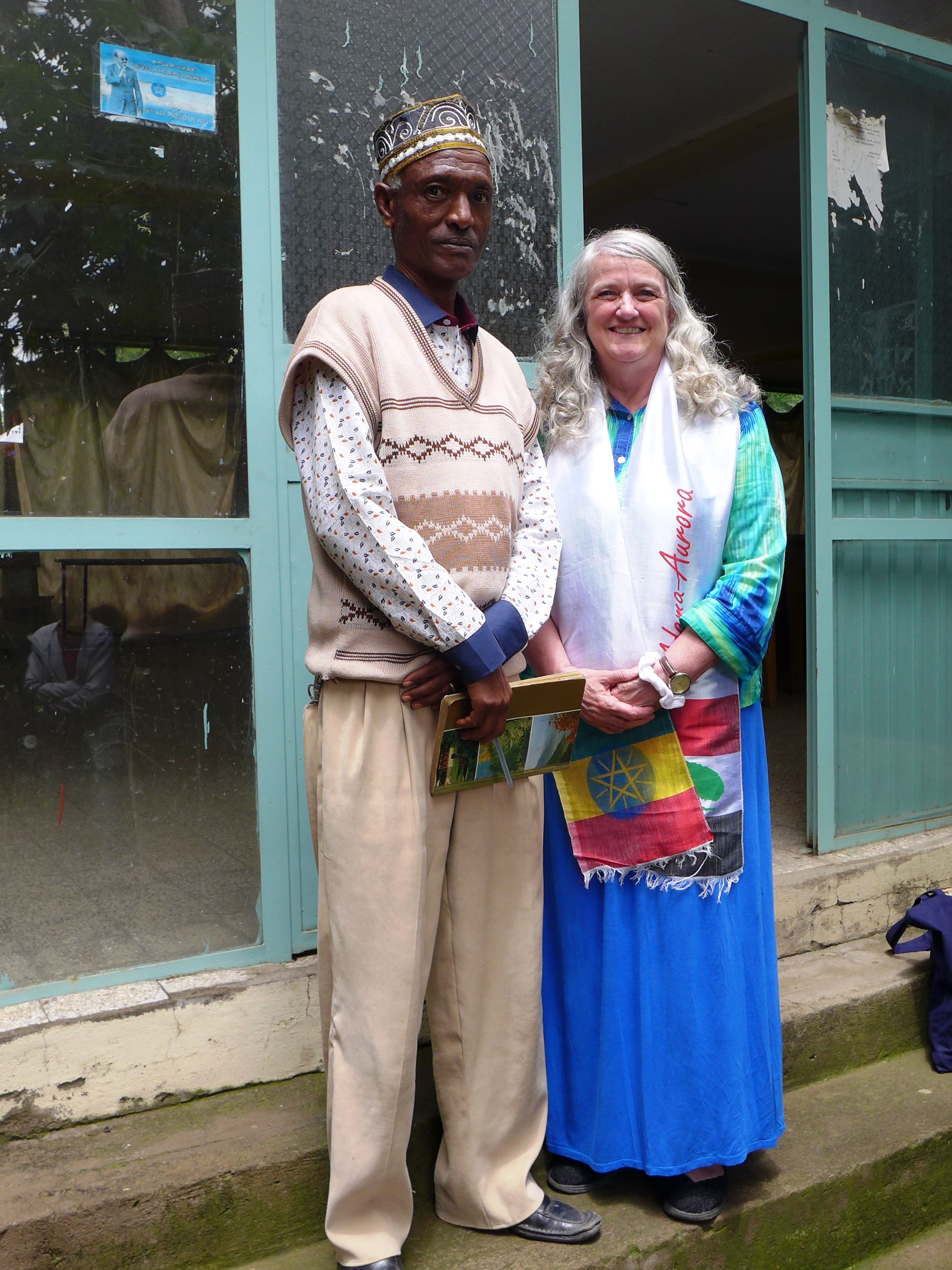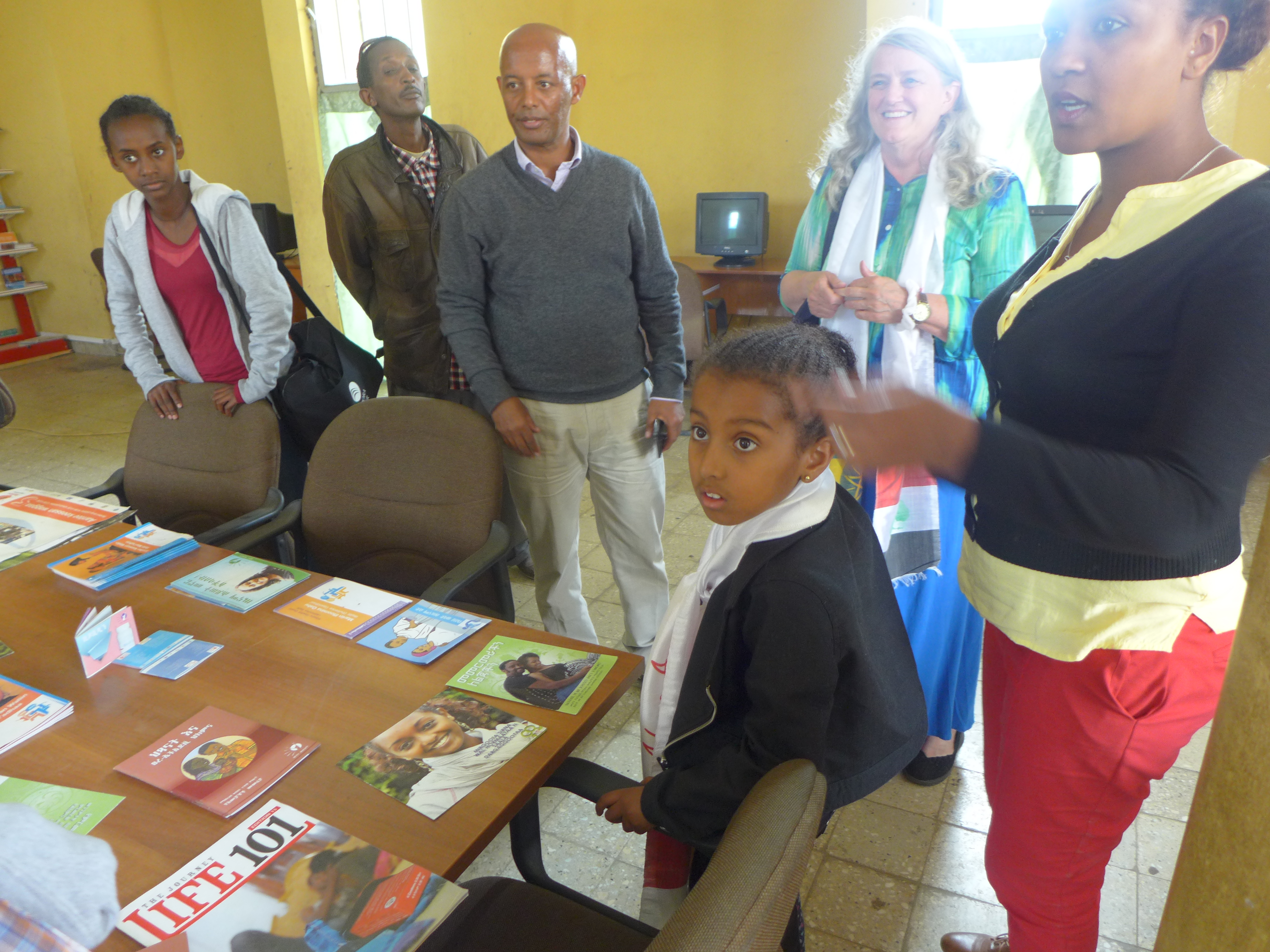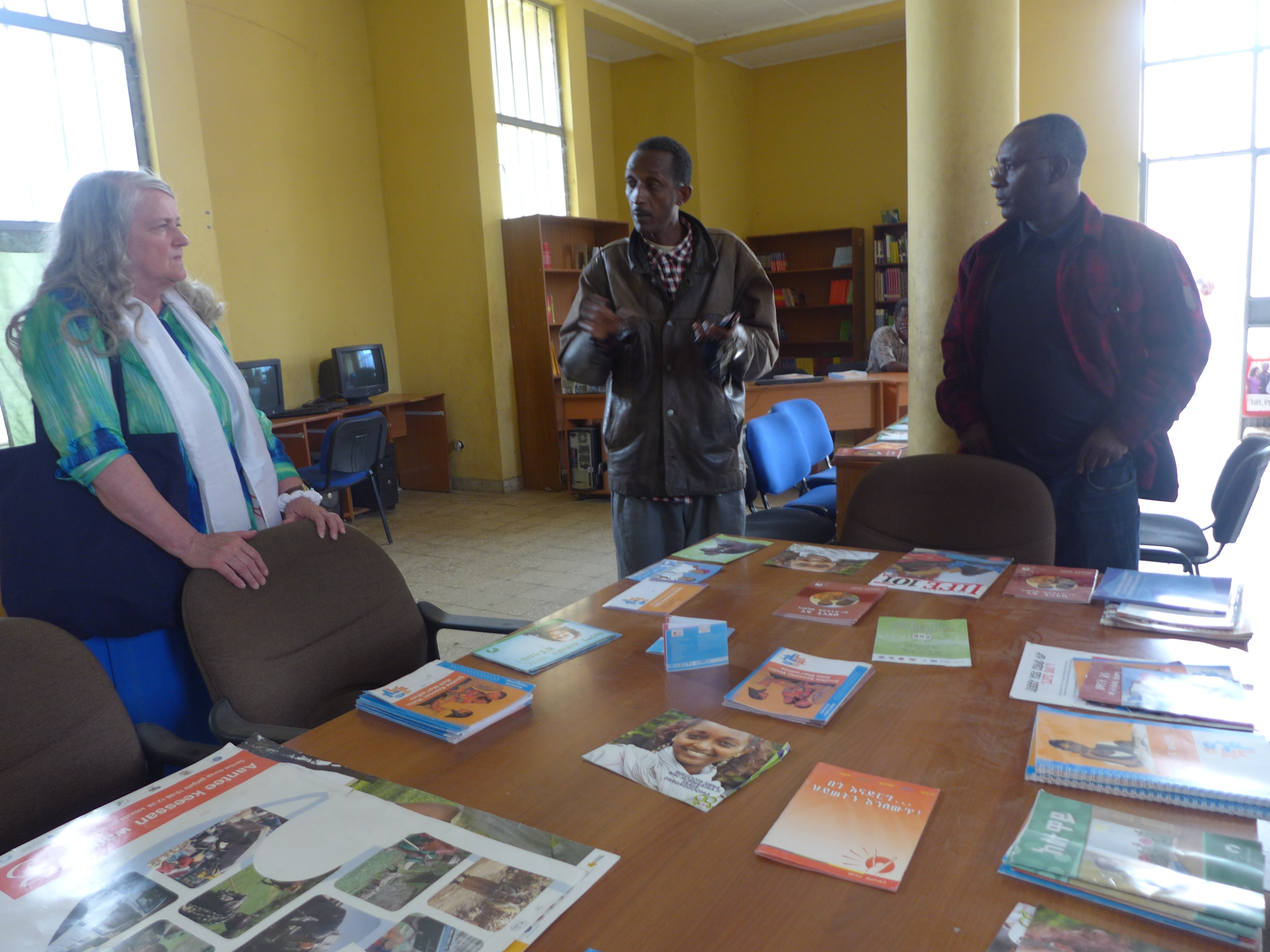
Axumite Heritage Foundation Library and Cultural Center

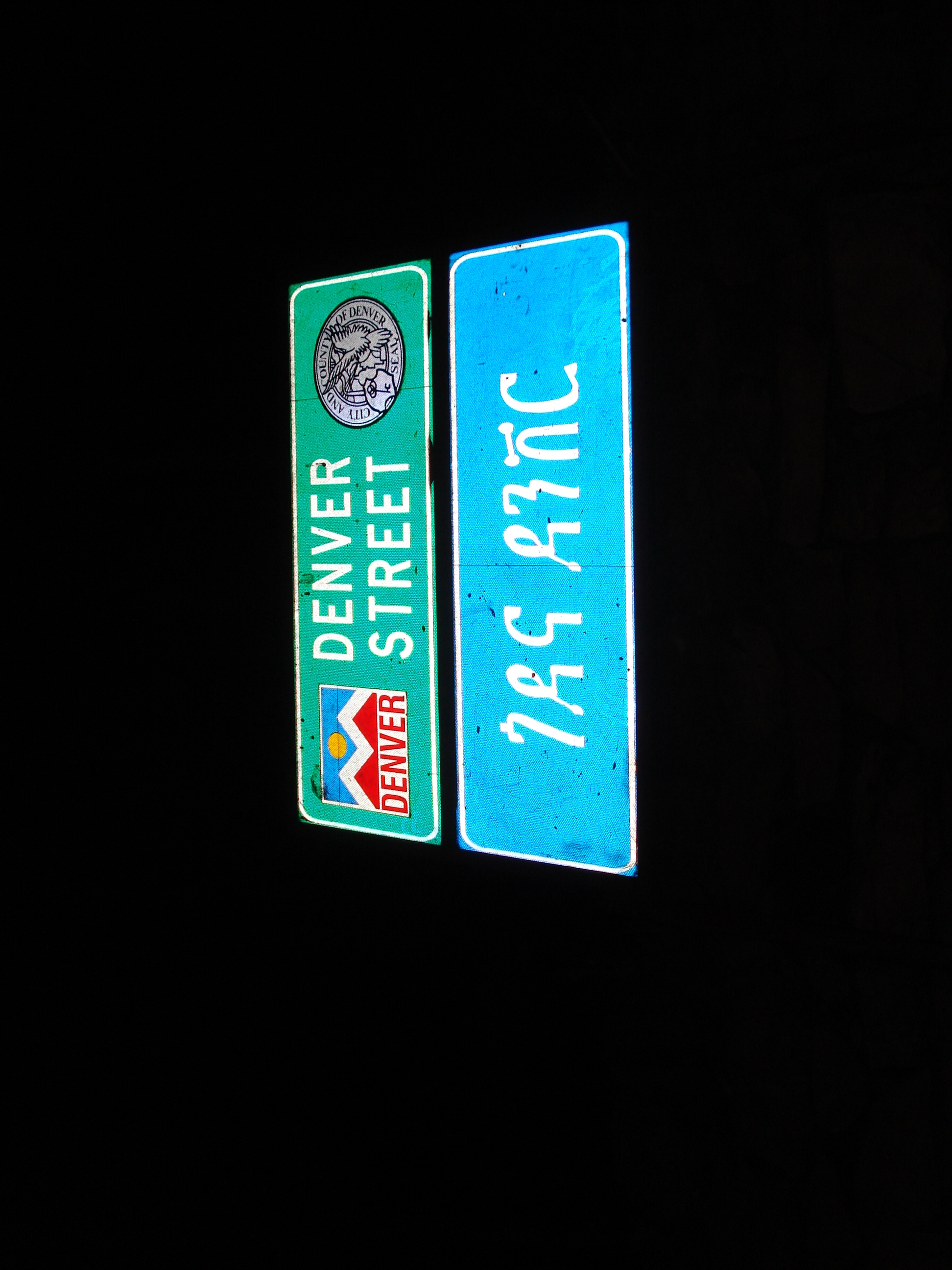
Denver Street, Axum Ethiopia

Denver Street, Axum Ethiopia

Axumite Heritage Foundation Library and Cultural Center, Axum, Ethiopia

by Janet Lee, Regis University

P1020430


Axum, the historical city

Axum is an ancient city that flourished 400 BC as a great trading partner in the region.  In 1980 UNESCO added it to its archaeological sites to its list of World Heritage Sites.

In 400 CE,  a large segment of the population converted to Christianity, making Ethiopia one of the first predominately Christian nations in the world.
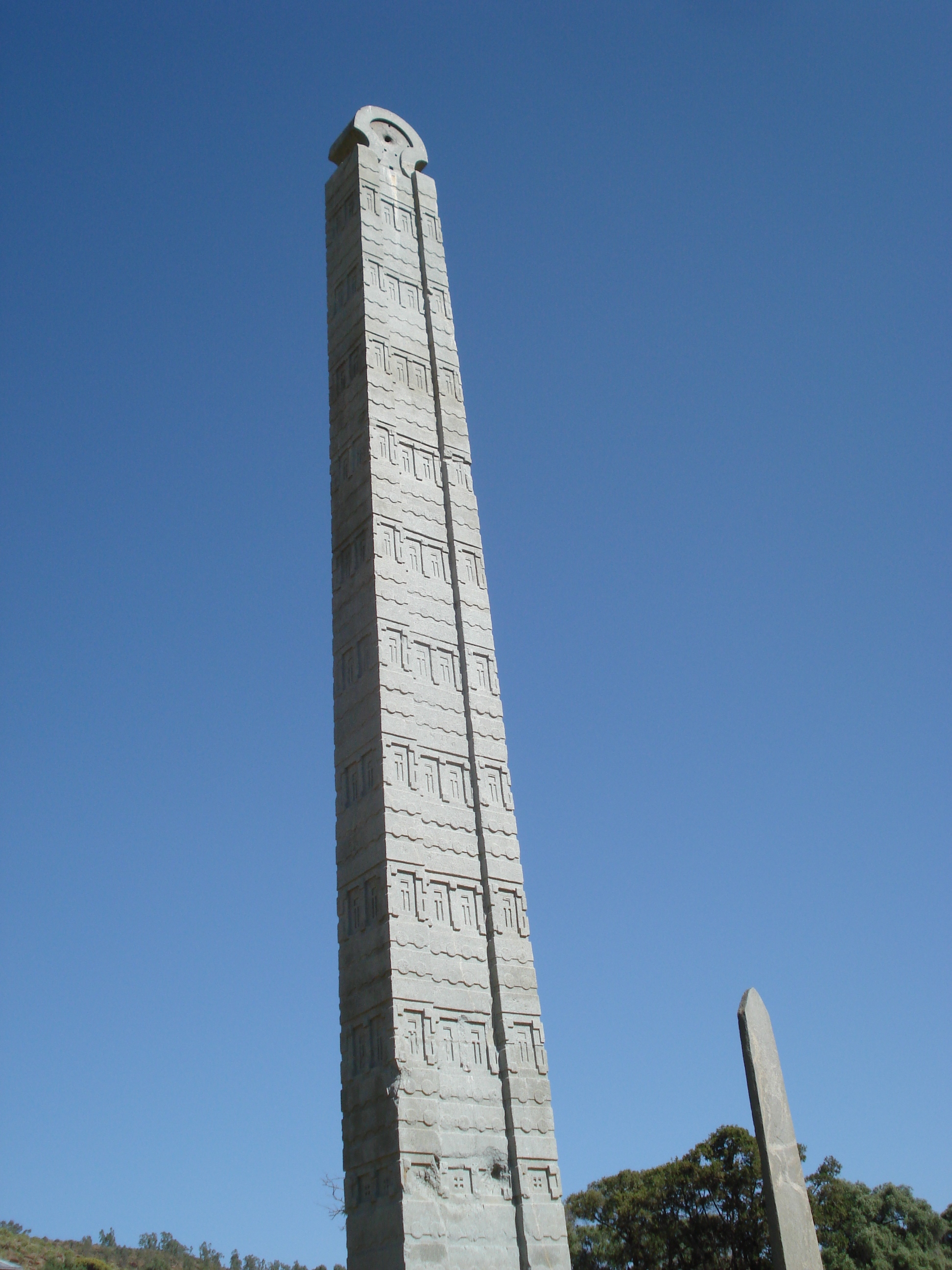
Stele
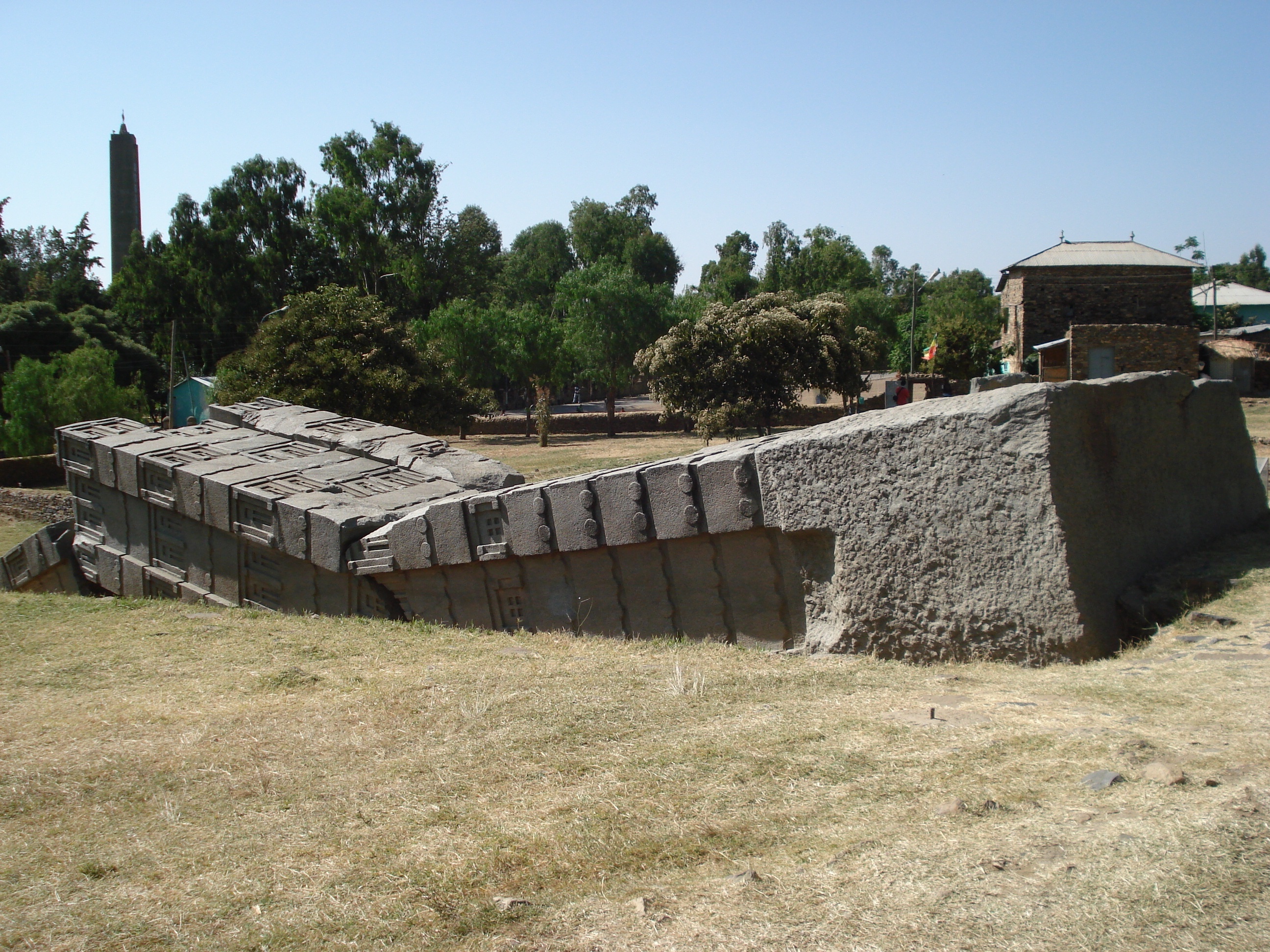
Stele

DSC05759

Stele

Stellae

Stele

Stellae field

Stele field


It is perhaps most well known for its stele, or obelisks, which date back to 5,000 to 2,000 BCE.  The function is to serve as a marker for underground graves.

During the brief occupation by the Italians in the 1930s (Ethiopia having never been colonized by a European country), one of the major stele was appropriated by the Italians and shipped to Italy where it was reassembled and erected.  After years of negotiations, an upgrade of the Axum airport, the stolen stele was returned to Ethiopia and placed in its proper place in the field of stele from 2005-2008.
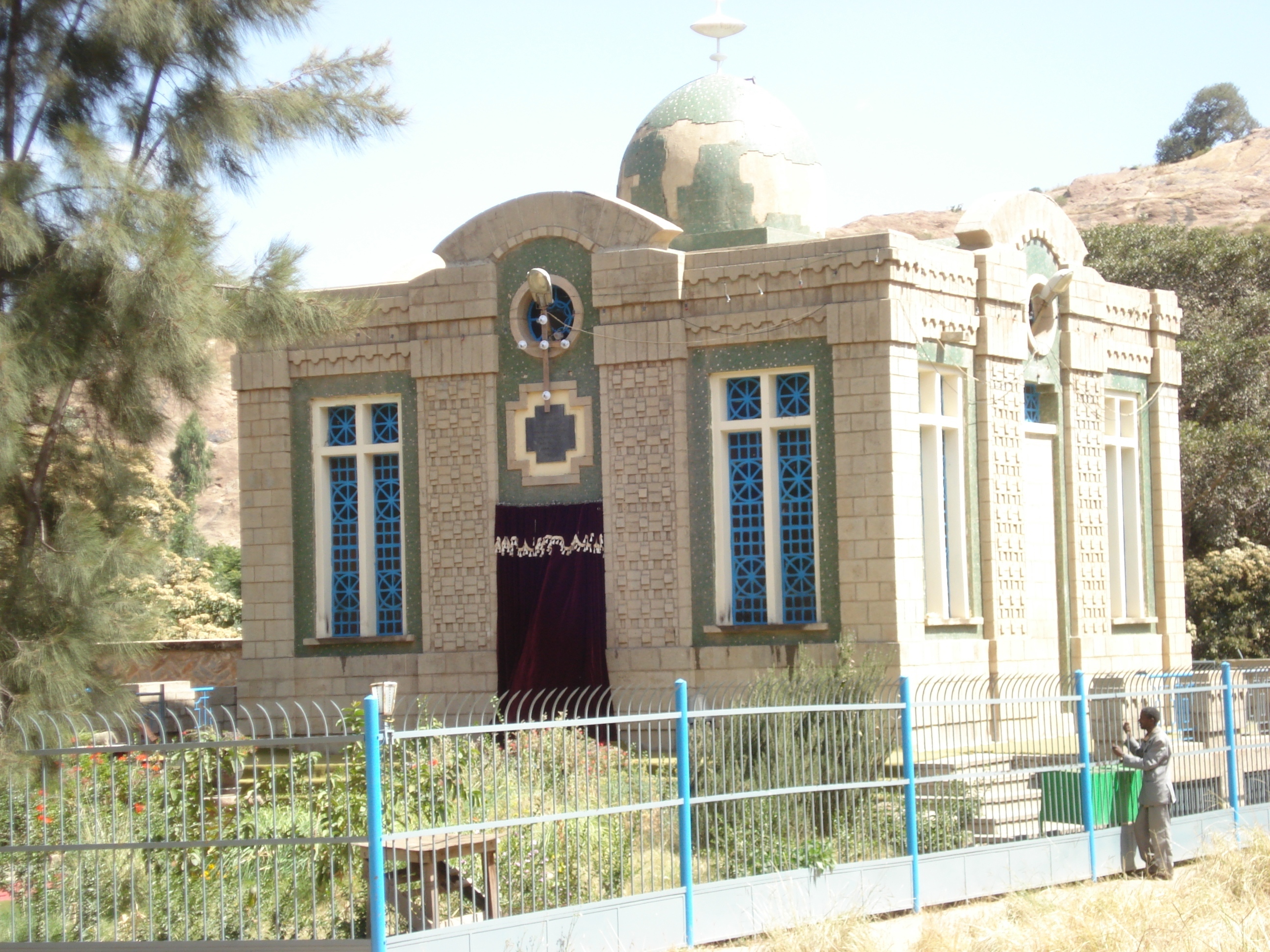
 

Church of St. Mary of Zion

Church of St. Mary of Zion

Tradition has that the Arc of the Covenant is housed within the walls of the Church of St. Mary of Zion, thus the city is revered as a holy place. The Church is located within walking distances of stele fields.
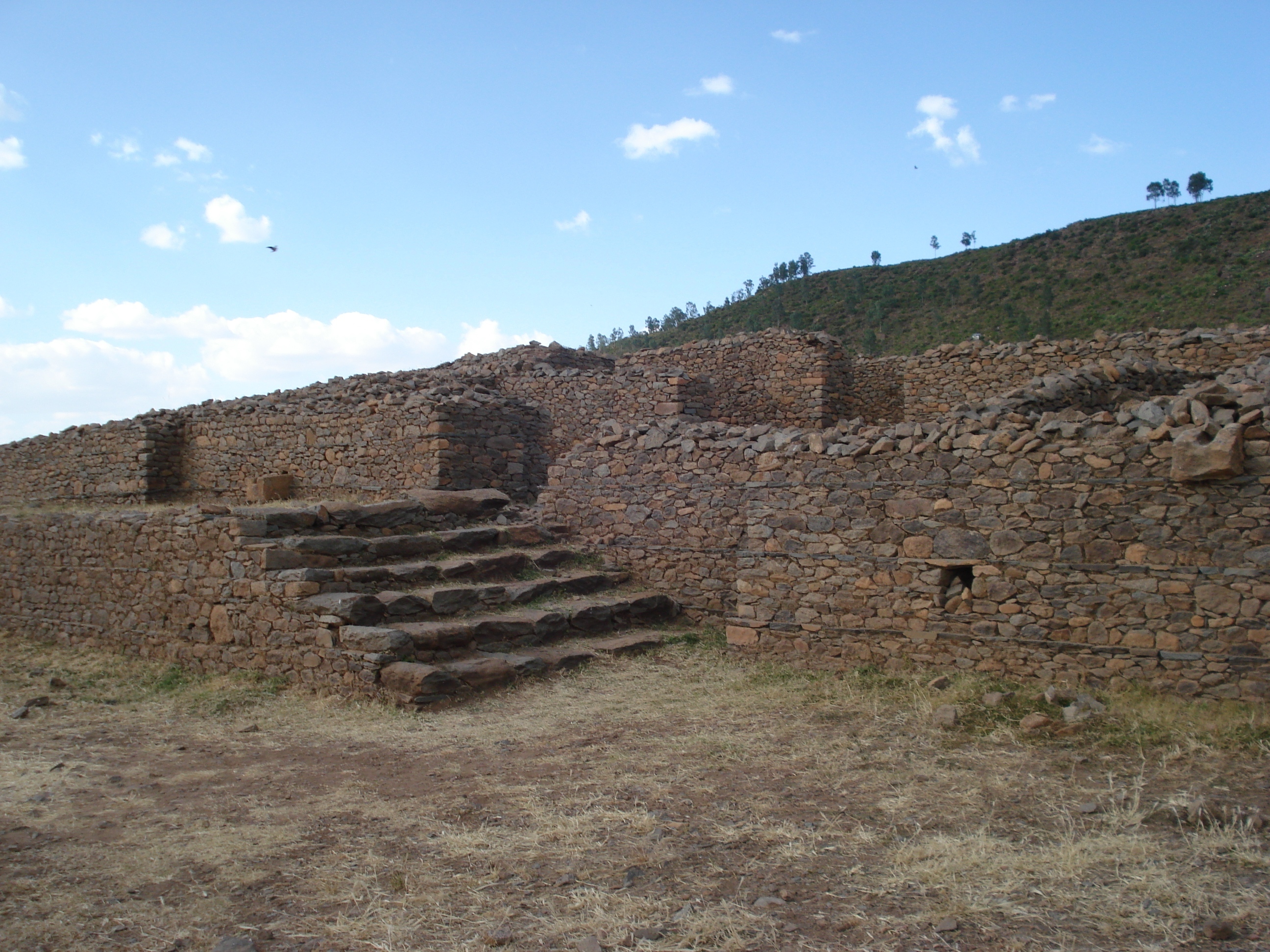


The ancient remains of Queen of Sheba's palace

The ancient remains of Queen of Sheba’s palace


Dungur Addi Kilte, popularly known as the remains of Queen of Sheba’s palace, but could also have been the palace of a wealthy Axumite.   Excavated in the mid 1960s.


Queen of Sheba's baths

Queen of Sheba’s baths

Tradition also has it that the reservoir pictured to the left is the Queen of Sheba baths.  According to legend, Sheba had a tryst with Solomon, resulting in a child.  From there is a long dynasty that included Emperor Haile Selassie.  This story is repeated frequently in art work that is sold on nearly every street corner in major cities like Addis Ababa.


Ancient hieroglyphs


Ethiopia has its own written language, based on the ancient Ge’ez script, a church language.


New Axumite Heritage Foundation Library

While I was on sabbatical in 2010, working in Mekelle, I had an opportunity to meet Dr. Tsehaye Teffera, the founder of the Ethiopian Community Development Council, headquartered in Silver Spring, MD.  He came to the library in Mekelle because he was about to embark on a new library project in Axum.  In previous years, he had opened up a library in the old Governor’s Palace, but it was beginning to outgrow its space.  Denver and Axum are Sister Cities, part of the International Sister Cities, International program, celebrating 20 years in this relationship August 2016.

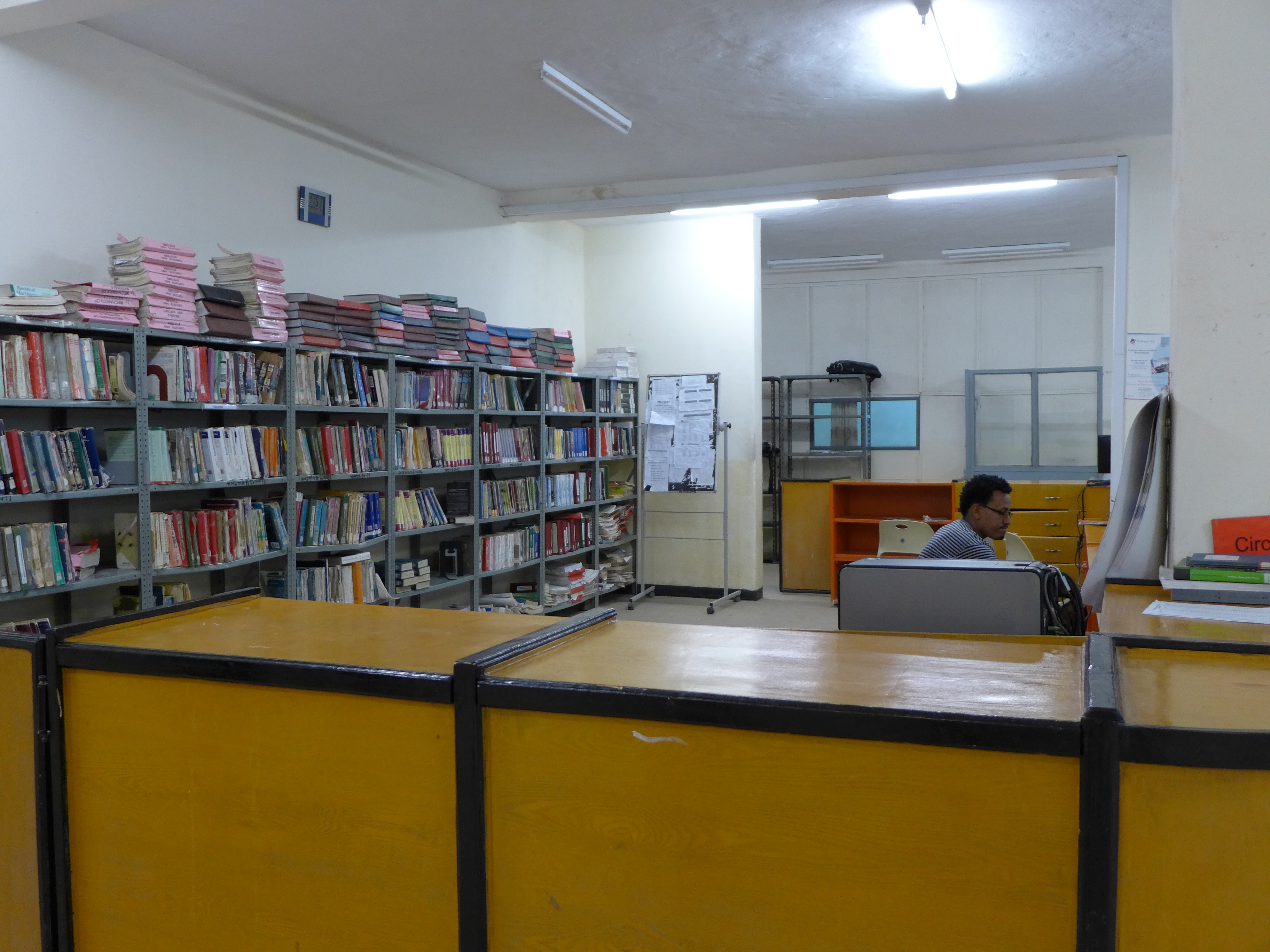
At the time that I began working with Dr. Tsehaye, I heard that there was another Returned Peace Corps Volunteer, an engineer, who was working with him, also.  By chance Dwight Sullivan and I were put in touch with each other and are collaborating on this project.   I visited the new library building when it was in its infancy in 2013 and took this opportunity while traveling for another project to get an update.  Each visit on this trip has left me in wonder at all that Dwight and Dr. Tsehaye have accomplished.  No longer is it a shell of a building, but one that is very much nearing completion and at the stage where we can seriously start discussing library programming.
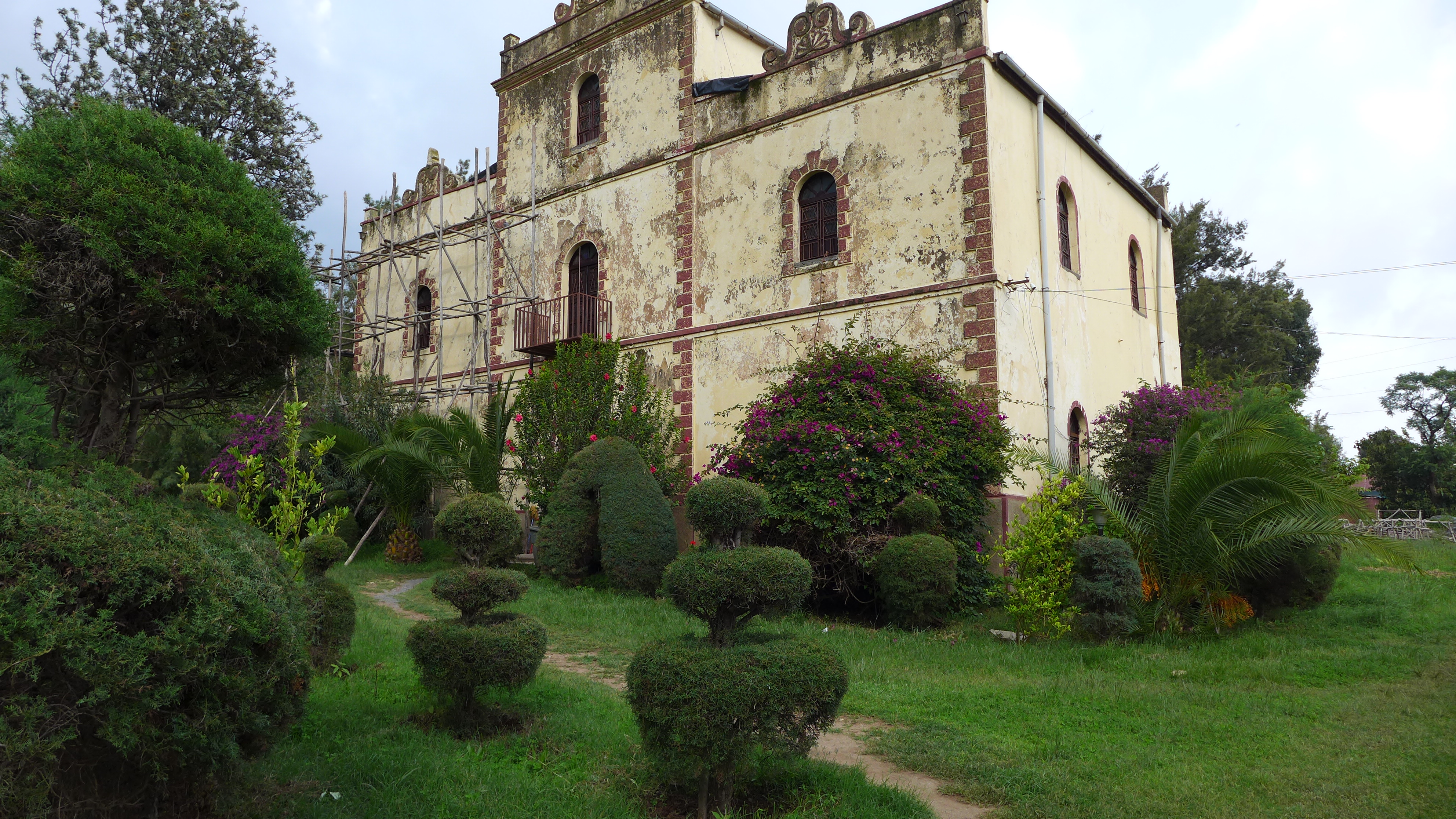
The current library in the former Governor's Palace

The current library in the former Governor’s Palace
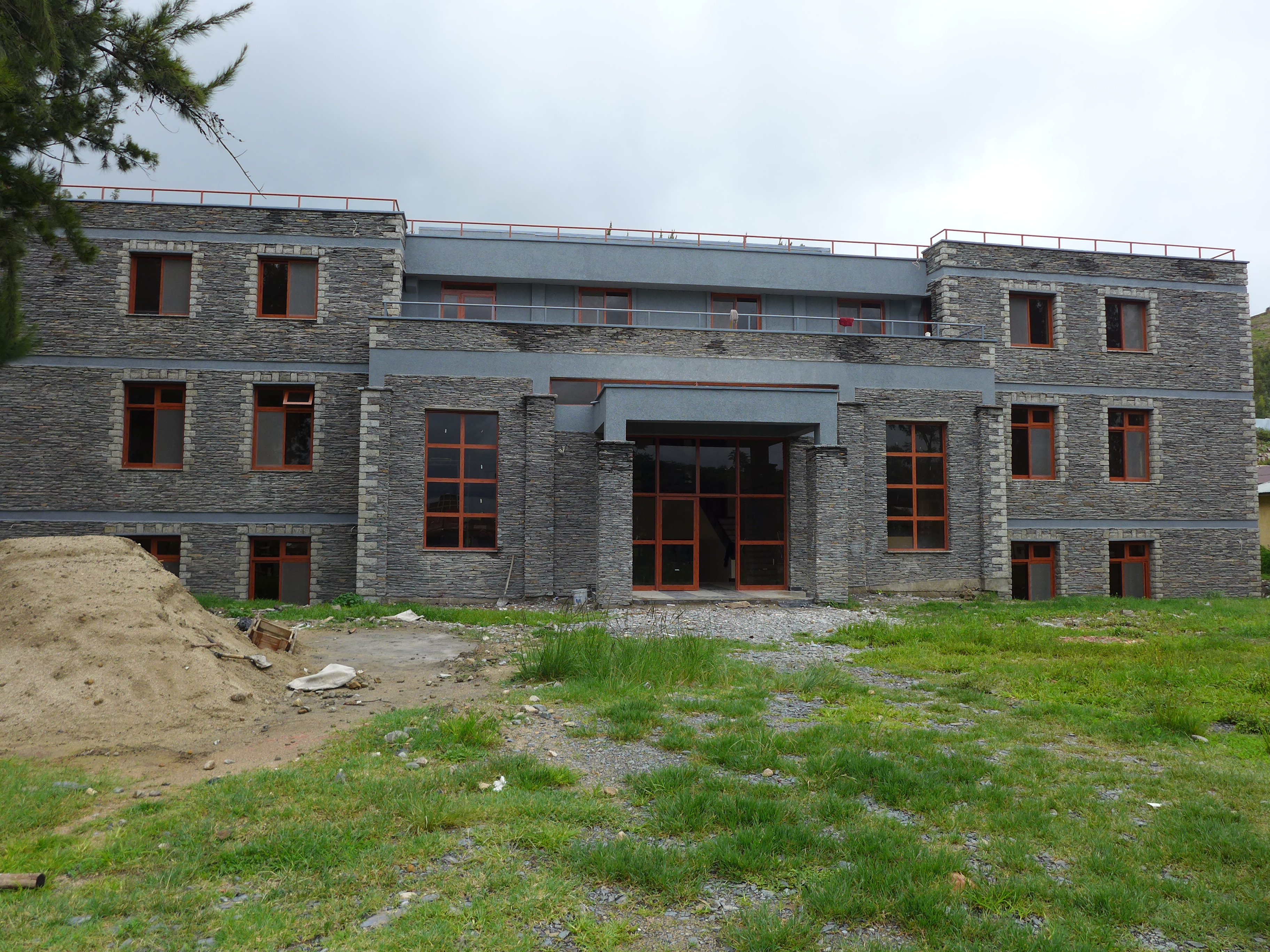
Front of the New Axumite Heritage Foundation Library

Front of the New Axumite Heritage Foundation Library

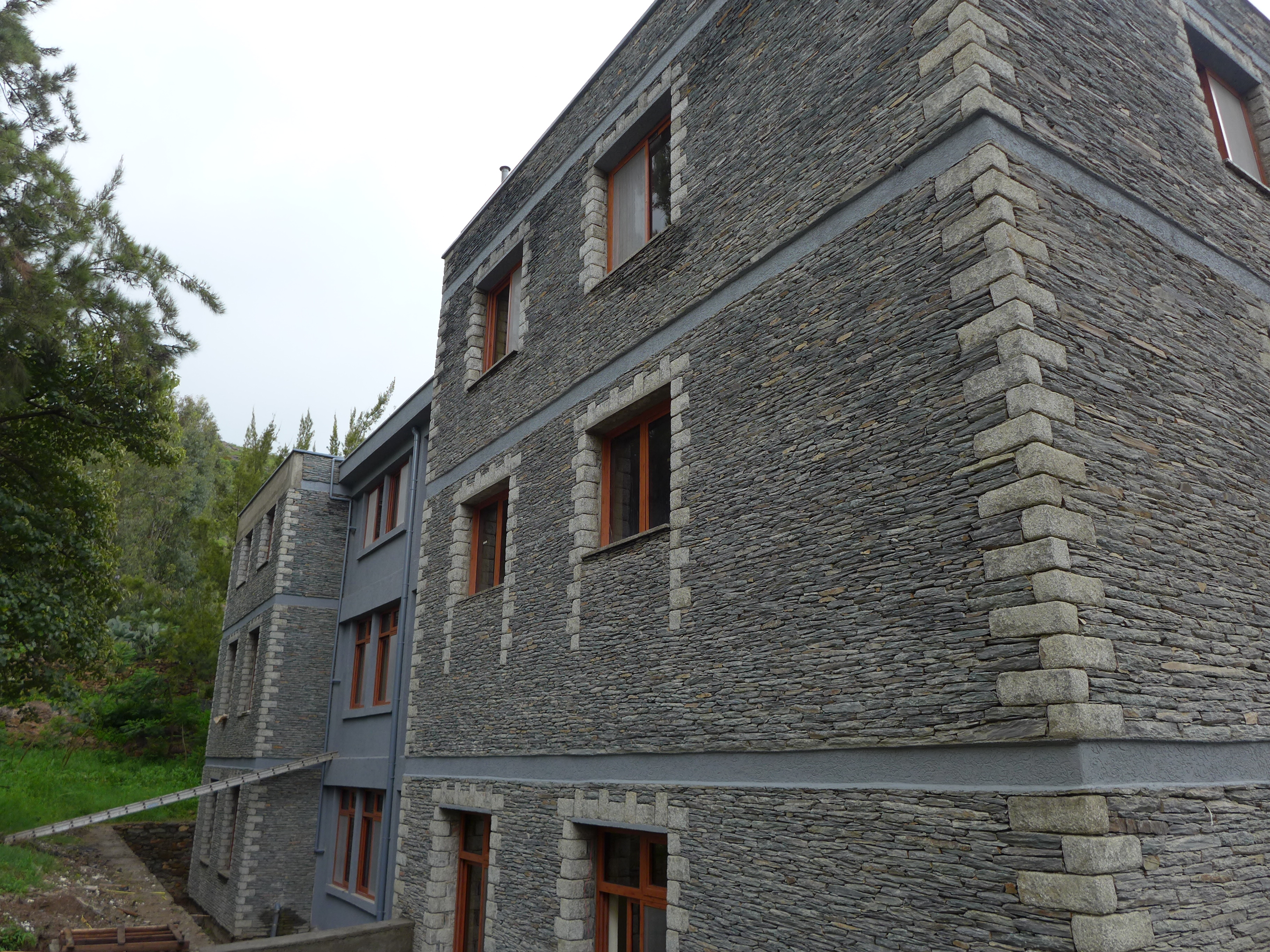
The concrete brick building has been faced with local stone from areas near Axum, including Adwa, the site of the infamous battle against the Italians, which Ethiopia won.  Windows have been imported from nearby Dubai. Dwight has leant his mechanical expertise, and building skills, and shipped power tools to enable this project to be completed expeditiously.  It is truly a work of art.
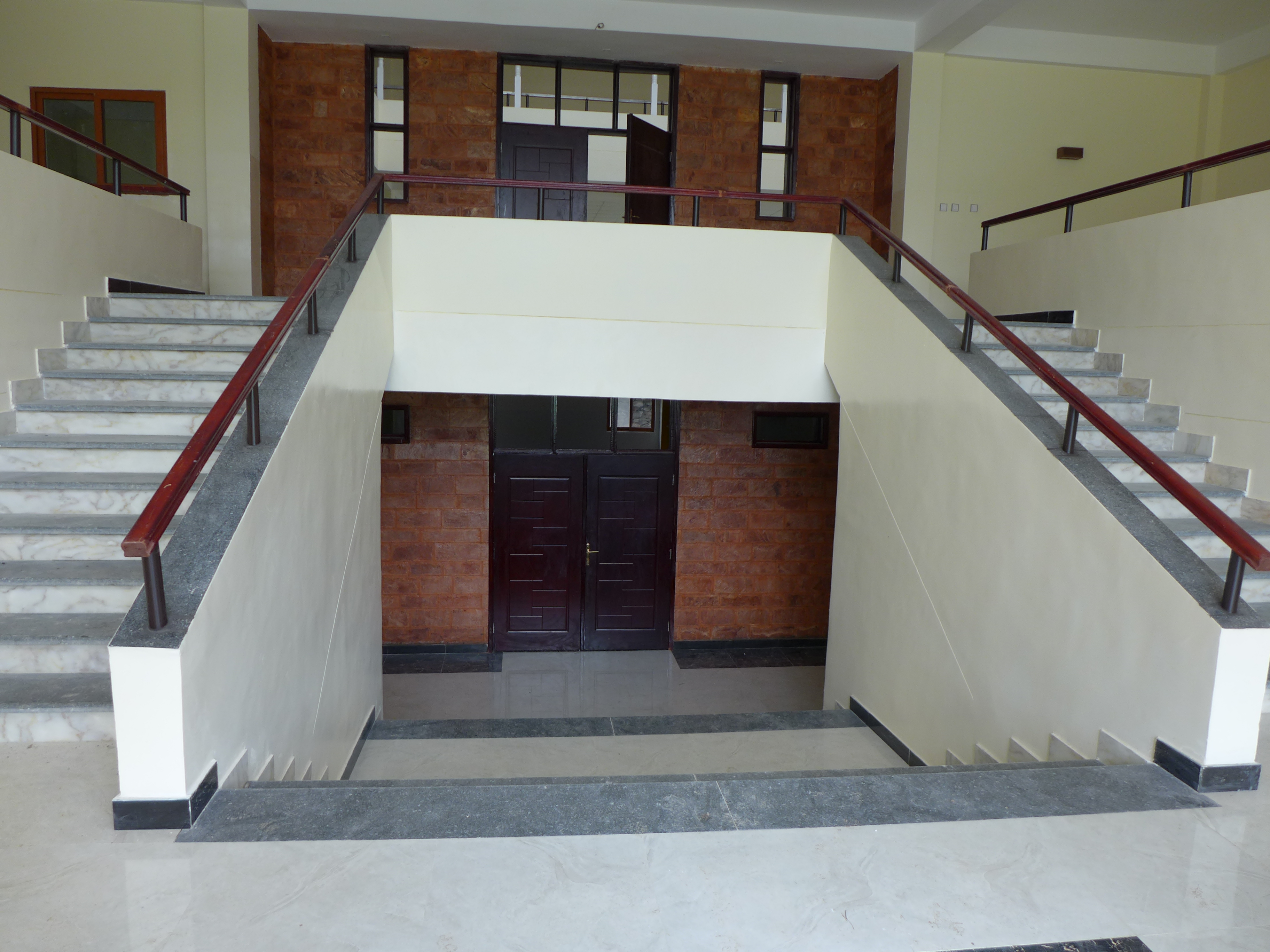
 

Grand entrance

Grand entrance


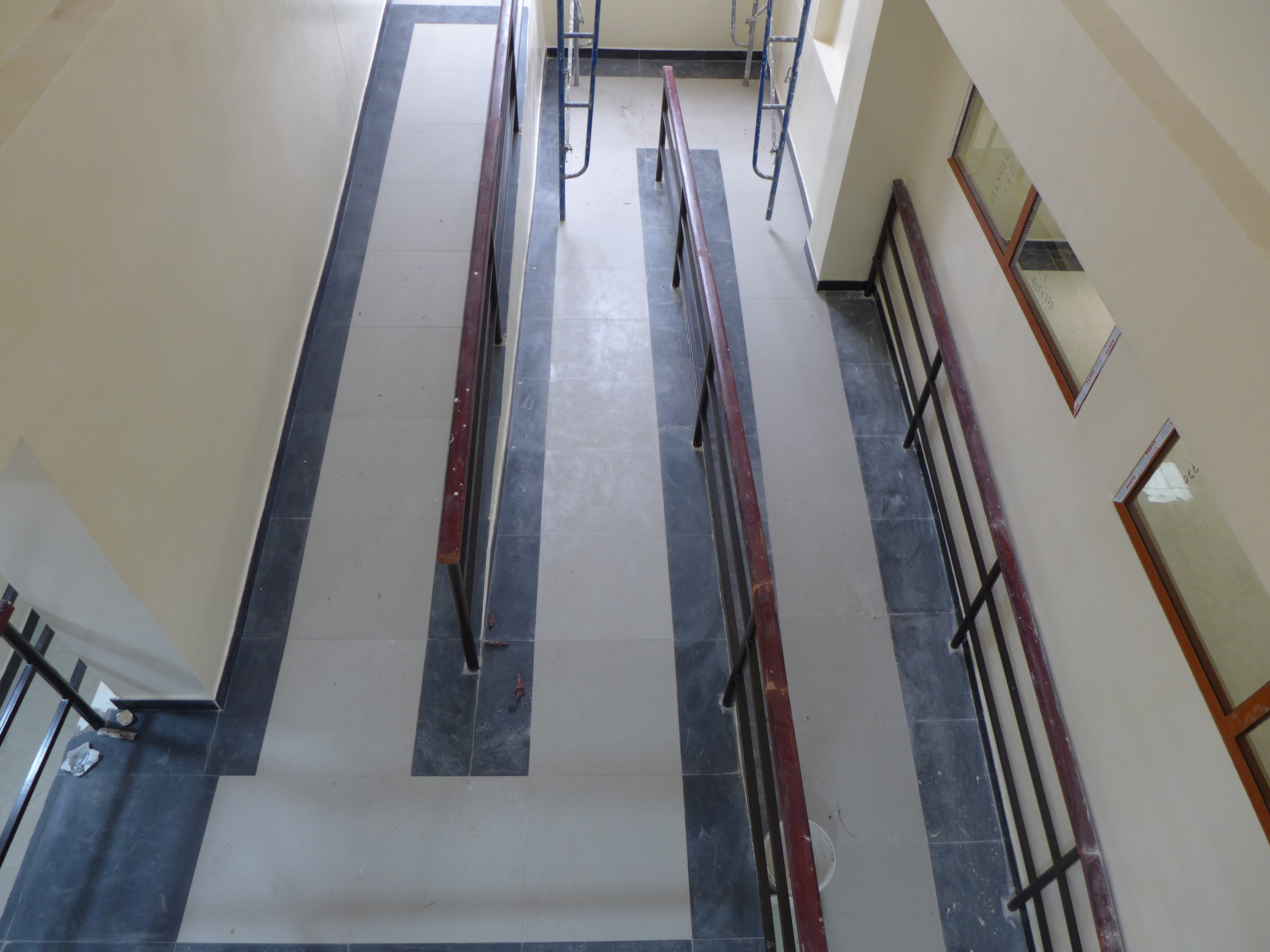
The entrance to the library is quite grand with two staircases leading up to the first floor.  On either side of the staircases are accessible ramps that lead to the lower level and to upper floors.  A rough in for an elevator is also available from the lower level to the third floor.  This is significant because few buildings in Ethiopia are accessible for persons with disabilities.
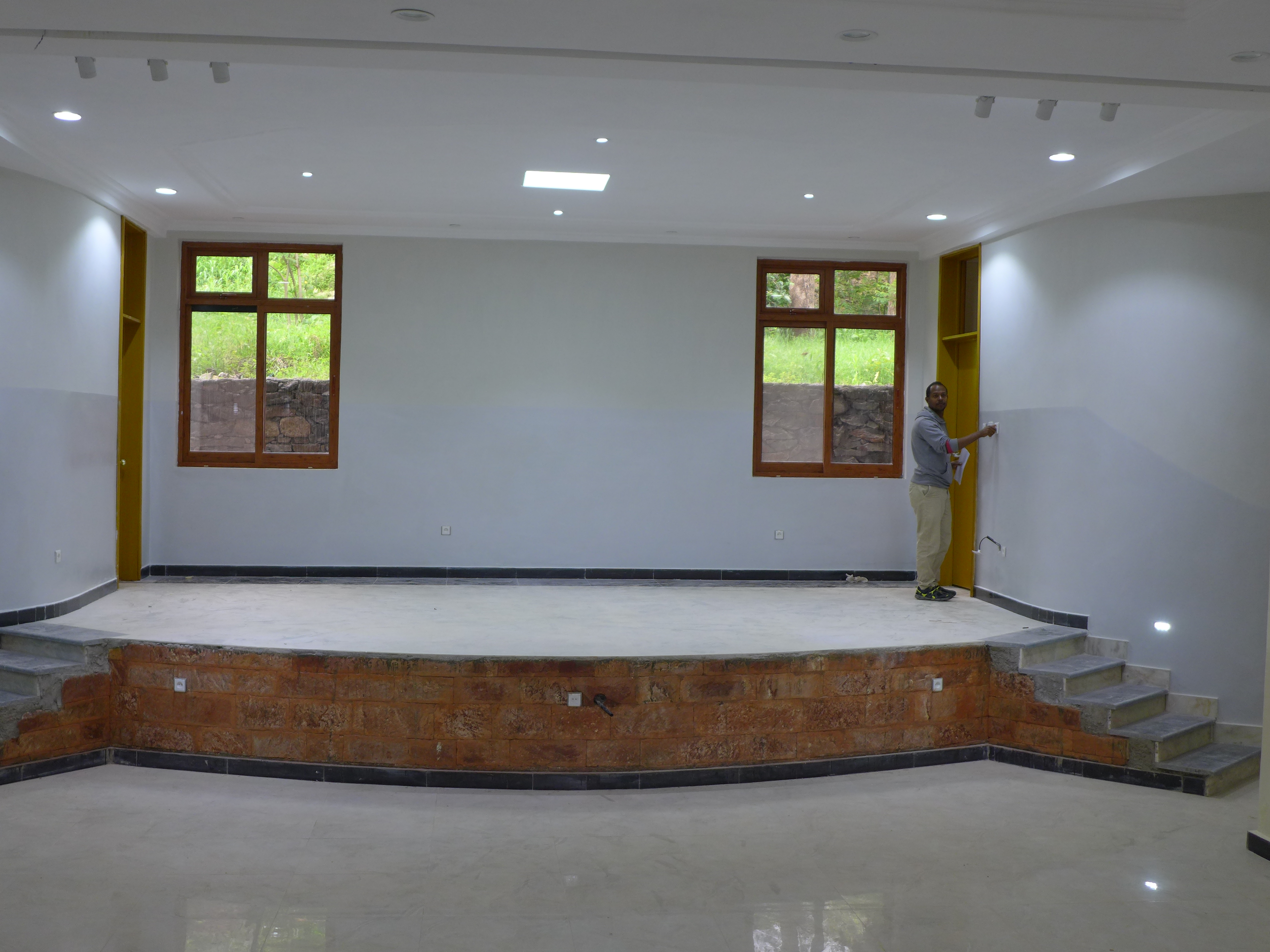


Auditorium stage

Auditorium stage

Rear of auditorium

Rear of auditorium


The auditorium is nearly complete.  It is accented with stone from local quarries.  Dwight has found theatre seating, which is currently in a container ready to be shipped to Ethiopia and installed in the upcoming months.  We discussed options for acoustics and will be creating cloth panels that will appear to be wall accents, but will serve to buffer the reverberations that were apparent in the room.  The panels will have a version of Axumite crosses that are prevalent in this area.
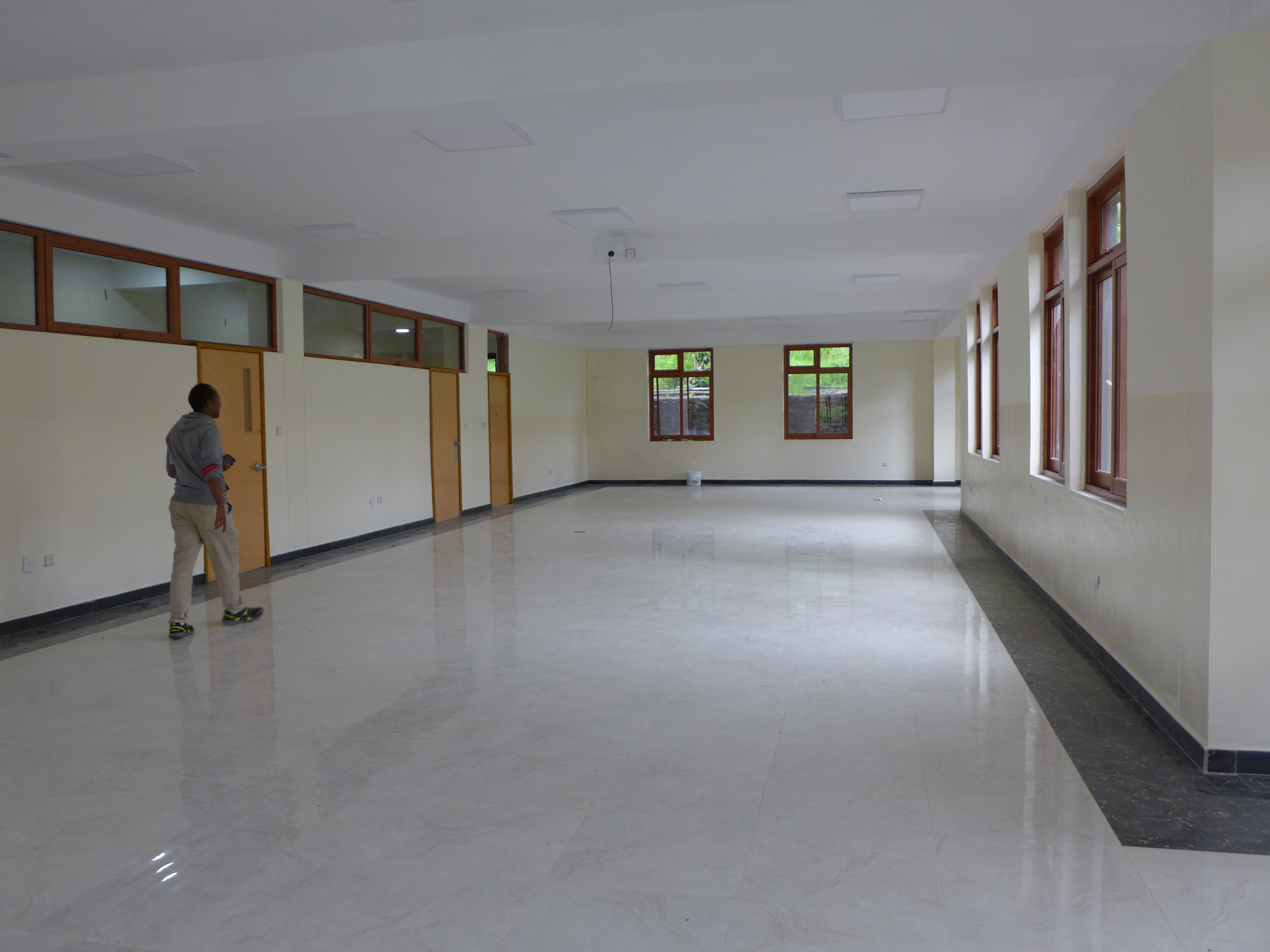
 

Classroom

Classroom


A large room has been designated to serve as a set of classrooms that will have partitions to separate the larger area into four classrooms on an as needed basis.
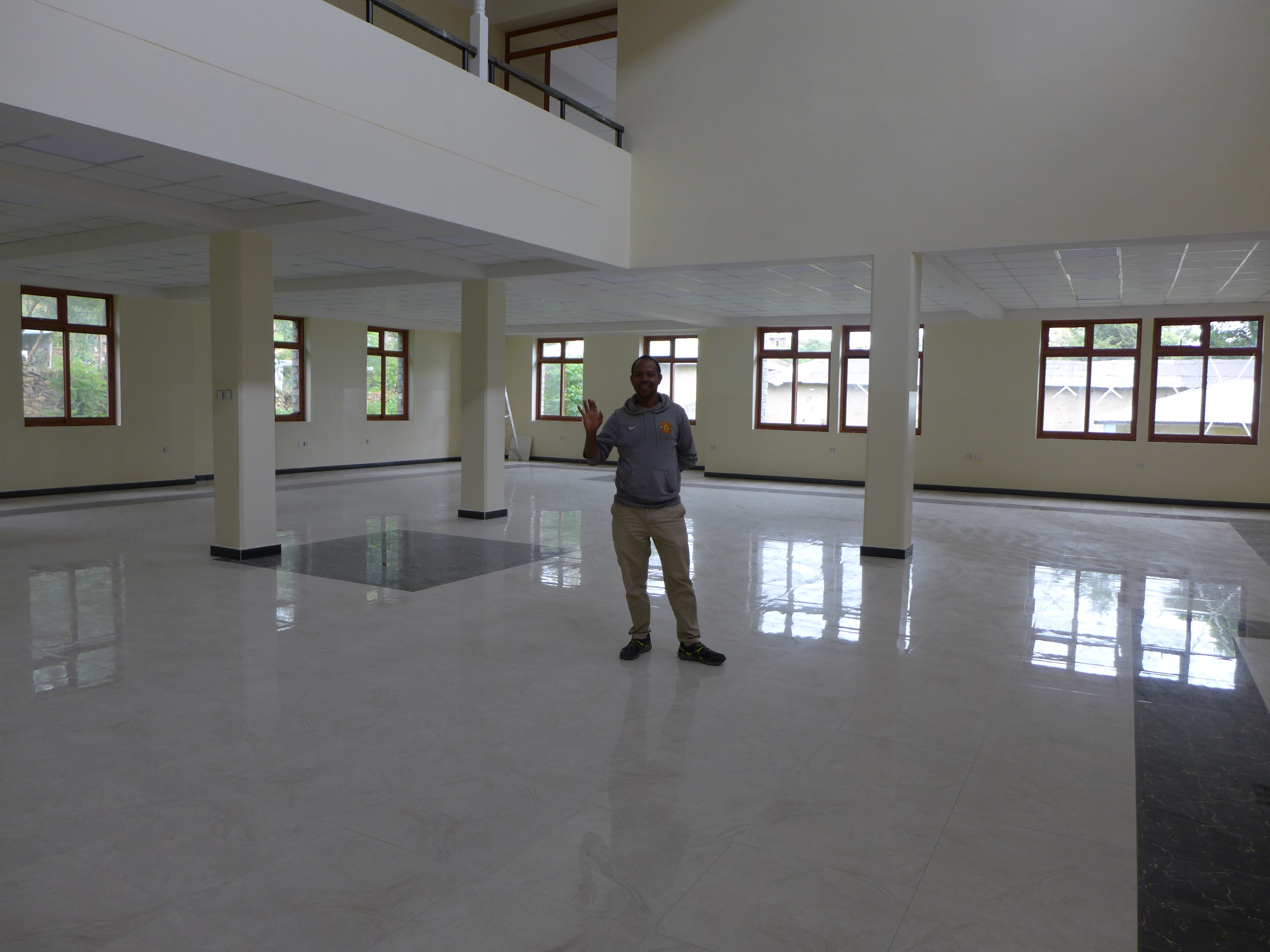


Great reading room
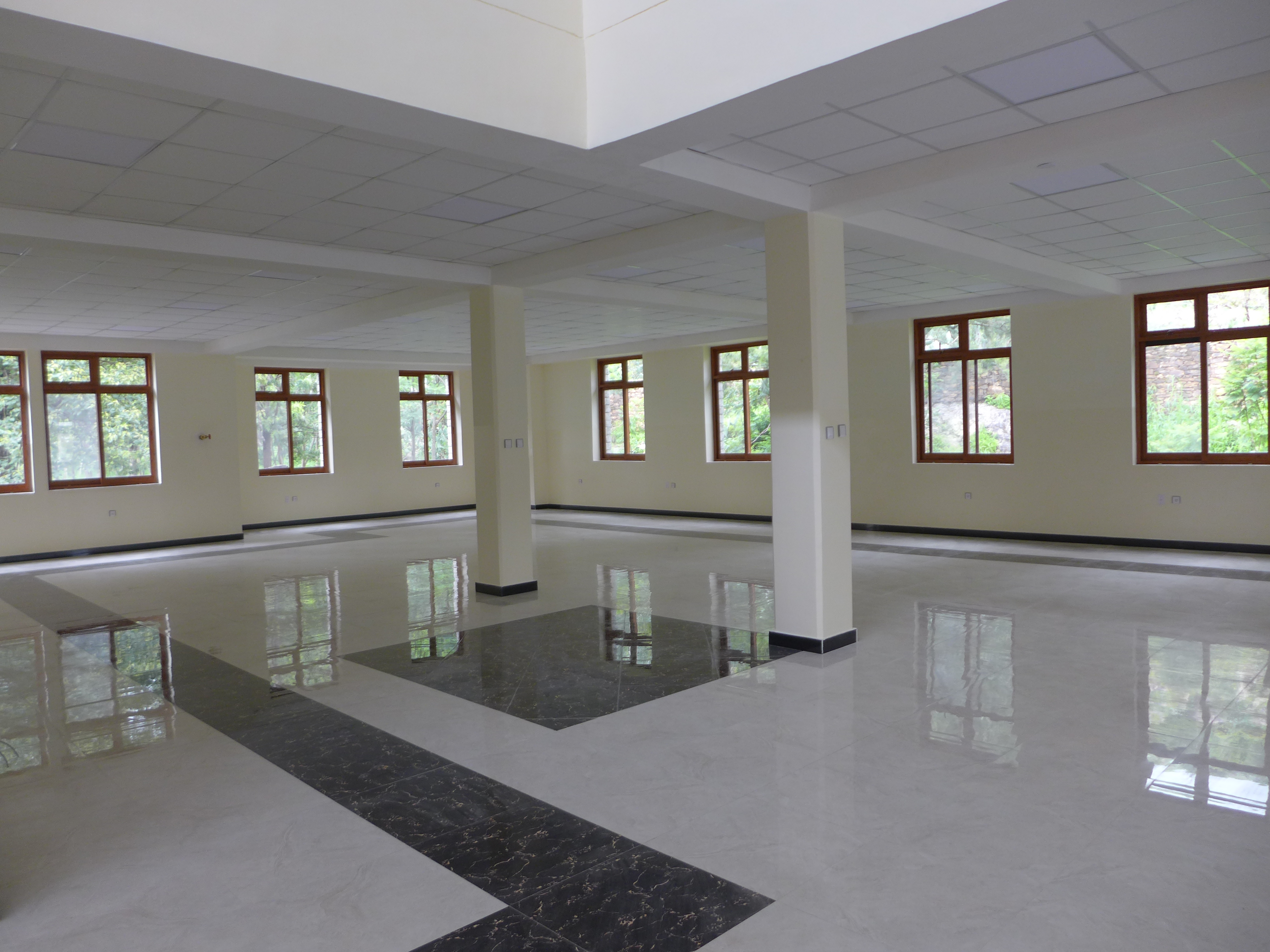
Great reading room

Great reading room extended view
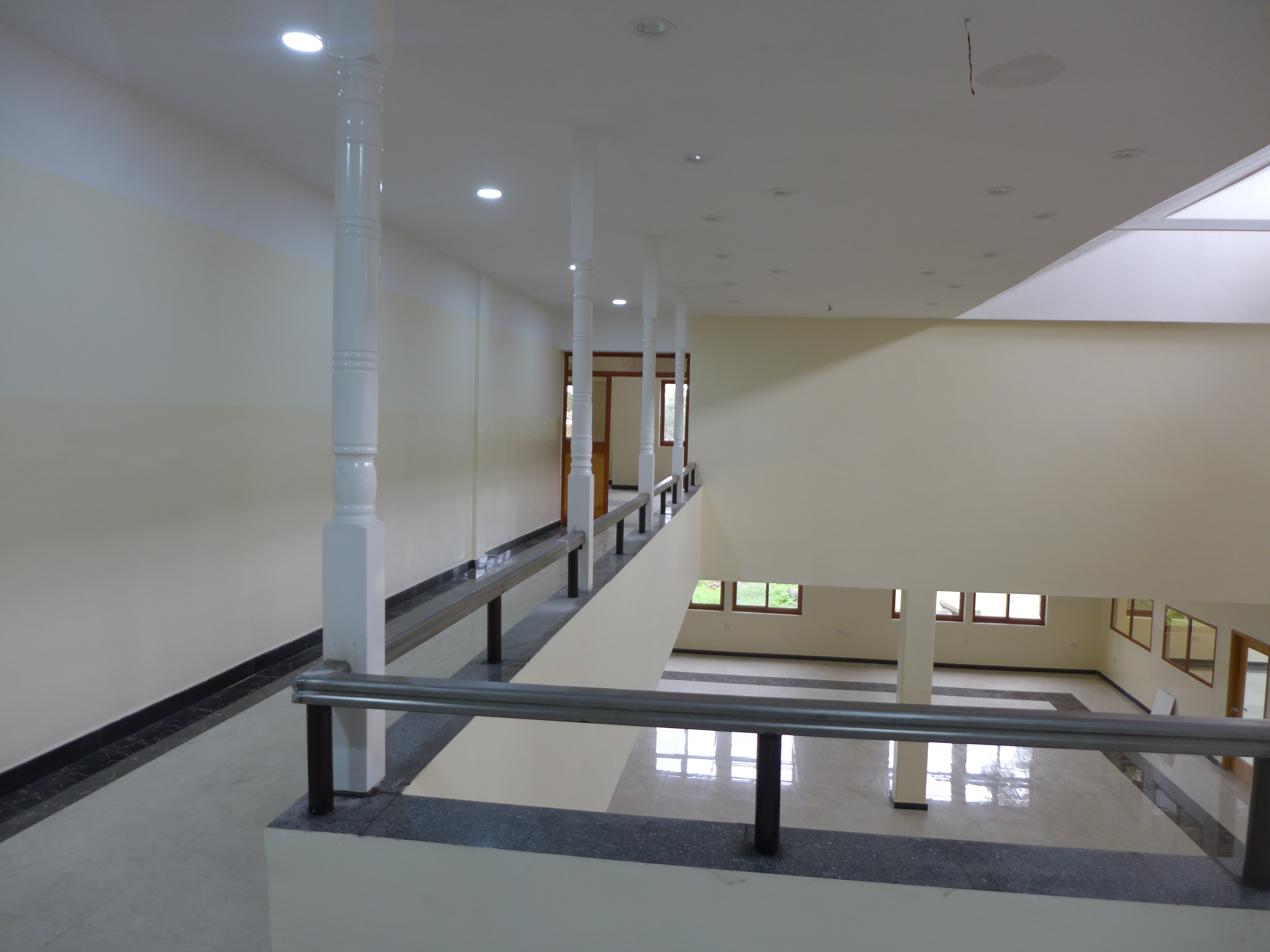
Great reading room extended view

Overlooking the great reading room

Overlooking the great reading room


The primary traditional area of the library is the Great Reading Room.  It will contain the primary print collection and a range of seating and study areas for students and researchers.  Dedicated ports have been installed around the perimeter and wireless access will be available.  There is ample natural light and ceiling light fixtures.
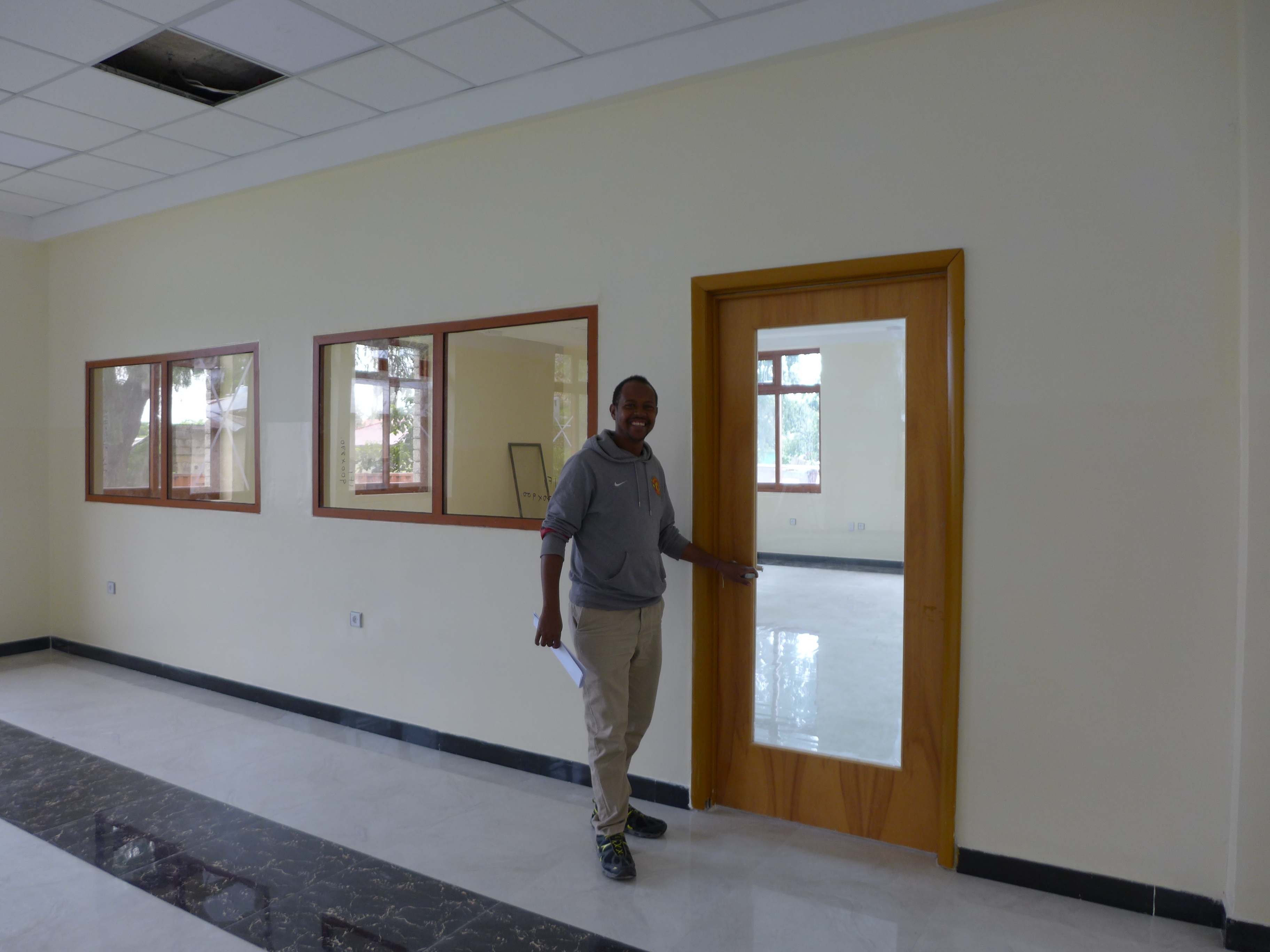
 

Computer room entrance
Computer room entrance

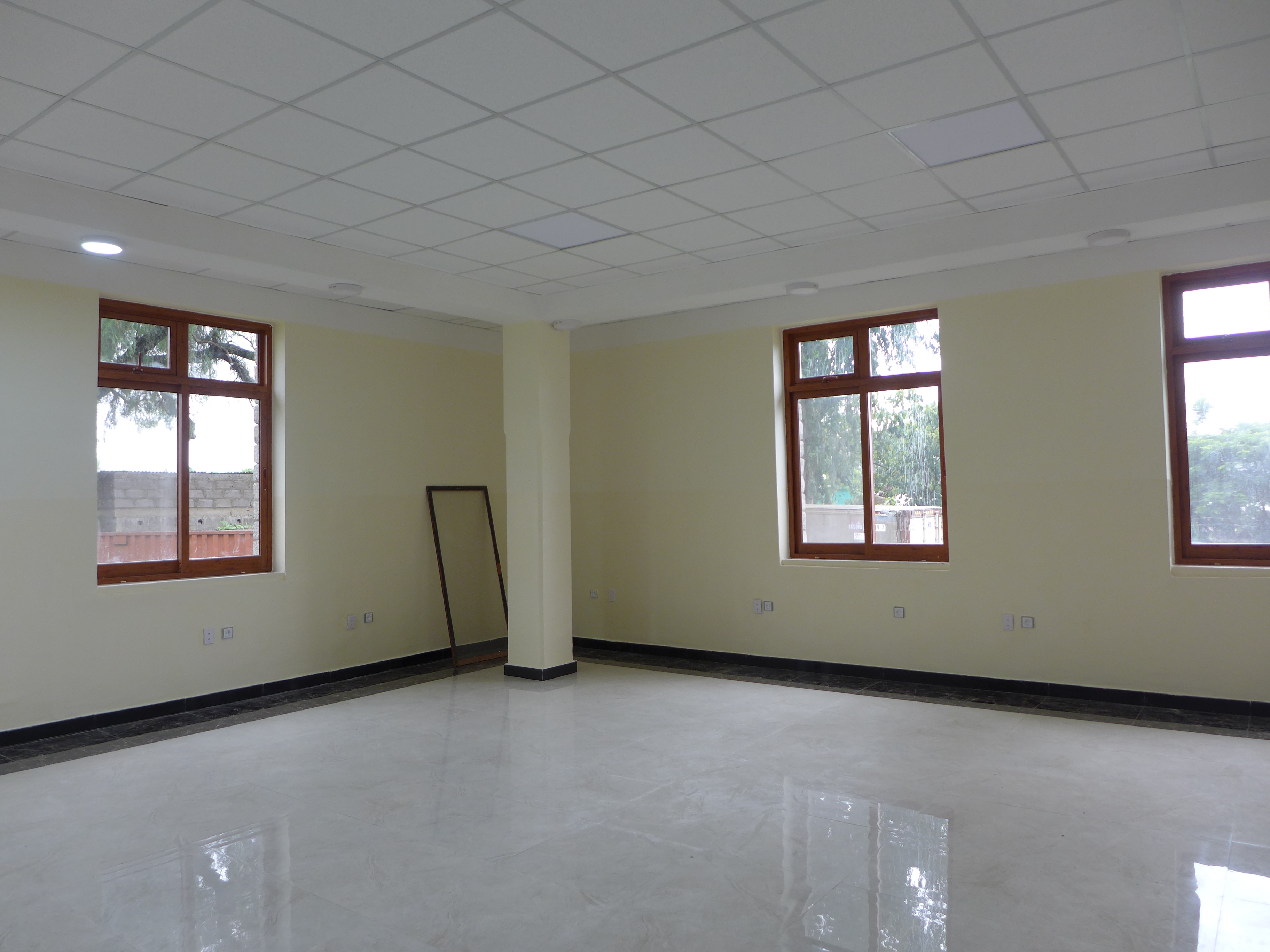
Computer room with drop ceilings

Computer room with drop ceilings


Adjoining the Great Reading Room, is a computer room, complete with drop ceilings.  It is anticipated that computer classes will be offered on a frequent basis.
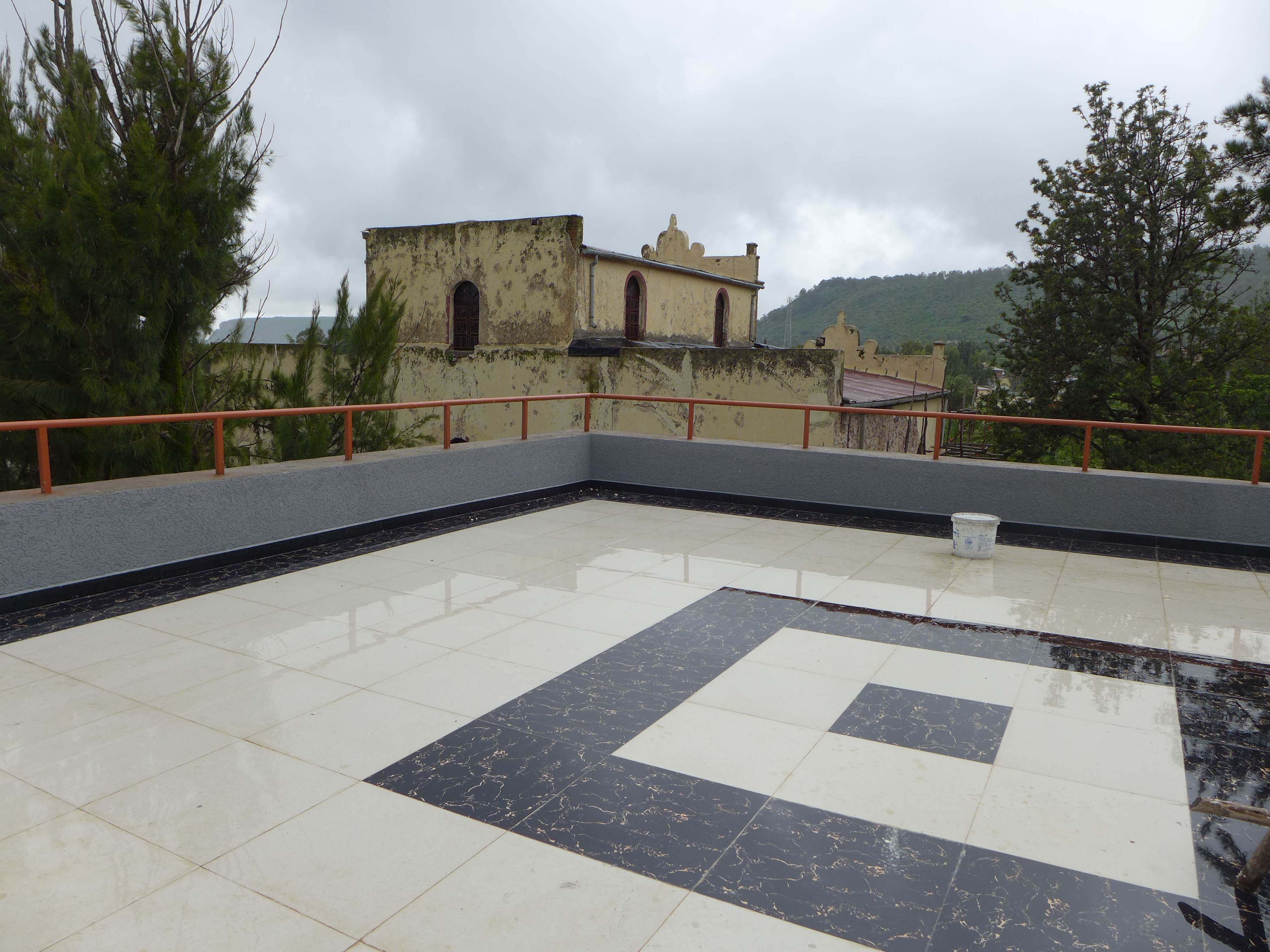
 

Rooftop reception area overlooking the former library

Rooftop reception area overlooking the former library

The fourth floor opens up to a large balcony that can serve as an area for receptions.  A small kitchen has been roughed in that will facilitate food service for the receptions.
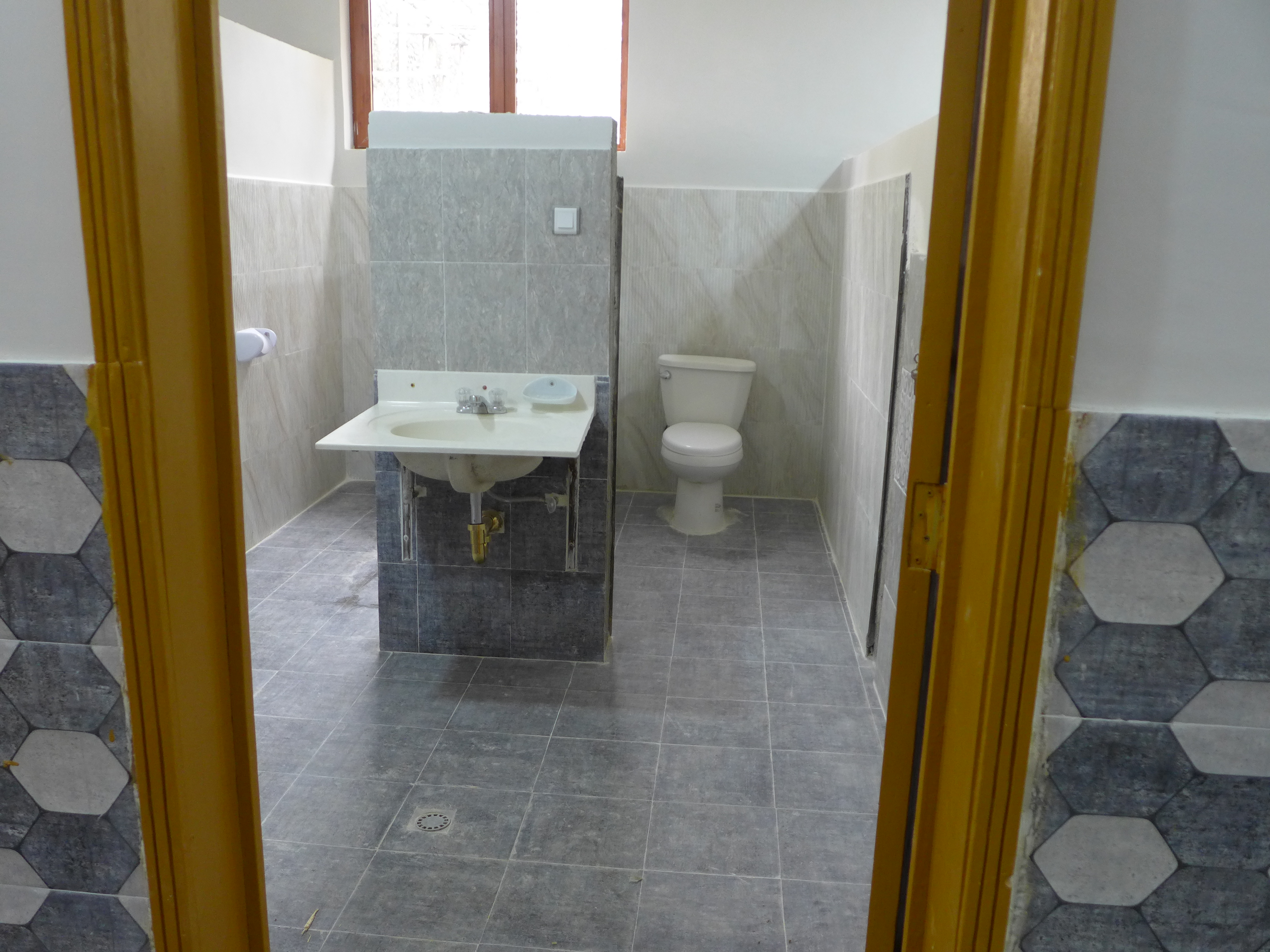


Accessible bathroom
Accessible bathroom

Accessible ramp

Accessible ramp

Several bathrooms have been installed including one that will be accessible for persons with disabilities.  Public bathrooms in general are few and far between.  These will probably be restricted to staff and to guests.  A separate outdoor bathroom has been proposed for the general public.  An accessible ramp will allow access to the lower level and to the first and second floor.  Only the balcony reception area will not be accessible.


Stone wall detail

Stone wall detail


A stone wall façade highlights the natural beauty of the new building.


P1020415

Commissioned art

Commissioned art

Commissioned art


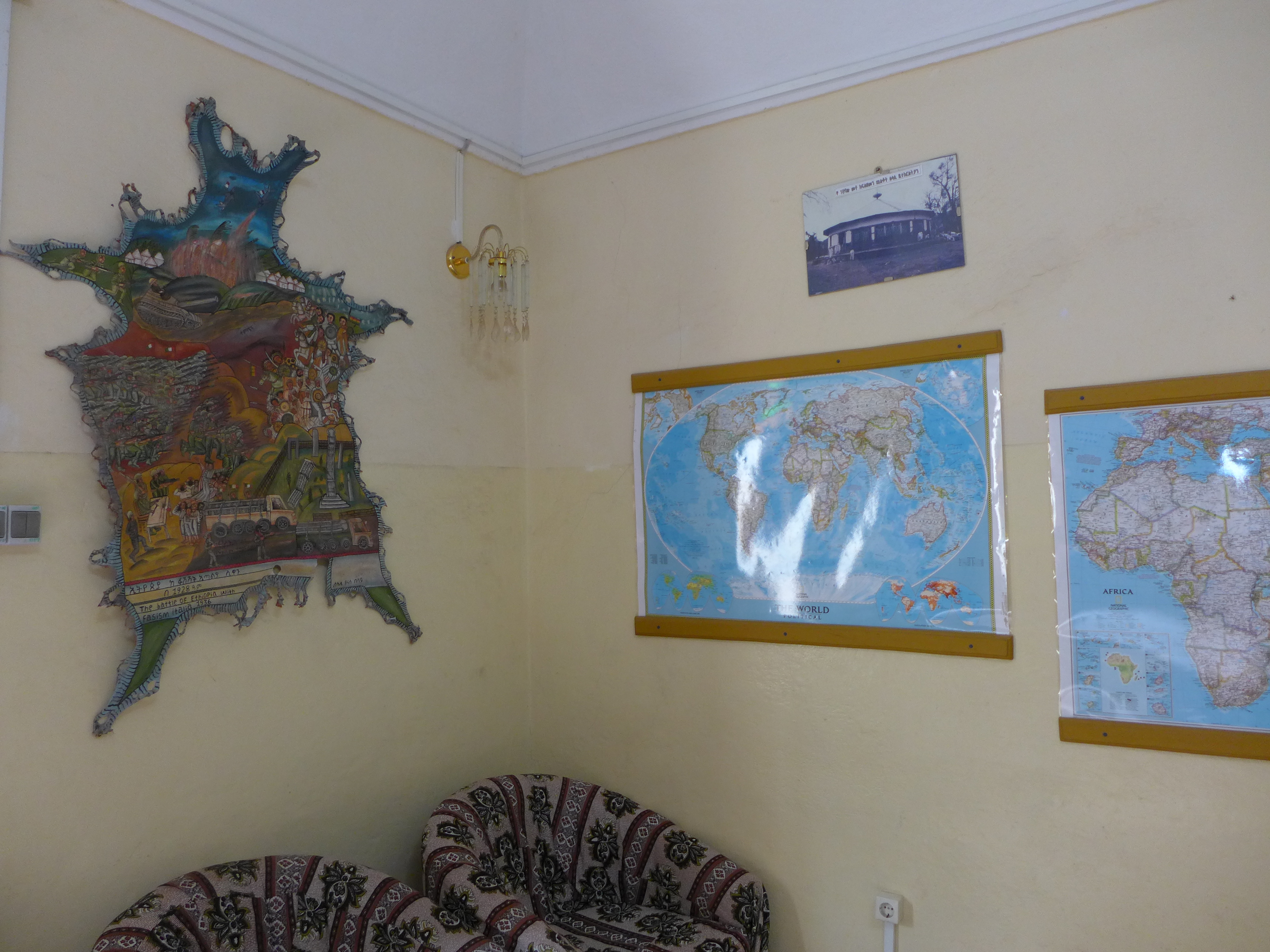
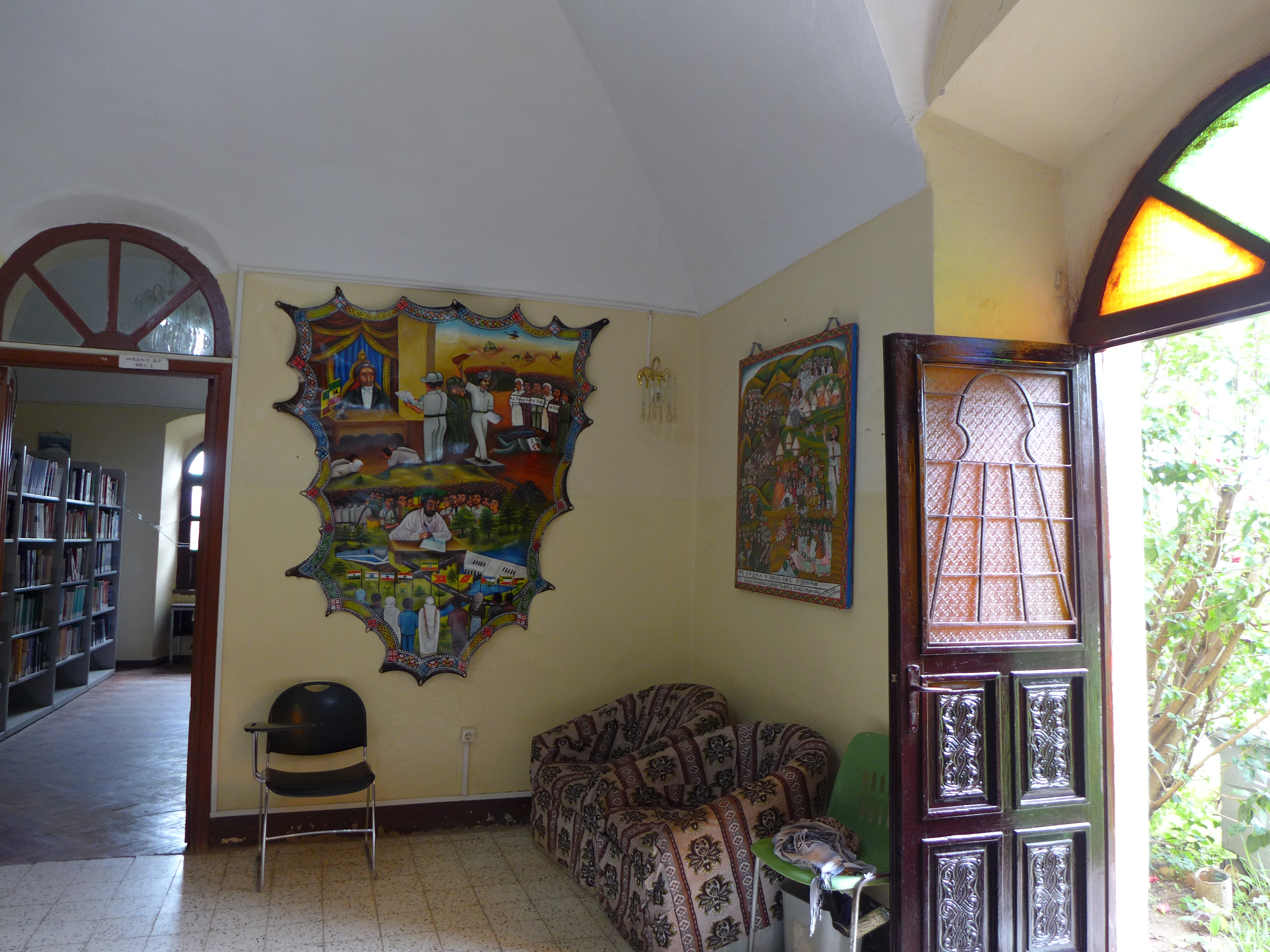
Dwight commission art on animal hides that depict various historical events, such as the Battle of Adwa, where the Ethiopians defeated the Italians.  Adwa is approximately 15 miles from Axum.  These pieces of art are currently hung in the existing library in the Governor’s Palace and created by a local artists.


Toys in the children's library

Toys in the children’s library

Temporary staging of materials in the Children's library

Temporary staging of materials in the Children’s library


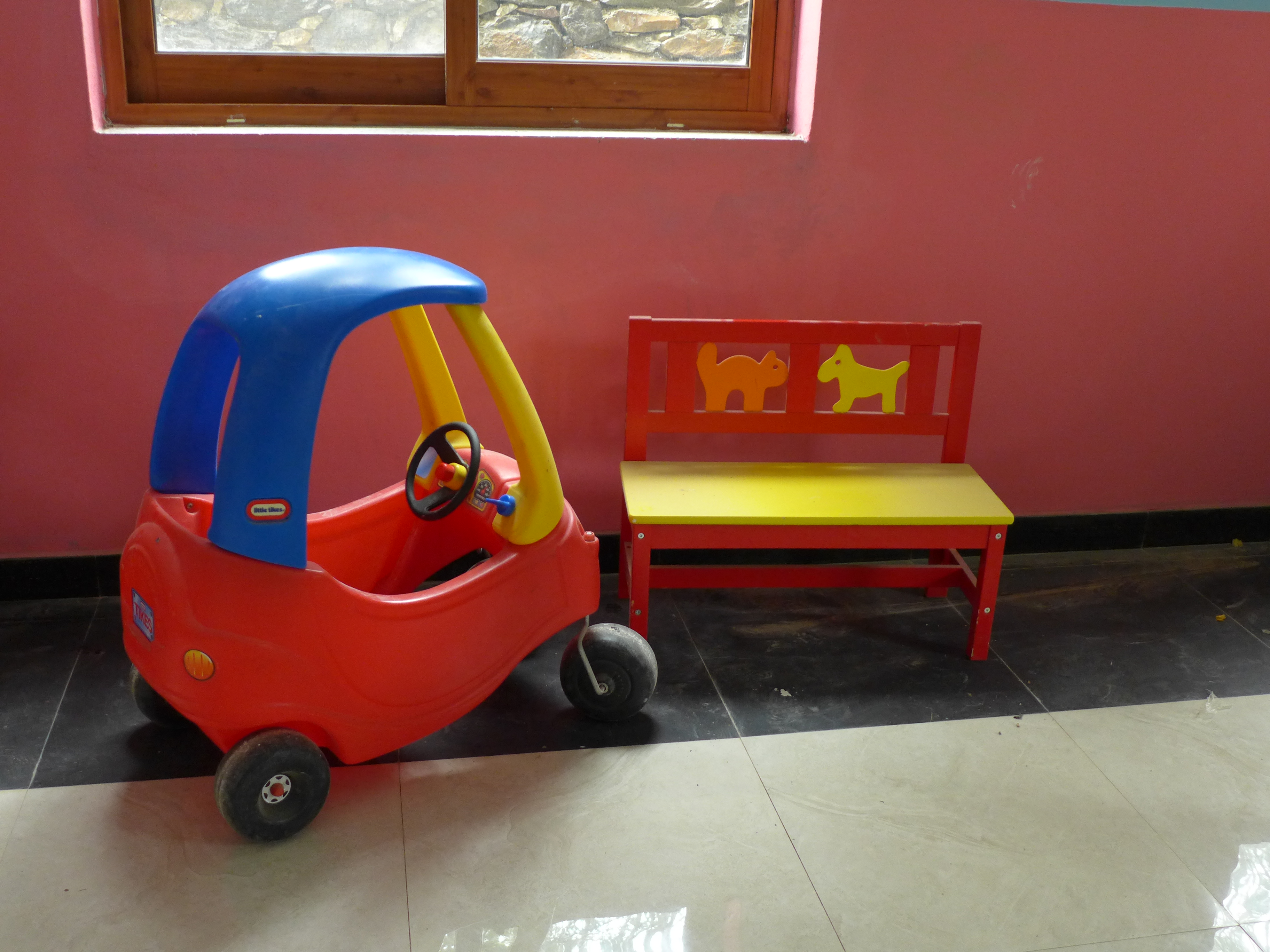
The children’s library is on the lower level.  It will contain books, toys, educational materials, child-sized furniture, tiered seating for story hours and AV presentations.  Dwight and I have been approved for a Returned Peace Corps Legacy grant, which will allow us to raise funds for the children’s library.  For more information on donating to this project, click on  https://eandeherald.com/rpcv-legacy-program/axum-childrens-library/
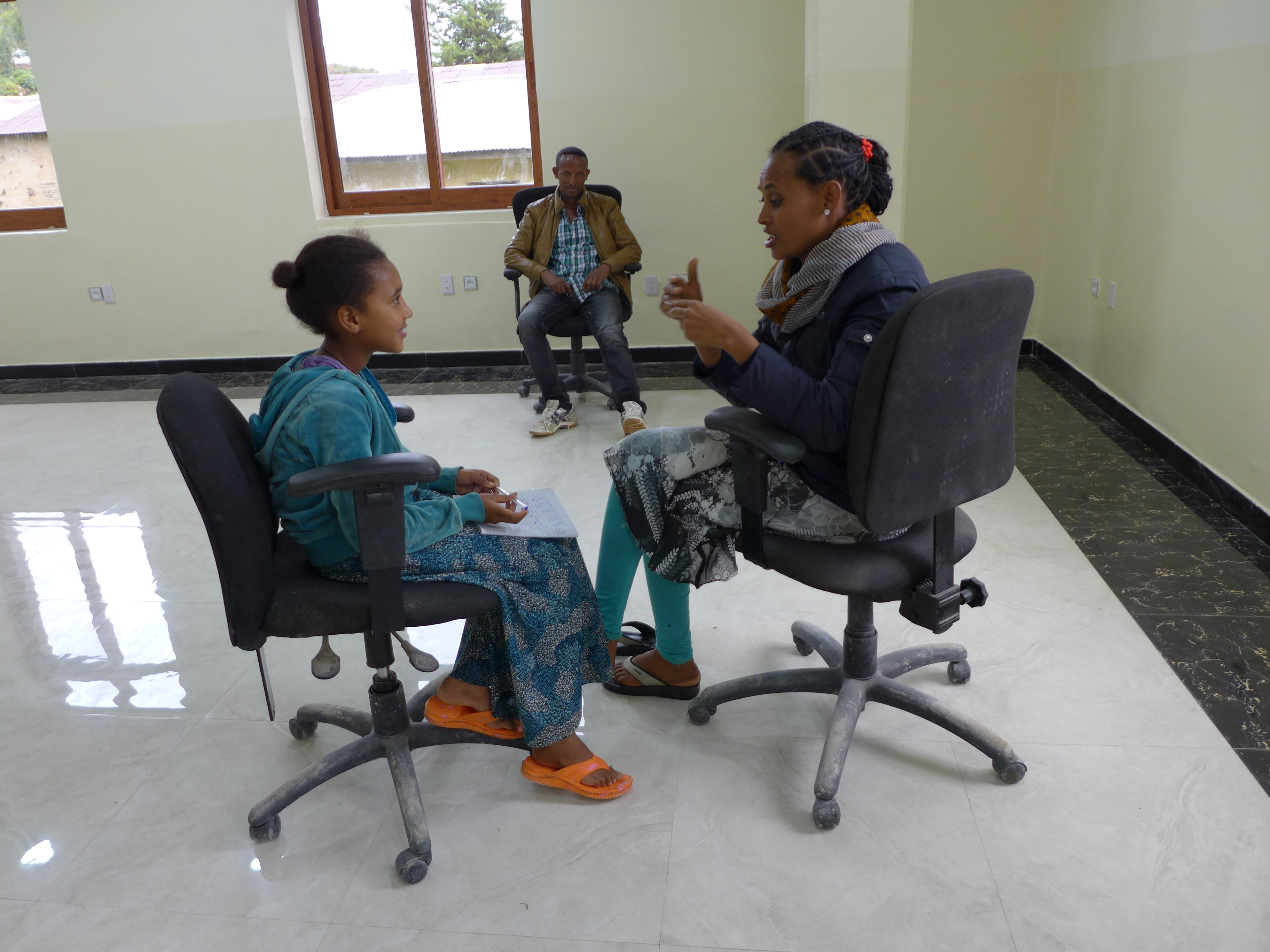


Tutoring a student in sign language

Tutoring a student in sign language

Although not yet opened, it is already being used for sign language tutoring, and sewing classes.
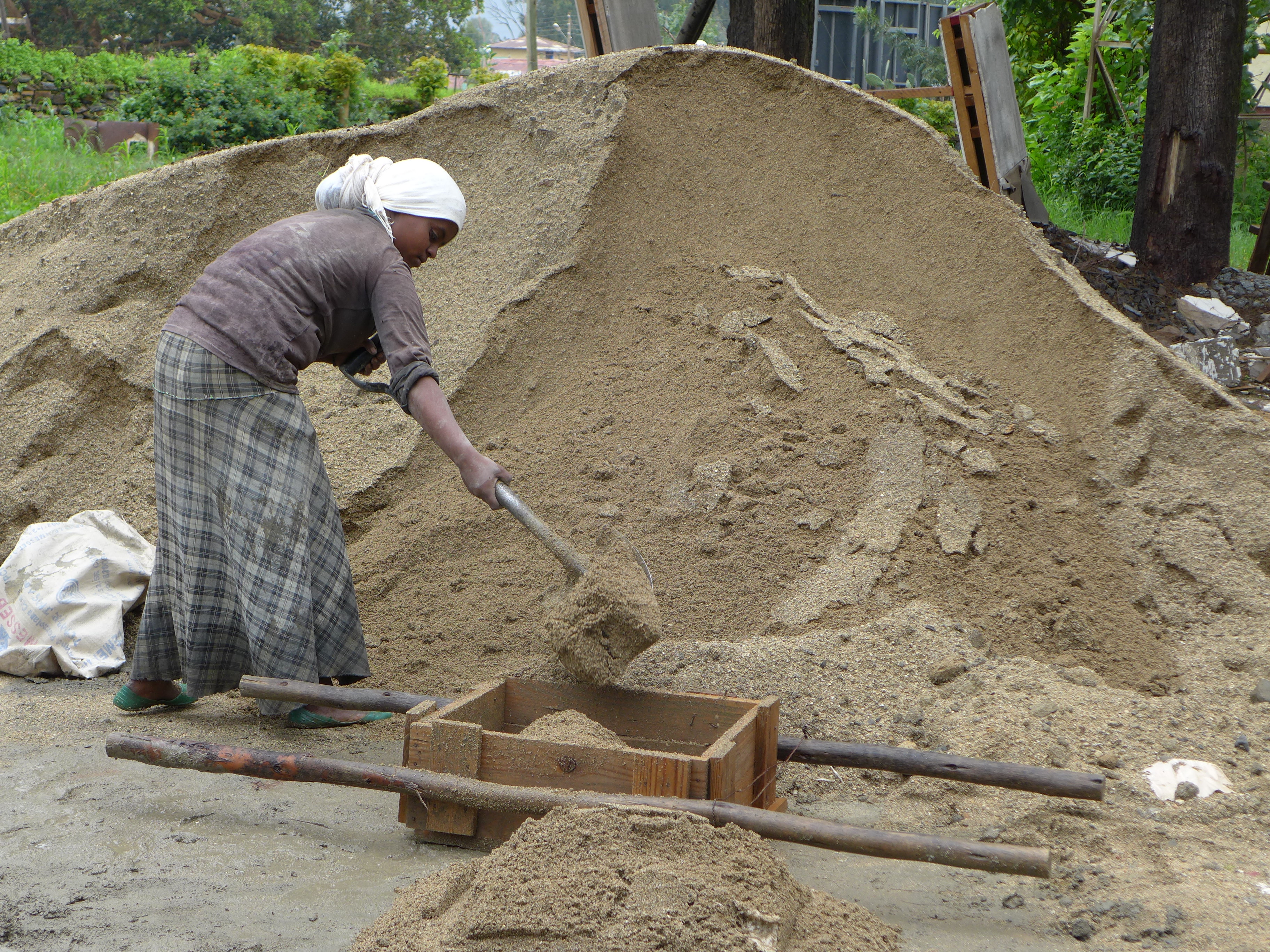


A young woman mixing cement for resurfacing the current library

A young woman mixing cement for resurfacing the current library

The current library in the Governor’s Palace is in the process of being renovated and will serve as a cultural museum.  This worker is mixing cement for the façade of the former Governor’s Palace.


Next Steps

Although there has been great progress since my visit in 2013, there is still much to do, much of it dependent on fundraising.  Significant donations have been received from the Ethiopian Diaspora, many who fled Ethiopia during the military regime.   Fundraising is ongoing.

Dwight is preparing another shipping container that will contain the theater seating, computers, more building supplies, books, and other materials.

I met once again with library staffing and IT personnel at the University of Aksum (note the alternate spelling of Axum, a transliterated word).  In my visit, in 2013, I had been informed that the online catalog had become corrupted with a virus.  On this visit, one of the IT experts had just downloaded Koha, an open source online catalog platform.  Thus, they have been without a catalog for this entire time. I was quite humbled when one of the Digital Librarians, pulled out my card from a prior visit.  I provided them with forms for database access supplied on an individual basis by the American Spaces as part of the U.S. Embassy.  The best I can determine, there is no access to commercial databases at the university.  They have made great headway with their institutional repository, using D-Space, another open source product.

Libraries in Ethiopia are faced with many challenges including the lack of training, professional status, library education, and general infrastructure.  During the last four days that I was in Ethiopia, the government-controlled internet was shut down, purportedly because of unrest in major cities in the country.  Yet, everywhere that I visited, there was optimism for the future and a drive to improve their skills and better serve their constituency.

Got more information, contact Janet Lee, janet.lee35@gmail.com
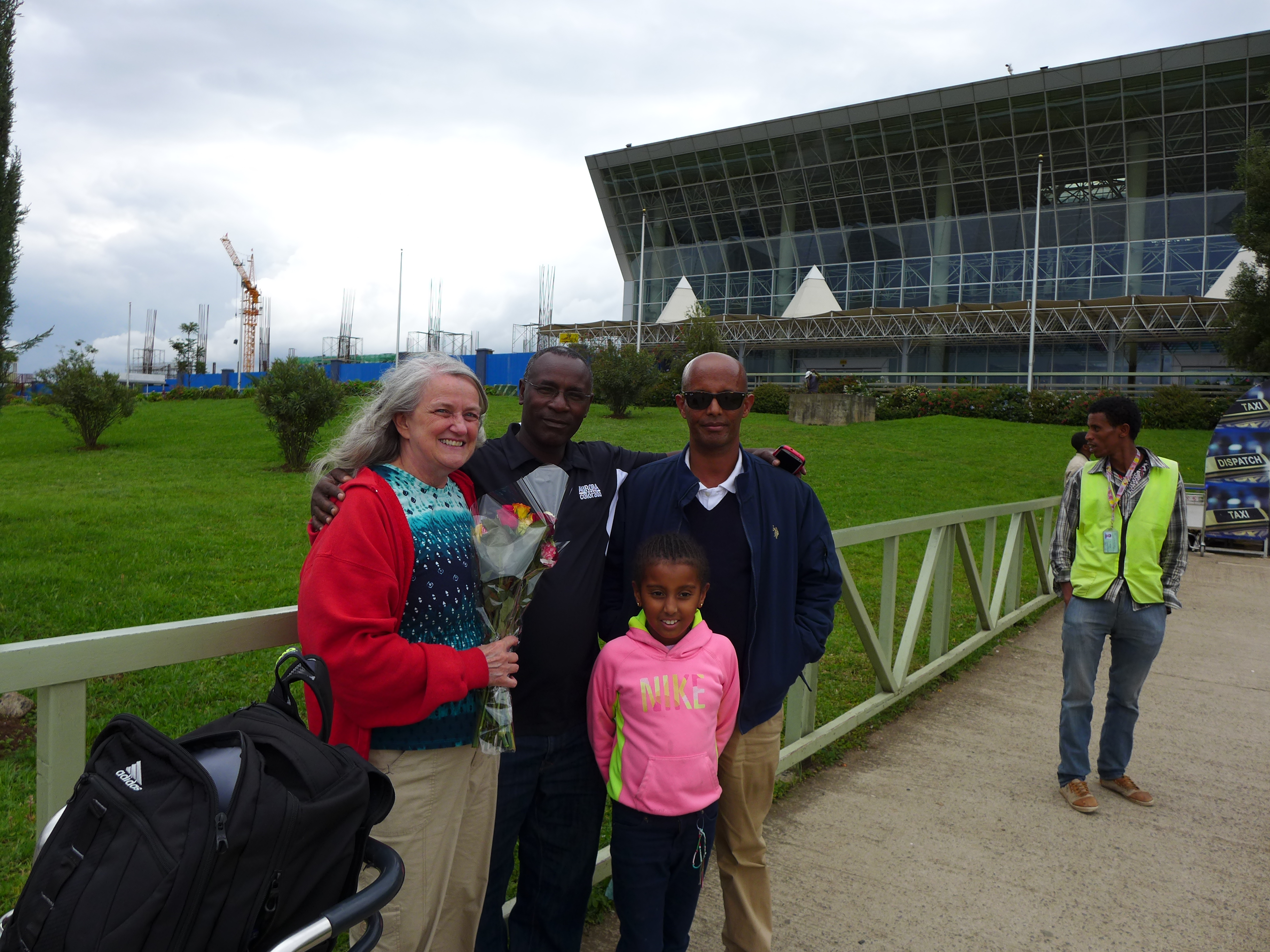
 

Aurora Sister Cities International/Adama Ethiopia

Sister Cities/Sister Libraries: the next steps

by Janet Lee, Regis University

Adama, Ethiopia

Nearly two years ago, the City of Aurora (CO) formalized an agreement with Adama, Ethiopia to become a Sister City, as Aurora Sister Cities International made the positive decision to reinvigorate and reestablish its Sister City program. A delegation, including the mayor, came from Adama to Aurora formalize the agreement.  In turn, a delegation from Aurora, including Mayor Steve Hogan, traveled to Adama.  In both instances, the delegations visited their counterpart’s libraries.
More recently, I have joined a library committee within Aurora Sister Cities International to investigate ways the International Library Cultural Exchange Interest Group and the Aurora Public Library could partner with libraries in Adama.

Taking advantage of a travel opportunity to Kenya with a Regis University colleague, I decided to travel through Ethiopia on my return. I also wanted to take the opportunity to meet with my University of Denver colleague, Dr. Shimelis Assefa, who was on sabbatical since January and teaching at the Adama Science and Technology University.  Jeglalo Guye, Executive Director of the Adama Sister City program, attended to local arrangements and with Shimelis greeted me at the Bole International Airport in Addis Ababa (the new flower) and capital of Ethiopia.

As a Returned Peace Corps Volunteer Ethiopia from the 1970s, I have seen many changes on recent visits. The most striking change on this visit was the express/tollway from Addis Ababa to Adama.  As we approached Adama we were met by a wind farm of 50 to 100 wind turbines, which supplies this region with much needed electrical power.

I immediately was escorted to the Adama Science and Technology University where I was greeted by Tagel Aboneh, Director of Libraries, who gave a presentation and overview of the libraries. In attendance was Vice President Lemi Guta who was very helpful with further explanations.

Universities in Ethiopia have specific areas of specialization and students who pass the national exam enter the appropriate program, even though the university may not be located within their region. ASTU, as the name indicates focuses on science and technology.

On Saturday, I visited three public libraries in the city, donated several children’s books including a copy of a book in Afaan Oromo, which I printed from the African Storybook Project (http://www.africanstorybook.org/) and holds a Creative Commons license.  I also presented the librarians a thumb drive that included 12 stories in Afaan Oromo and 12 stories in Amharic to either be printed or shown on a computer.

Finally, I met with library staff on Monday to determine next steps for the library committees.

The following photos will serve to illustrate the next steps in our discovery process.

An Adama City welcome: including Jeglalo Guye, Dr. Shimelis Assefa, and Abigail

An Adama City welcome: including Jeglalo Guye, Dr. Shimelis Assefa, and Abigail


Tagel Aboneh, Director of Libraries

Tagel Aboneh, Director of Libraries

Vice President Lemi Guta attended the presentation and provided valuable information

Vice President Lemi Guta attended the presentation and provided valuable information

Tagel Aboneh

Tagel Aboneh


I was greeted at the airport by Dr. Shimelis Assefa, Associate Professor at the University of Denver, who is completing a sabbatical project at the Adama Science and Technology University and by Jeglalo Guye, Executive Director of Adama Sister City International.  We immediately drove to Adama using a newly built super highway/toll road to Adama for a prearranged visit to the ASTU libraries and a presentation by the Library Director Tagel Aboneh.  Seated in the audience was ASTU Vice President Dr. Lemi Guta, who was showing both his support for the libraries and his great appreciation for their work.

Tagel gave a noteworthy presentation on the current state on the six libraries on campus, including defining the mission of excellence and to become the leading library in science and technology as a 2025 goal, a goal which I believe they will achieve.  The ASTU library system has 65,000 books, 14,795 photocopies of books, and 25,000 ebooks.   The libraries can hold approximately 1500 students at a given time.  It should be noted that the spring session just ended and most students are on break, otherwise the seats would have been filled with students.

Throughout Ethiopia, universities typically have a room or area that is designated female only.  ASTU is different in that it has an entire library that is designated female only.  With 24/7 access to all library buildings, this is done for the female students’ safety in mind.  The female-only library is located near the women’s dormitory.

Tagel oversees approximately 250 total staff who maintain three shifts to cover the 24/7 access.  These include employees with diplomas, first degrees (Bachelors) and second degrees (Masters).

Like 90% of the university libraries in Ethiopia, ASTU runs its online catalog using Koha open source software.

The institutional repository utilizes D-Space.

They receive great support from KOICA, (Korean-sponsorship) and plan to digitize 10,000 in high demand book titles utilizing 20 scanners of varying levels of robustness.

He has a proposal to the Vice President for Administration to implement a fully electronic library and 200 additional computers.

Challenges faced are similar to those worldwide:

Capacity building

Advanced technical training

Lack of RFID microchip

Resource & experience sharing

Community service project with local libraries


The circulation desk

The circulation desk

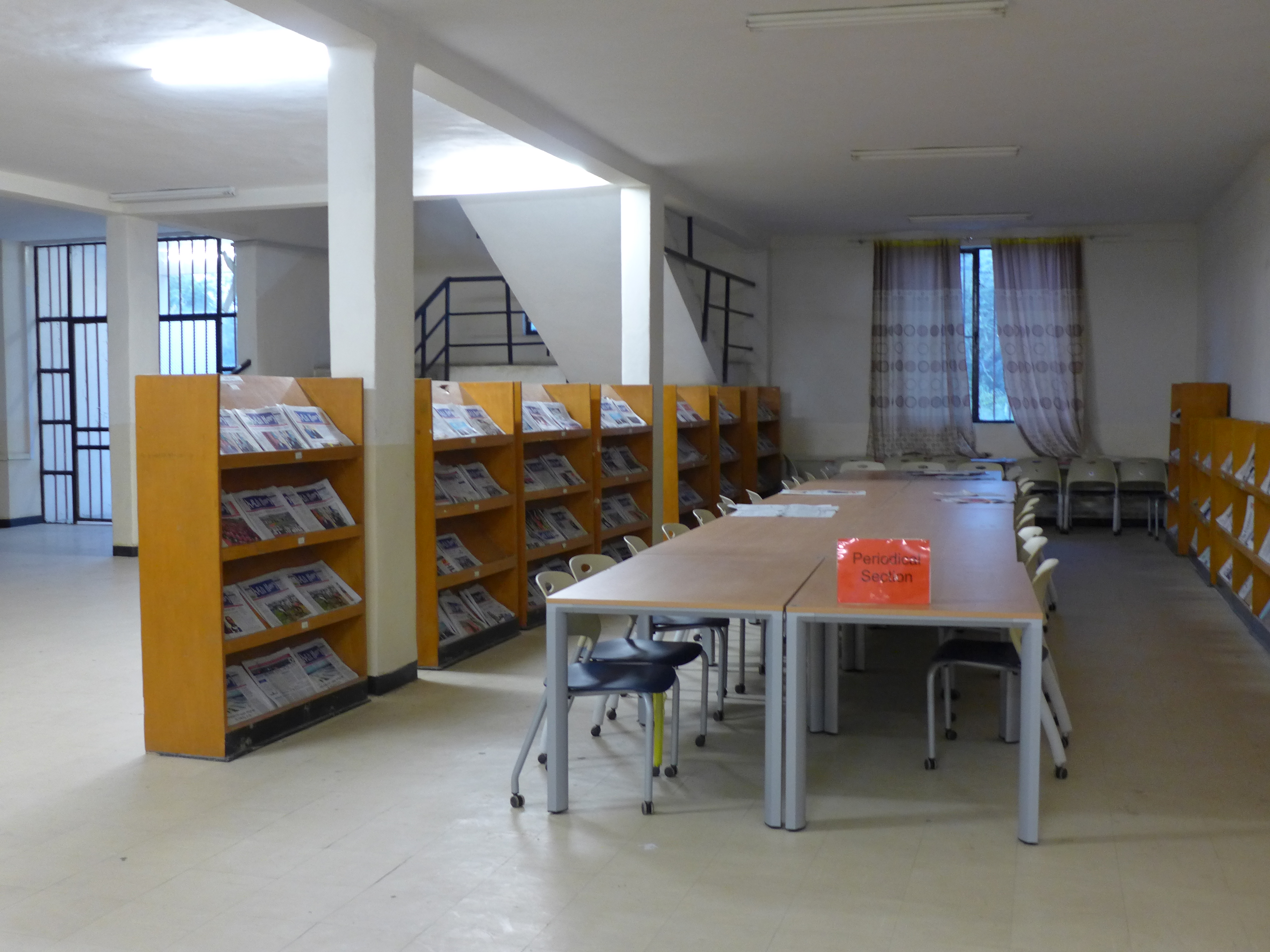
Newspaper area

Newspaper area

Newspapers in local languages

Newspapers in local languages


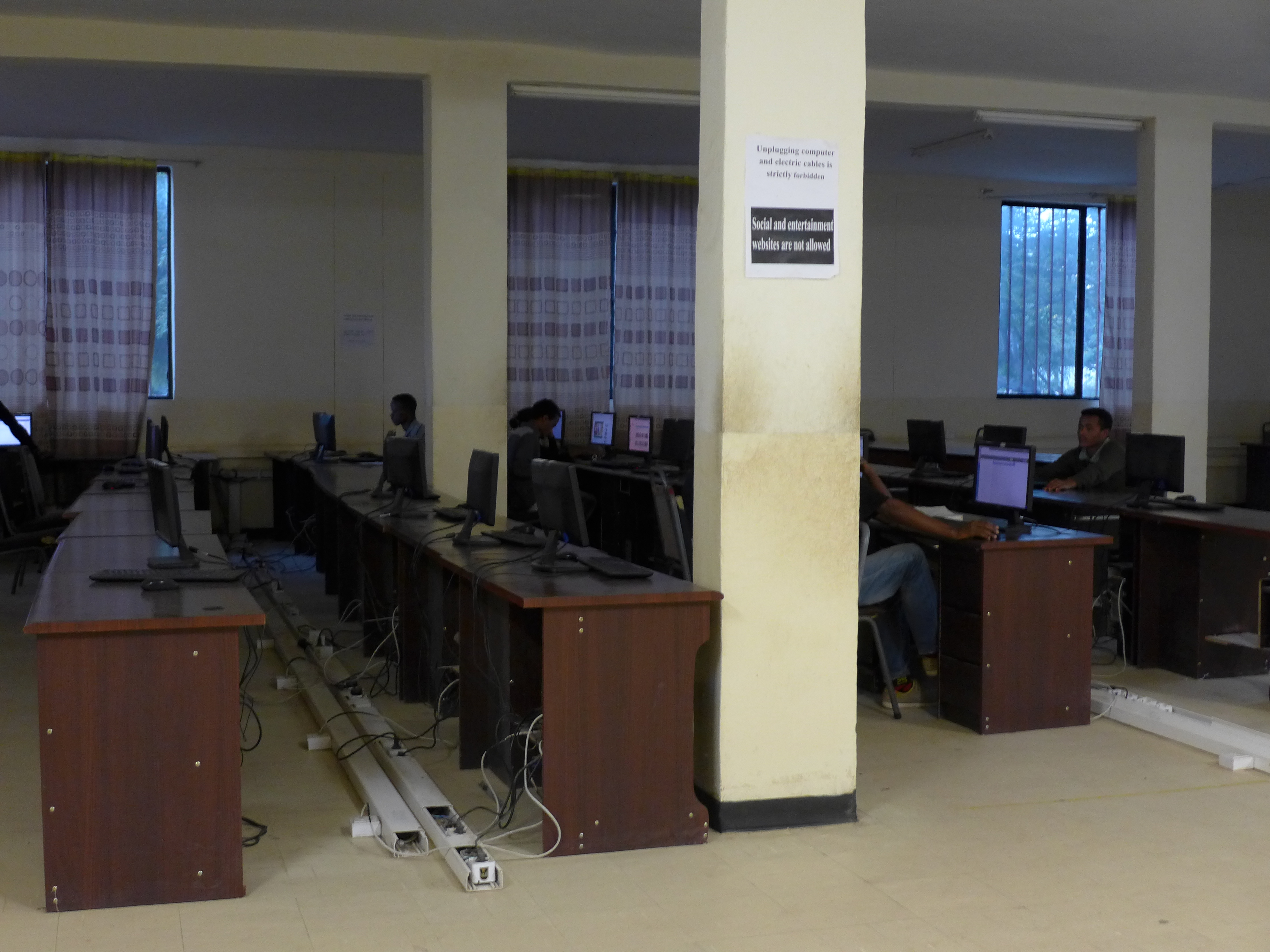
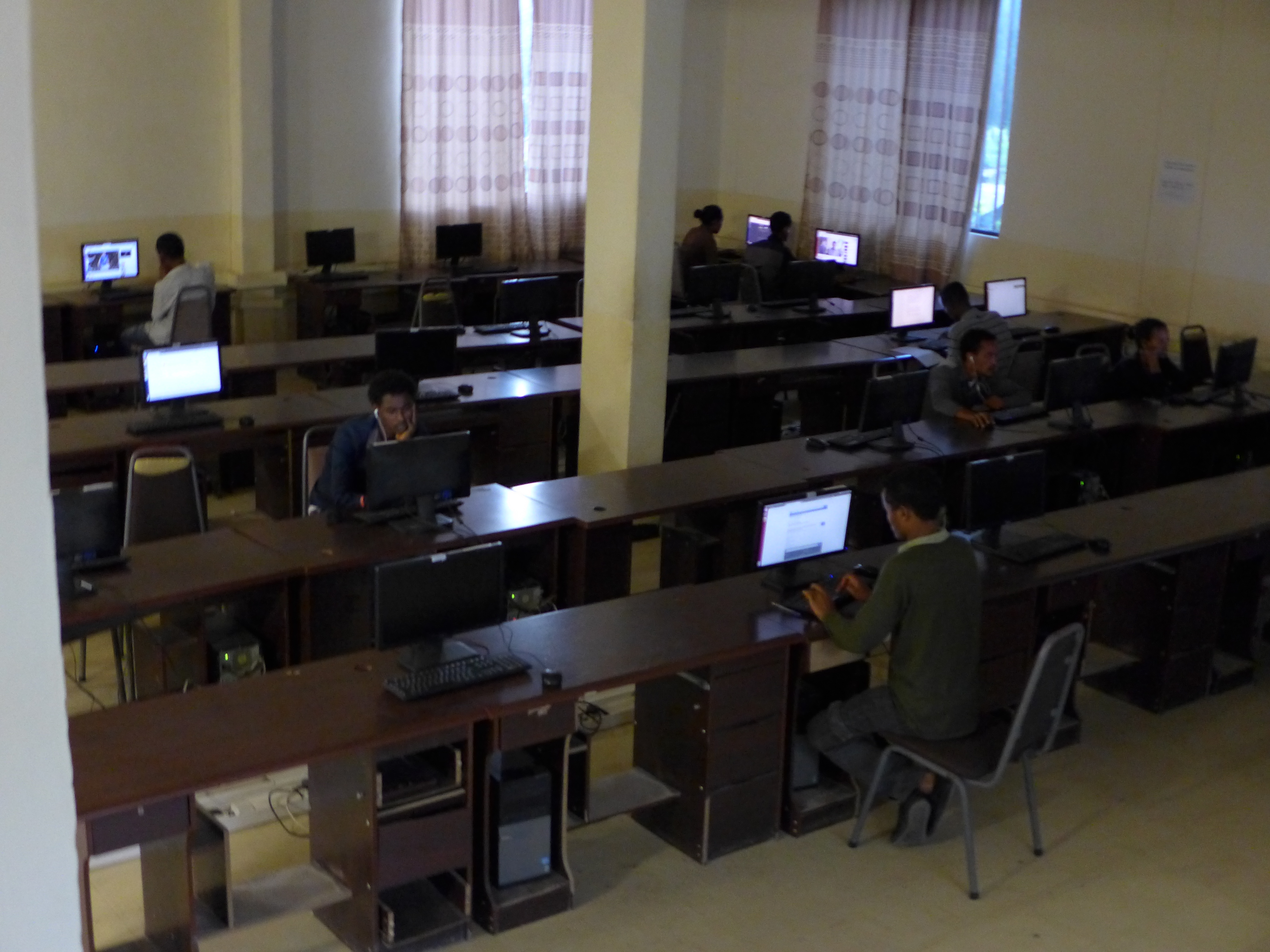
Computer room

Computer room

Computer room

Computer room

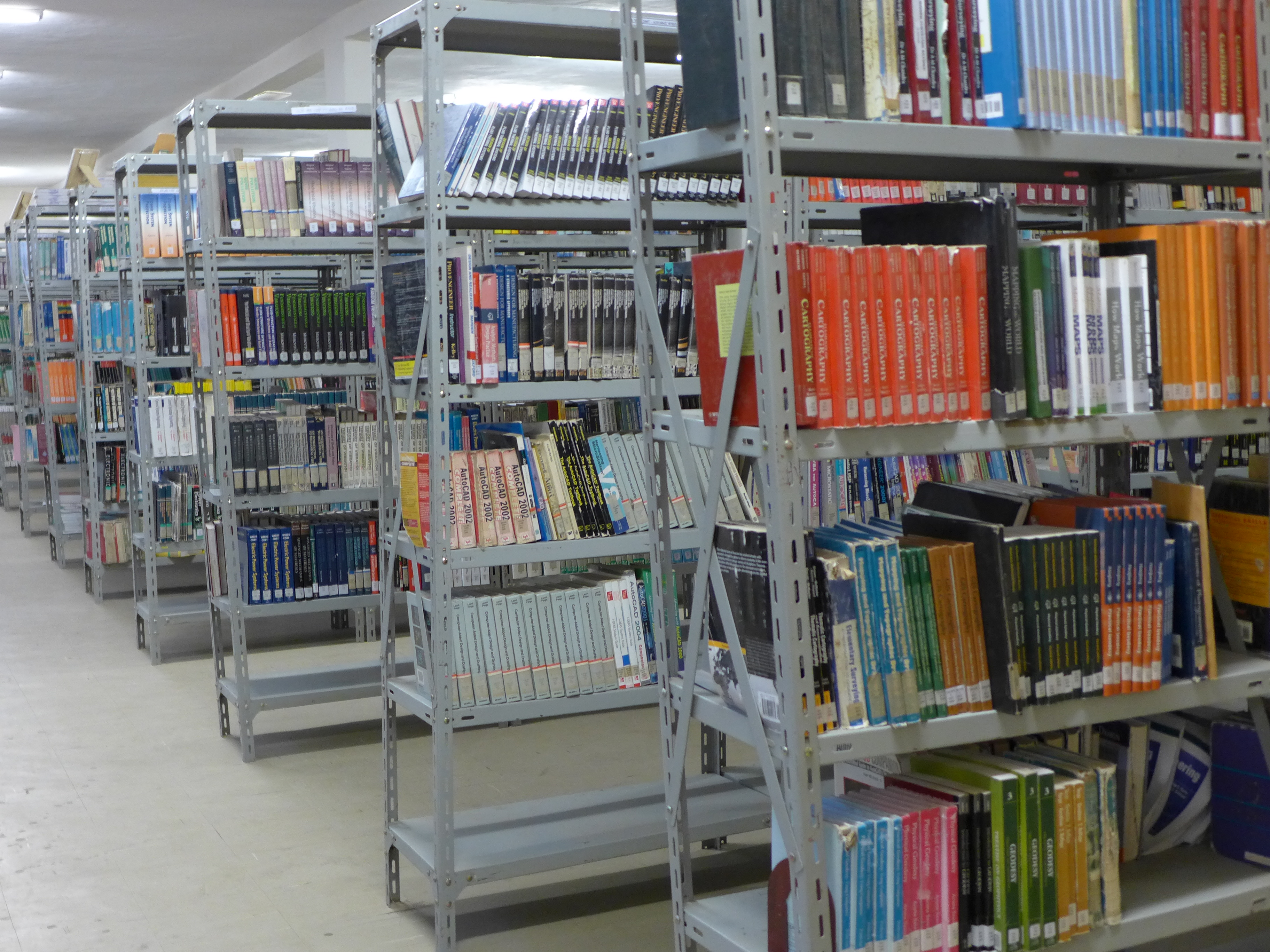
The stacks

The stacks


Atrium

Atrium


In visiting the primary library we were shown the circulation area, newspapers in local languages and in English, the general stacks and the computer areas.  Dr. Lemi also informed me that they are investigating a plan to equip 300 high performing scholars with laptops to aid in their instruction.  There are approximately 9700 total students, 30% female and 70% male.  They are actively recruiting female students to the school for this upcoming year.

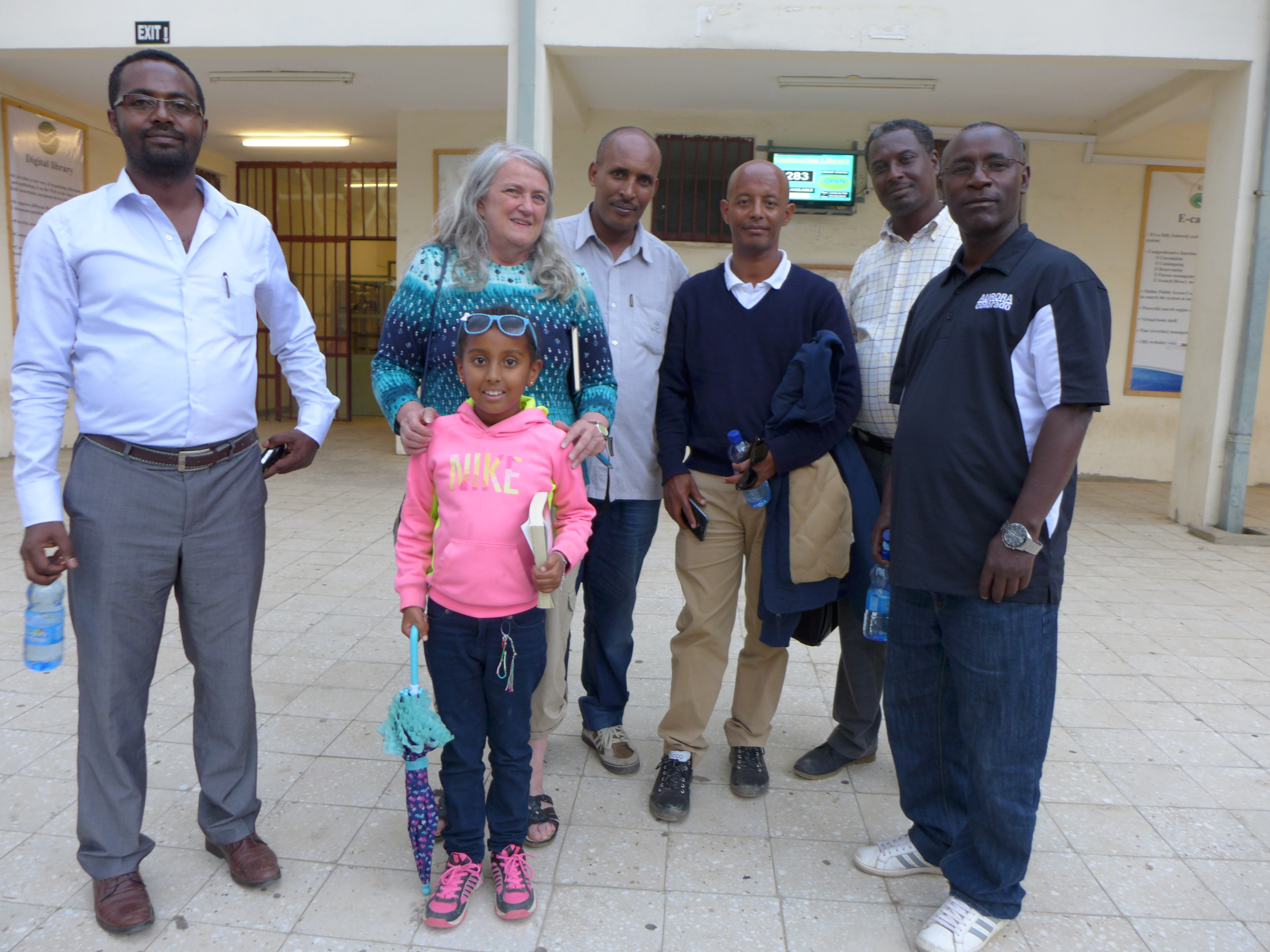
Final group shot in front of the library

Final group shot in front of the ASTU library


Youth Center Library # 1


Initial greetings with Youth Center Manager # 1 Gizaw Alemu and Abebe Yifru Library staff member

Initial greetings with Youth Center Manager # 1 Gizaw Alemu and Abebe Yifru Library staff member

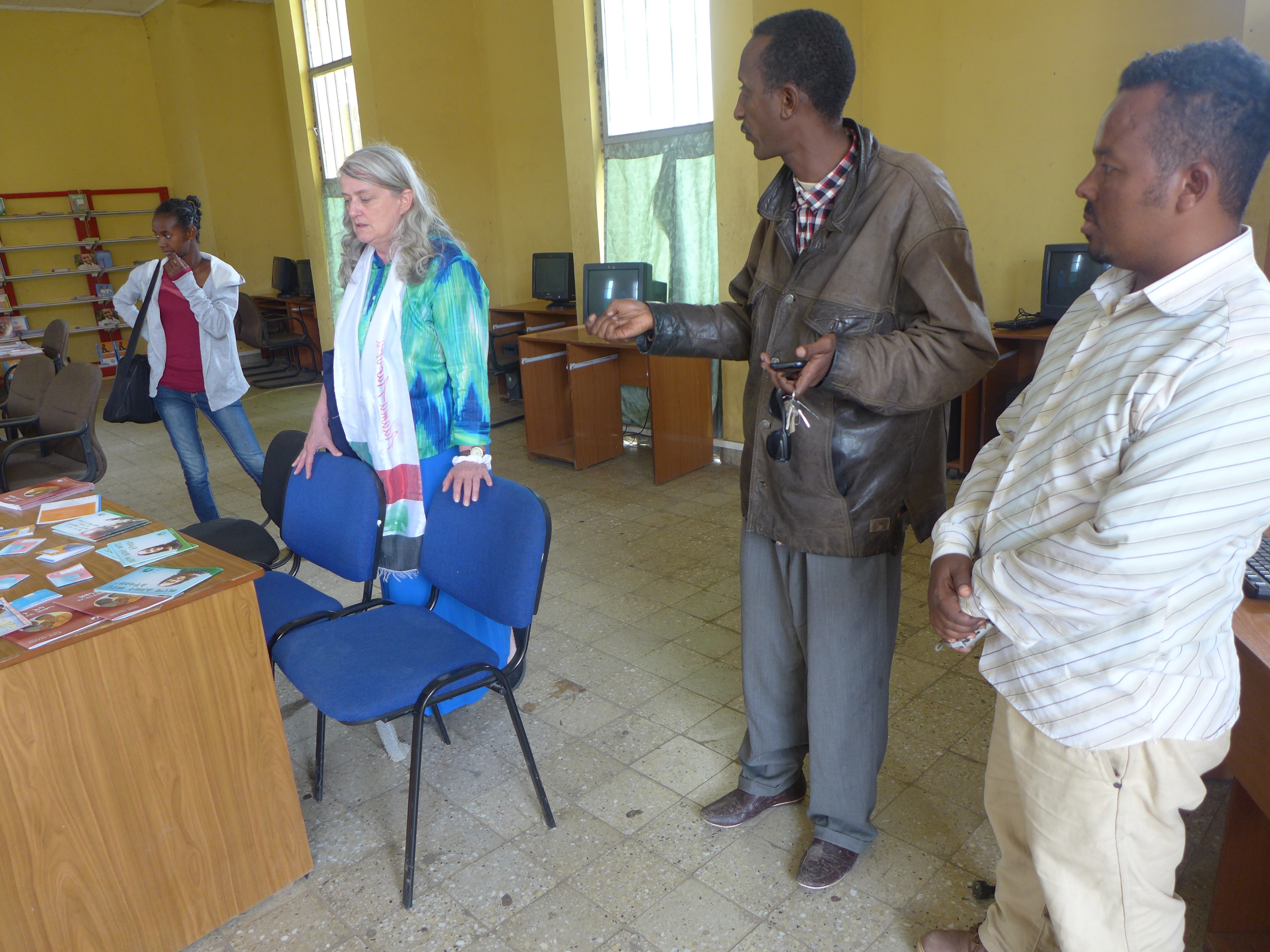
On Saturday, I was greeted by the library staff of all three of the Youth Center libraries at Youth Center Library #1.  The libraries are under the direction of the Youth Center and are situated in the same building as the recreation center, allowing children and students to avail themselves of both.  I was initially confused because I saw photos of the library when the Aurora Mayor and his contingent had visited.  This didn’t look like the same building as in the picture, but it was.  The main difference was the removal of wooden shelving and the replacement of much sturdier metal shelving with the books neatly in place.

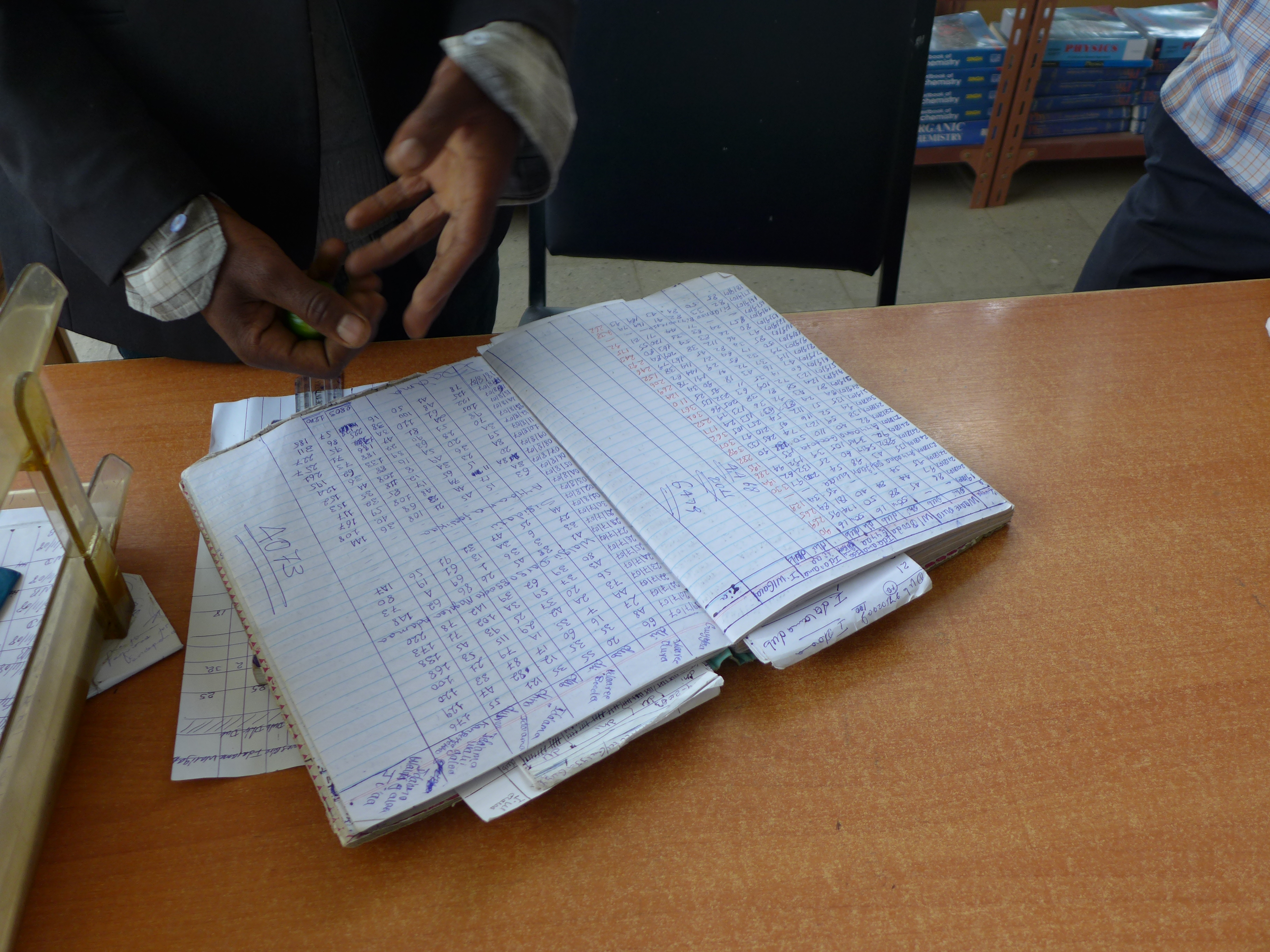
Daily attendance records

Daily attendance records

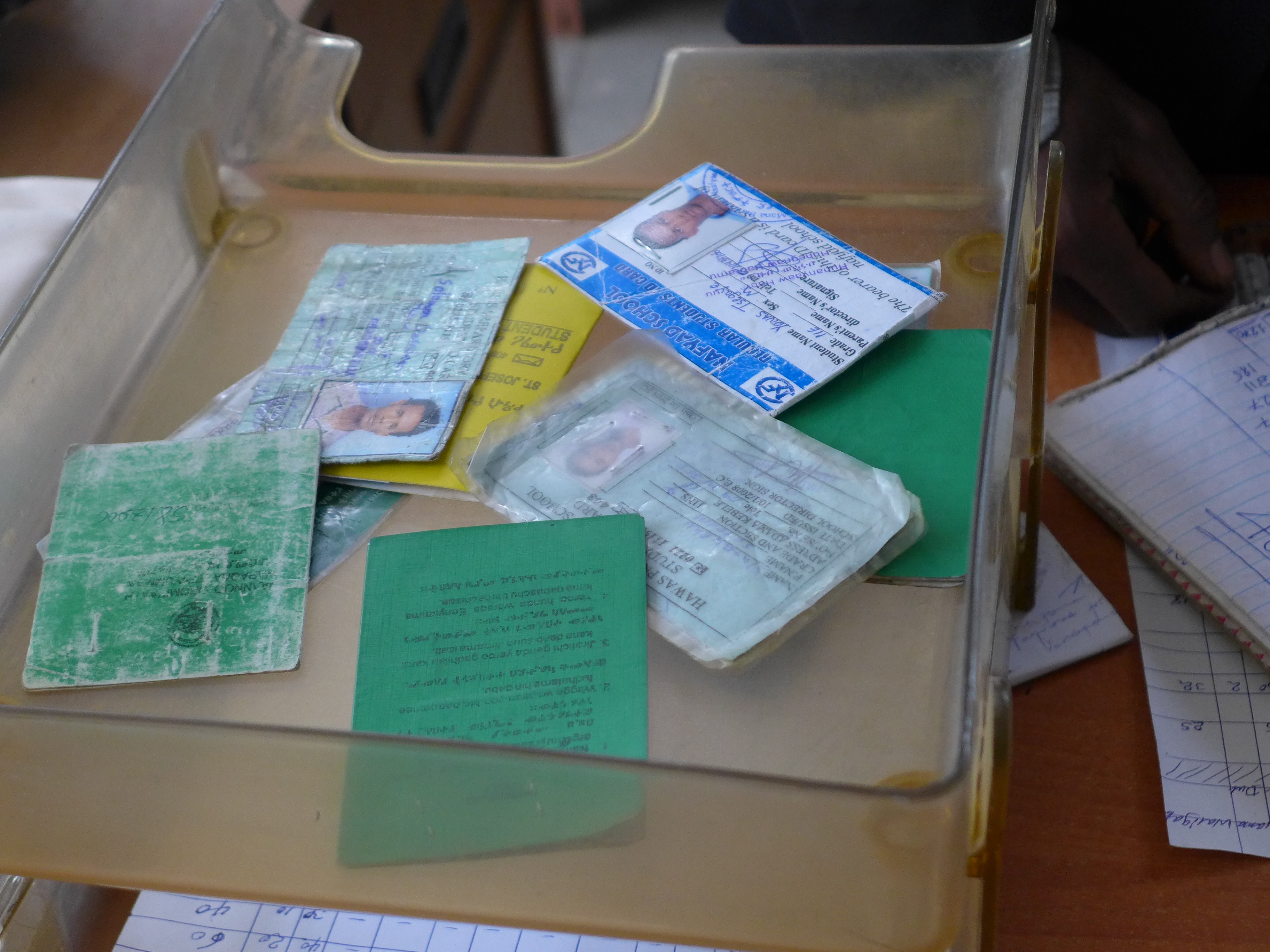
IDs

IDs


The library staff tracks attendance and Youth Center Library #1 usually sees approximately 300 student on average per day.  Students drop their IDs in the box upon entrance.  Similar to other libraries that I have visited, there is an abundance of textbooks and very few reference books of note.  Also missing were any types of books for young children.  Aurora Sister Cities International has shipped a container of books to Adama, but it is being held up in Djibouti, a not so uncommon experience.


Jeglalo with Yomi Abeje, Youth Center Sport Office, Youth Center Coordinator

Jeglalo with Yomi Abeje, Youth Center Sport Office, Youth Center Coordinator

Reading room

Reading room

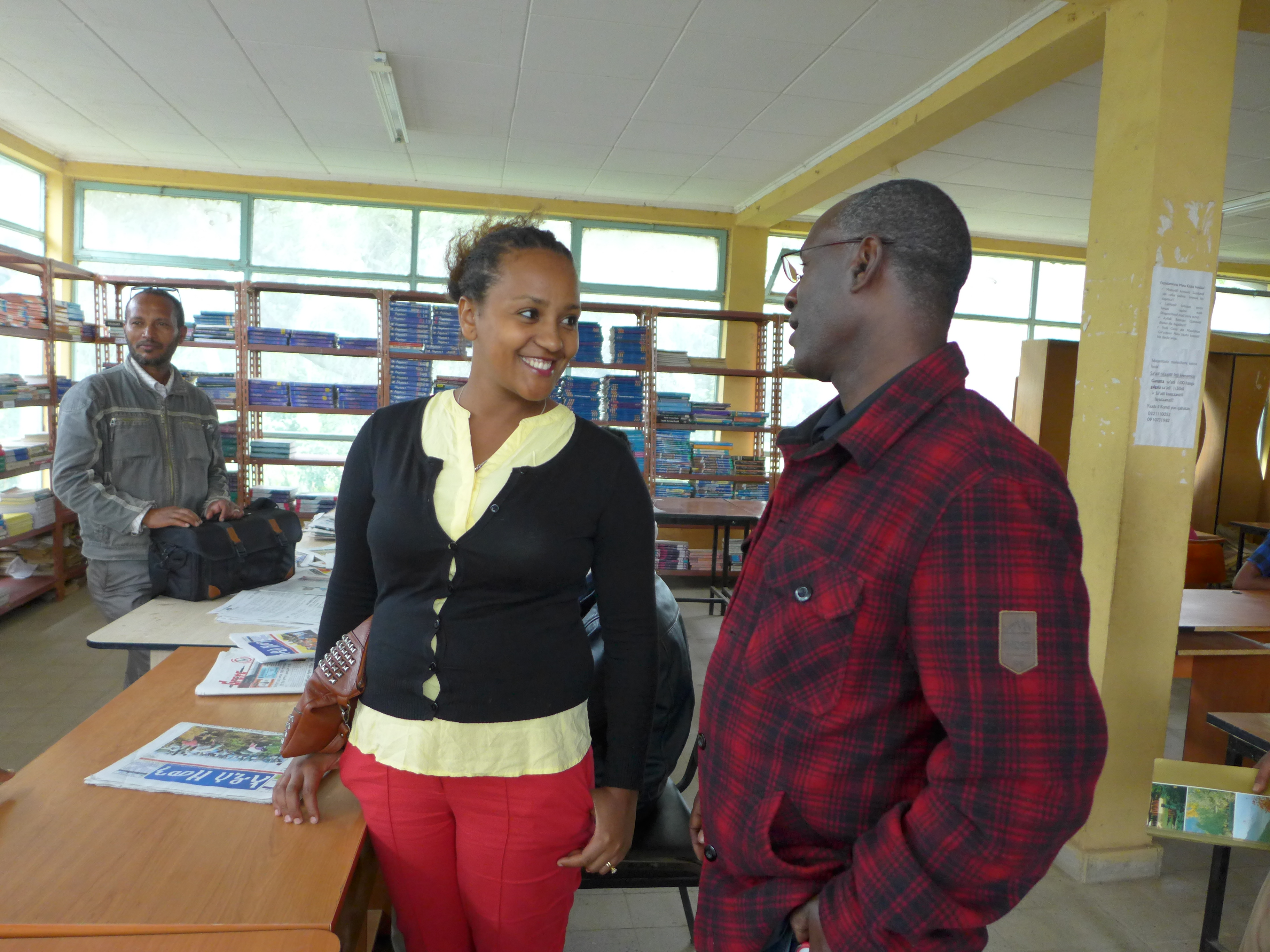
Abebe, Gizaw, Janet, and Yomi

Abebe, Gizaw, Janet, and Yomi


The reading room is spacious, especially now when school is not in session.  The library staff did state that it is frequently full as students look for a quiet place to read and study.  There is ample natural light, but no signs of technology.


P1020057P1020060resizedP1020067


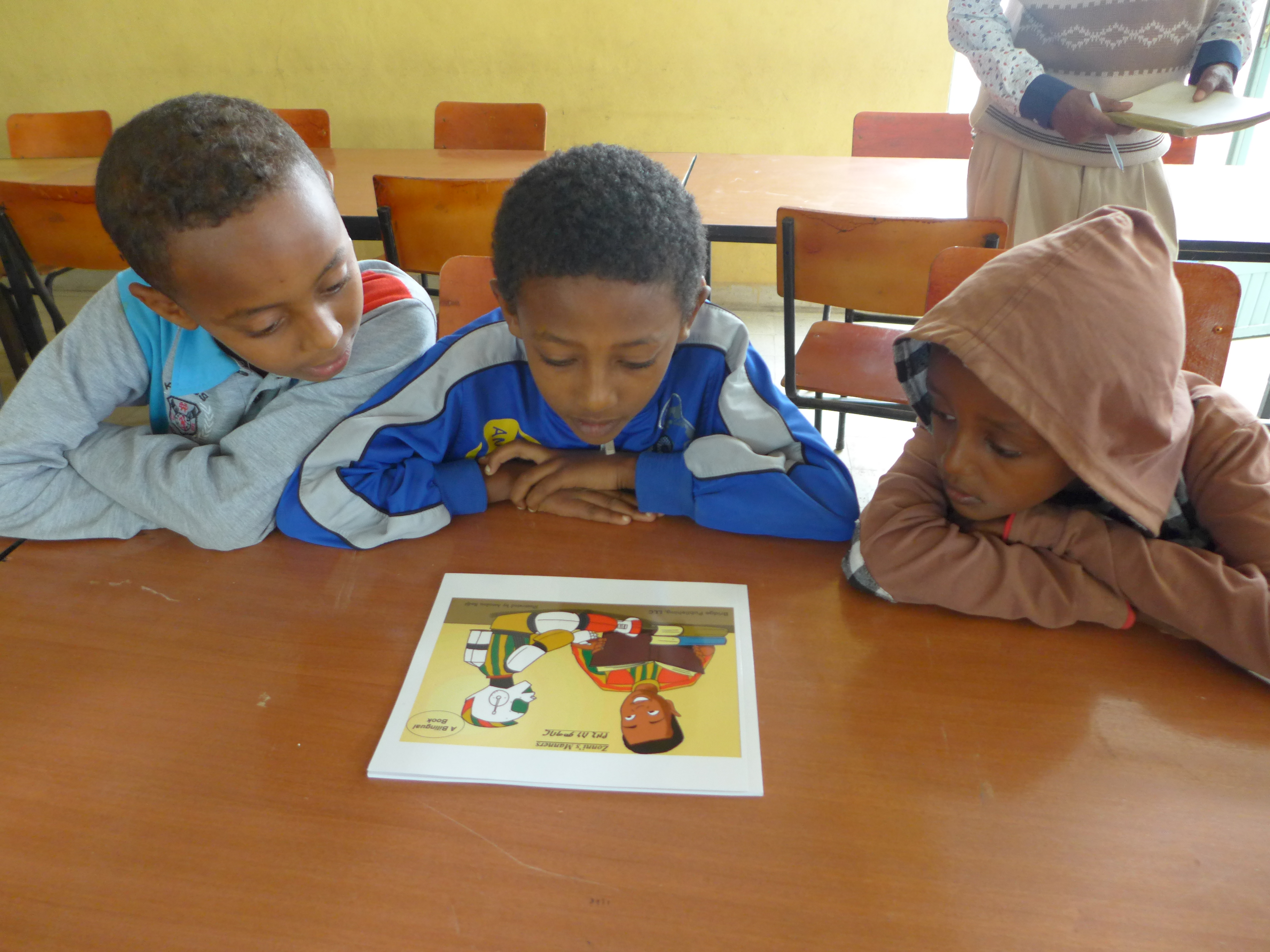
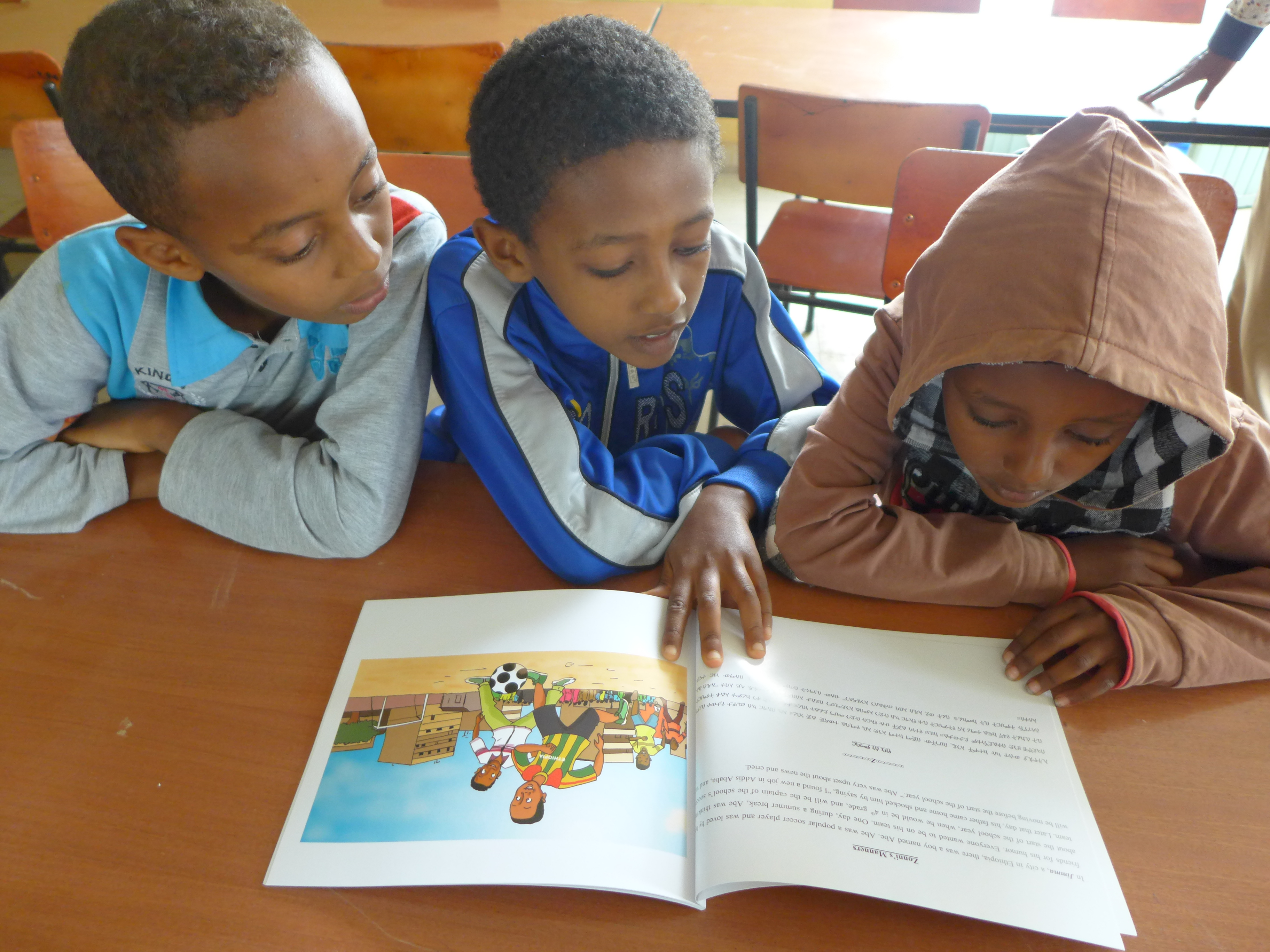
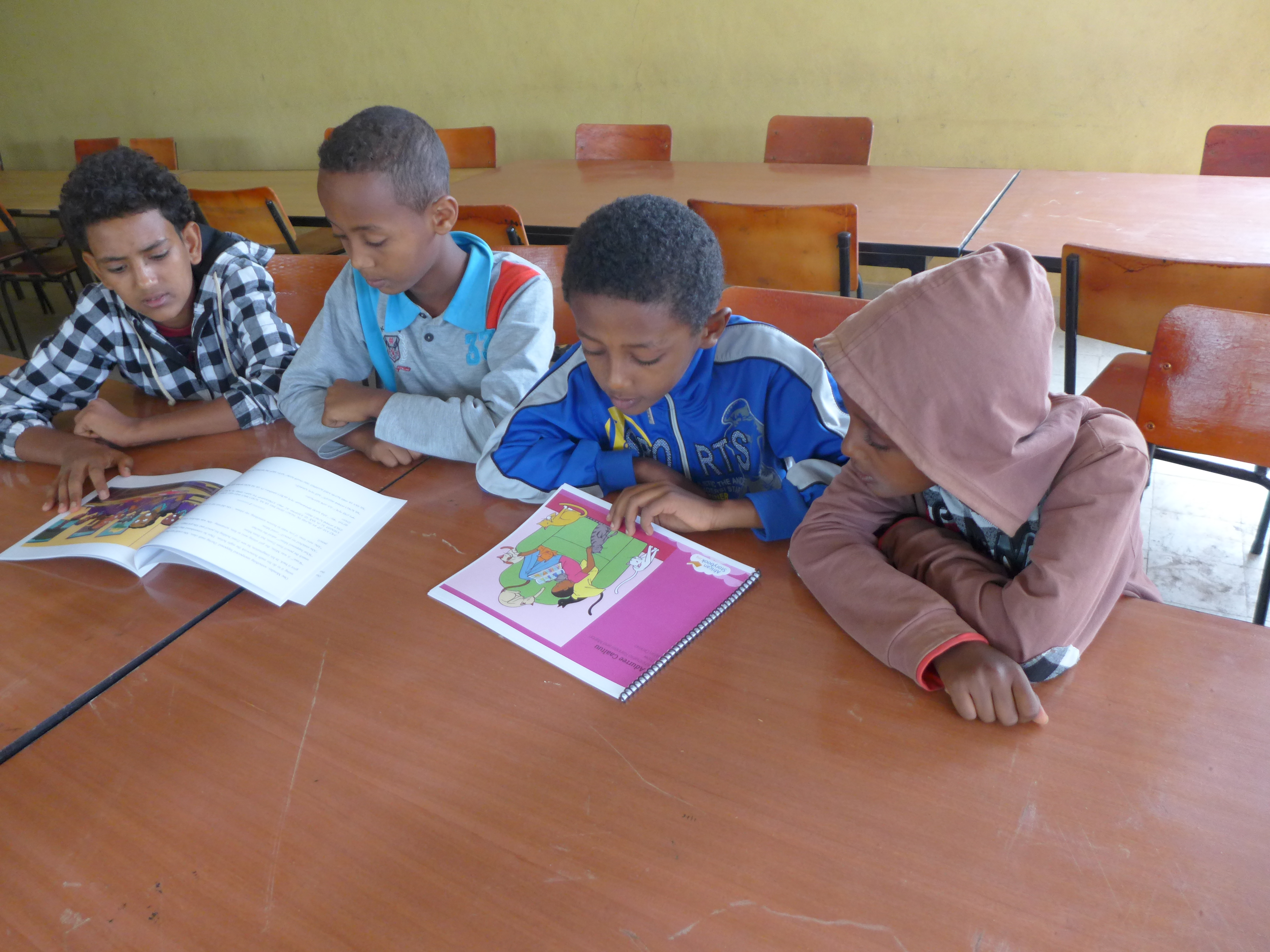
An Ethiopian-American author found me on the internet seeking advice on children’s publishing.  He published Zonni’s Manners on Amazon as an ebook and just a couple weeks prior to my trip announced that it was available in print.  I purchased a few copies and promised that I would take some photos of children reading his book.  I also downloaded books from the African Storybook Project and printed one copy in Afaan Oromo and one copy in Amharic for demonstration purposes.  I left this copy in Afaan Oromo as well as a flash drive with 12 titles in each language.

Janet presents books to Gizaw Alemu

Janet presents books to Gizaw Alemu

P1020090

Janet presents book bag to Yomi Abeje Youth Center Coordinator

Group shot outside # 1 with Library staff member, Abebe and Library manager, Gizaw

Group shot outside # 1 with Library staff member, Abebe and Library manager, Gizaw


Upon the recommendation of Jeglalo, I gave all of the books that I had for Adama to Youth Center Library #1.  It is the larger of the three libraries and the one more likely to have children.  Definitely more books are needed in the future.


Youth Center Library #2

Youth Center Library # 2 Manager, Jamal Tuke

Youth Center Library # 2 Manager, Jamal Tuke

Local language collection

Local language collection

Group shot with Jamal Tuke

Group shot with Jamal Tuke


Jamal Tuke with Janet in front of Library # 2

Jamal Tuke with Janet in front of Library # 2


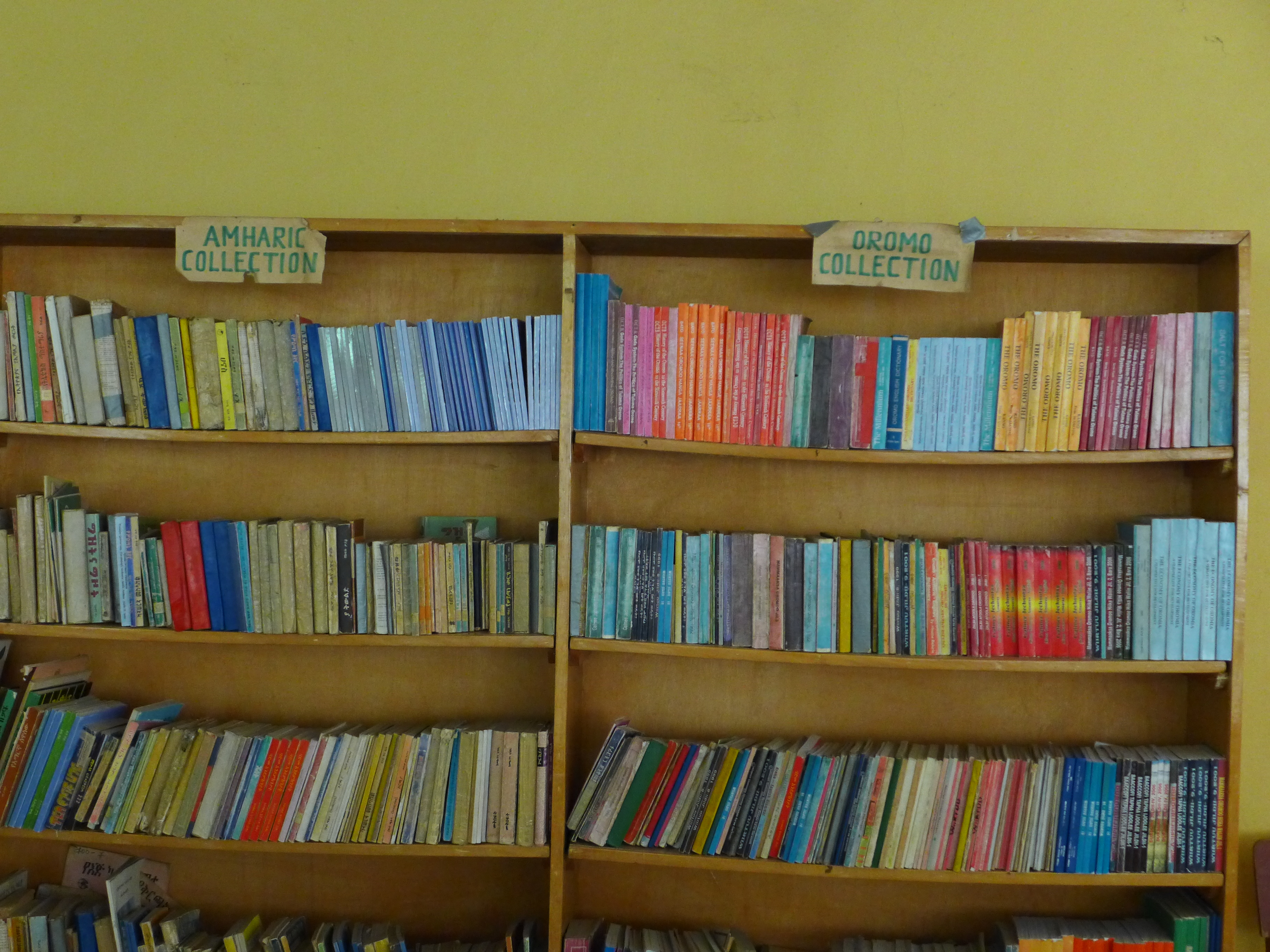
The strength of Youth Center Library #2 is its local language collection, both in Amharic and in Oromo. One could also say that about its Library Manager, Jamal Tuke, who brings eighteen years of experience to his position.  High school and University students come to this library to take advantage of the local language materials.


Youth Center Library #3

Group shot in front of a table filled with health-related brochures

Group shot in front of a table filled with health-related brochures

Adil Ahmed describes the health related pamphlets

Adil Ahmed describes the health related pamphlets

Adil Ahmen with Yirgalem Mekonnen

Adil Ahmen with Yirgalem Mekonnen


Internet access

Internet access

Health related posters and pamphlets

Health related posters and pamphlets


Youth Center Library #3 holds a substantial health care focus with pamphlets, posters and other materials providing a wealth of information about preventative care for healthy well being.  It also boasts free, but limited Internet Access for interested parties to search for further health care information.


The final wrap-up

The final wrap-up


Everyone came together on Monday from Youth Center Libraries 1, 2, 3 as well as representatives from Tourism and Culture, which has a few libraries of its own.

The group articulated their major challenges and concerns clearly and fervently.  There was no expectation that the issues would be solved, but clearly appreciation that they had a voice.  After describing the services that they are capable of providing, they voiced some frustration that they could not serve to the best of their ability because of many challenges:  shortage of reference materials, no children’s books, inability to provide customer services at the level that they desired.  The materials that they did have were dated.  The size of their facilities was inadequate for the population that they served.  They lacked technology, even basic computers and internet.  The budget provided for salaries (they did not complain about salaries, but I am sure they are minimal) but did say that they were short staffed.  The budget provided for little else.  All services must be provided free of charge, so there is no provision to recoup expenses by charging for internet, for instance.  Overall they have had no training and would greatly appreciate training to improve their skills.  The libraries themselves are not attractive (although the new shelving in library # 1 greatly approved its appearance).  There is inadequate lighting for studying.  Some facilities lacked sufficient toilets.

In our discussion, we agreed that we are starting positively by having public libraries and that the next step is to make improvements.  Jeglalo is charged with voicing their concerns to the mayor by giving a report of activities.  He will also meet with Tagel at the University Library to arrange for the training that the library has so generously offered.  When the Mayors of Aurora and Adama met, they spoke of a new library in the new industrial complex that will be developed over the next decade.  I will return to Aurora Sister Cities and share their concerns and see what ASCI might be able to do.  We discussed the possibility of first language publishing and Jeglalo would see if there are funds to print the remaining African Storybook Project books.  We departed on a high note with hope for the future.


Rural Kenya: Baitigitu Primary School

Welcome! Karibu!

Welcome! Karibu!

Welcome! Karibu!


Rural Kenya: Baitigitu Primary School

by Janet Lee, Regis University

I was invited to join colleague, M.D. Kinoti, Associate Professor in the Masters in Nonprofit Management program at Regis University, to join him and his family for a trek to Kenya. One of his enticements was the opportunity to meet his mother.  Joining us would be Roberta Bourn a member of a local Rotary Club, and her grandson Chris.  We would each carry a 50 pound suitcase of medical supplies furnished by Project Cure, located in Denver.  Kinoti grew up in rural Meru Kenya, where he attended primary and secondary school.  Upon graduation from high school, he attended and graduated from Moi University in Nairobi where he met his future wife, Victoria.  After working for several years, he took his family, now including son Timothy, to California to attend Fuller Seminary where he went on to earn two masters degrees and a PhD.

As a Returned Peace Corps Volunteer Ethiopia, I longed to return to this part of the world and the opportunity to explore rural schools and especially rural libraries. By planning carefully, I would also be able to hop on over to Ethiopia on my return.  In preparation for the trip, Kinoti and I Skyped with an organization called Worldreader, which utilizes Kindles as a delivery method of distributing books.  Worldreader began its program in Ghana and is now in Kenya.  Although we hoped to visit a school that had a program, ultimately we made do with meeting a rep on the last evening.

It would not be possible to visit Kenya for the first time and not go on safari. This was my second visit to Kenya and my third opportunity to go on safari in East Africa, but there is still a thrill to see animals in their natural habitat.  We saw three of the Big Five the first evening and repeat sightings of many different animals on the second day.

The universities in Nairobi have modern libraries complete with databases and other resources, but the main point of the trip was to visit schools in rural Meru, Kinoti’s ancestral home. Over the course of several days we visited a tea plantation, met with local Rotary Club members, met with local farmers who belonged to a farming co-op, and three schools:  Kaubau Primary school, Uruku Girls School, and Baitigitu Primary School, Kinoti’s school when he was a boy.

In this posting, I will focus on Baitigitu Primary School. All three schools mentioned had many similar challenges:  inadequate toilet facilities, insufficient number of textbooks for students, and lack of water.  Kaubau had a library, but it had not been maintained and in fact the books were disintegrating from lack of care.  Uruku Girls School was a boarding school, typical for rural secondary schools in Kenya, did not have a library and had a more pressing need for a dining facility and improved kitchen.  One set of pit latrines had collapsed and more latrines were needed.  The dormitories were built of stone with the interior walls exposed.  In time, it would be aesthetically pleasing to have the walls finished, but for now the dormitories appeared solid and functional.

Through photos I will include the reader on my journey.

Baitigitu Primary School

Baitigitu Primary School

Computer Room

Computer Room

Two of six computer donations

Two of six computer donations


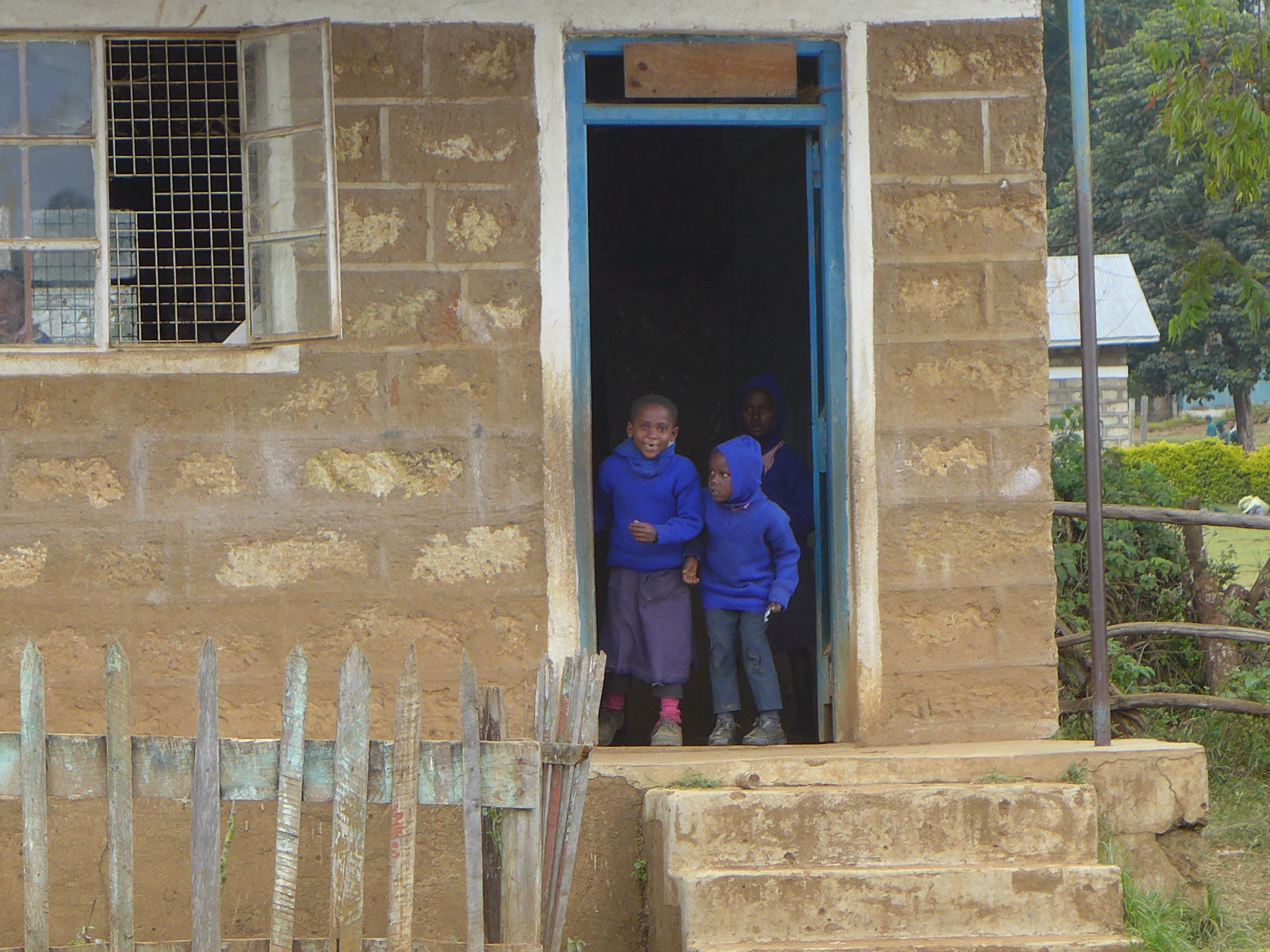
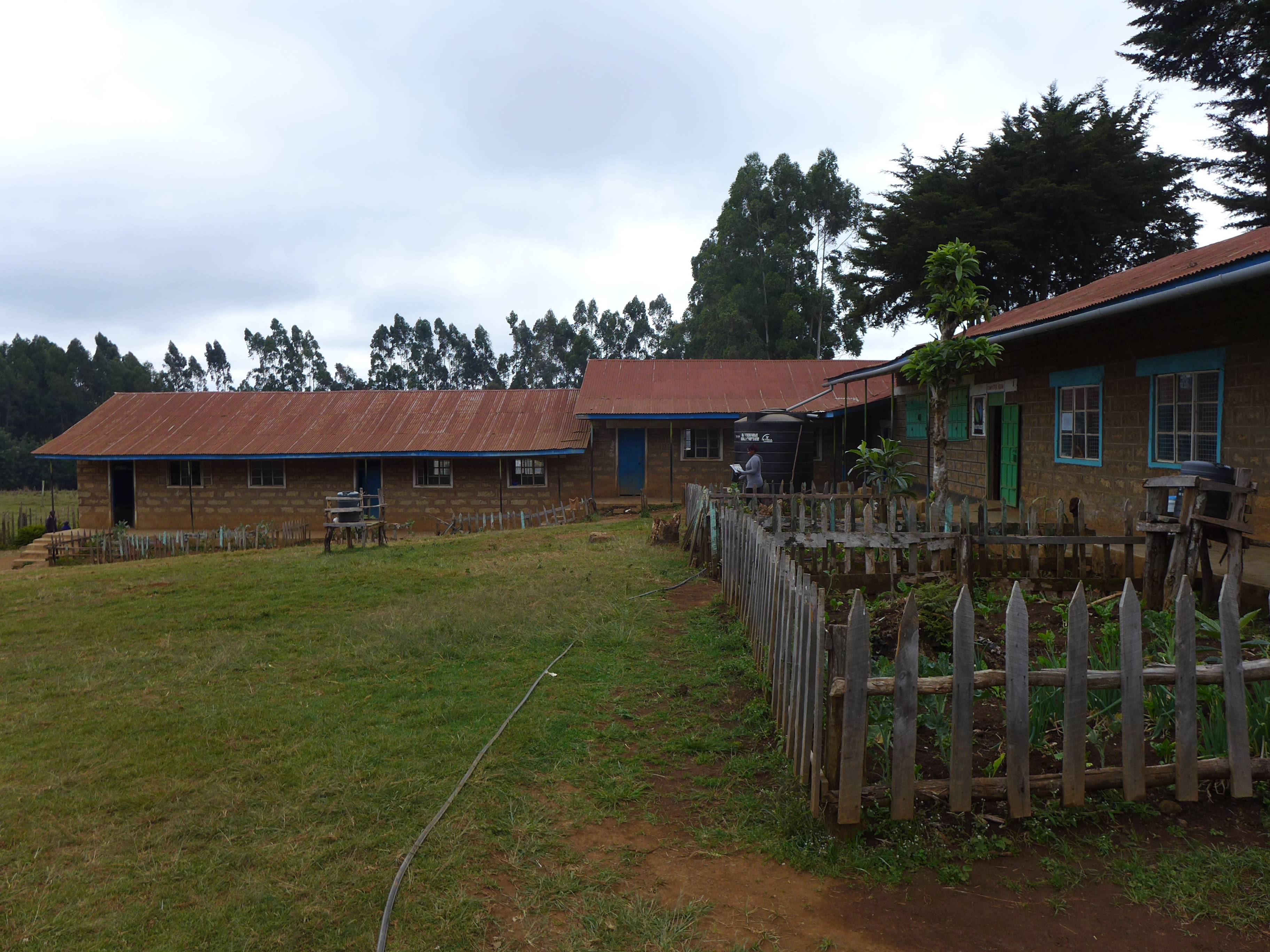
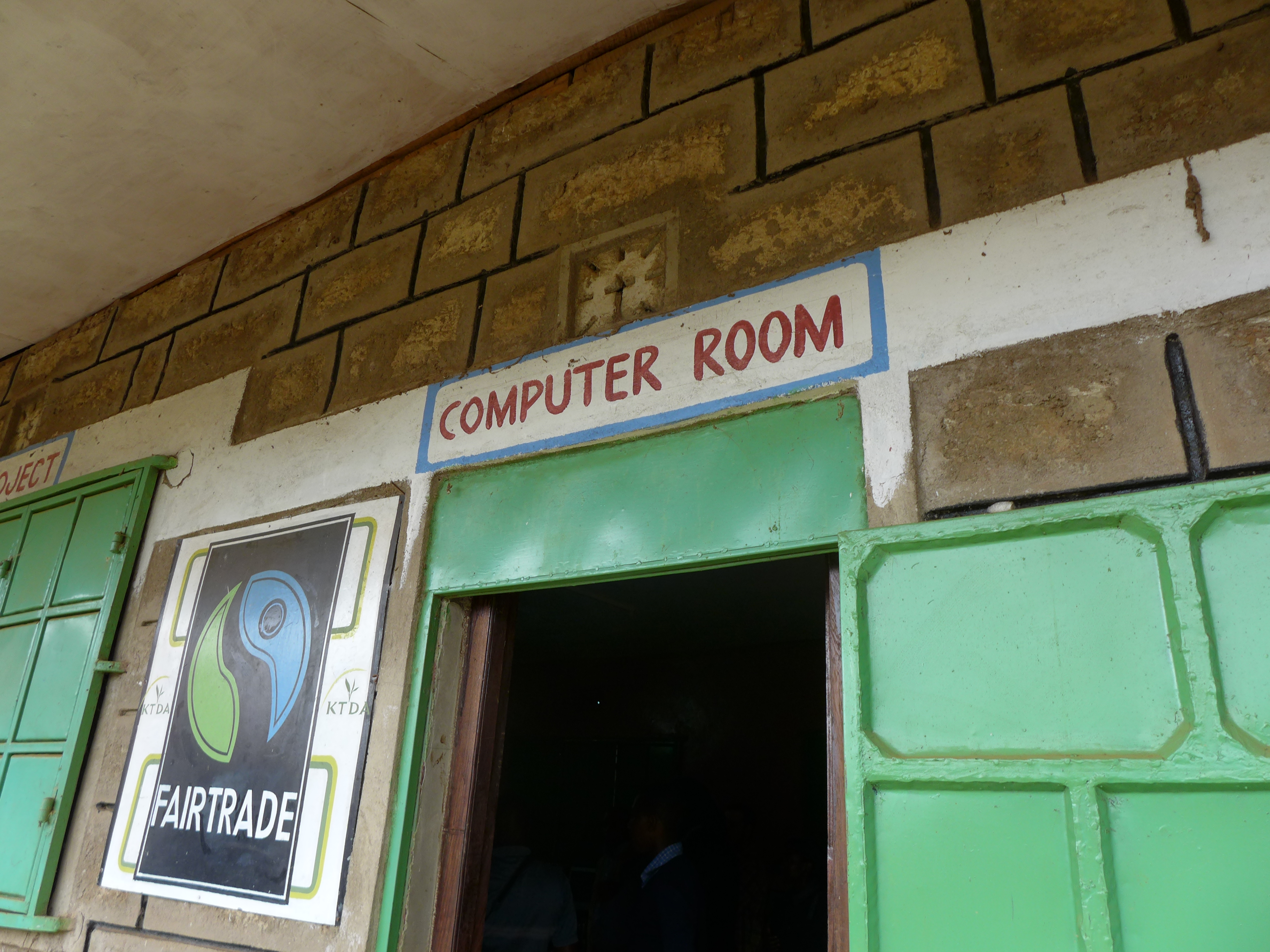
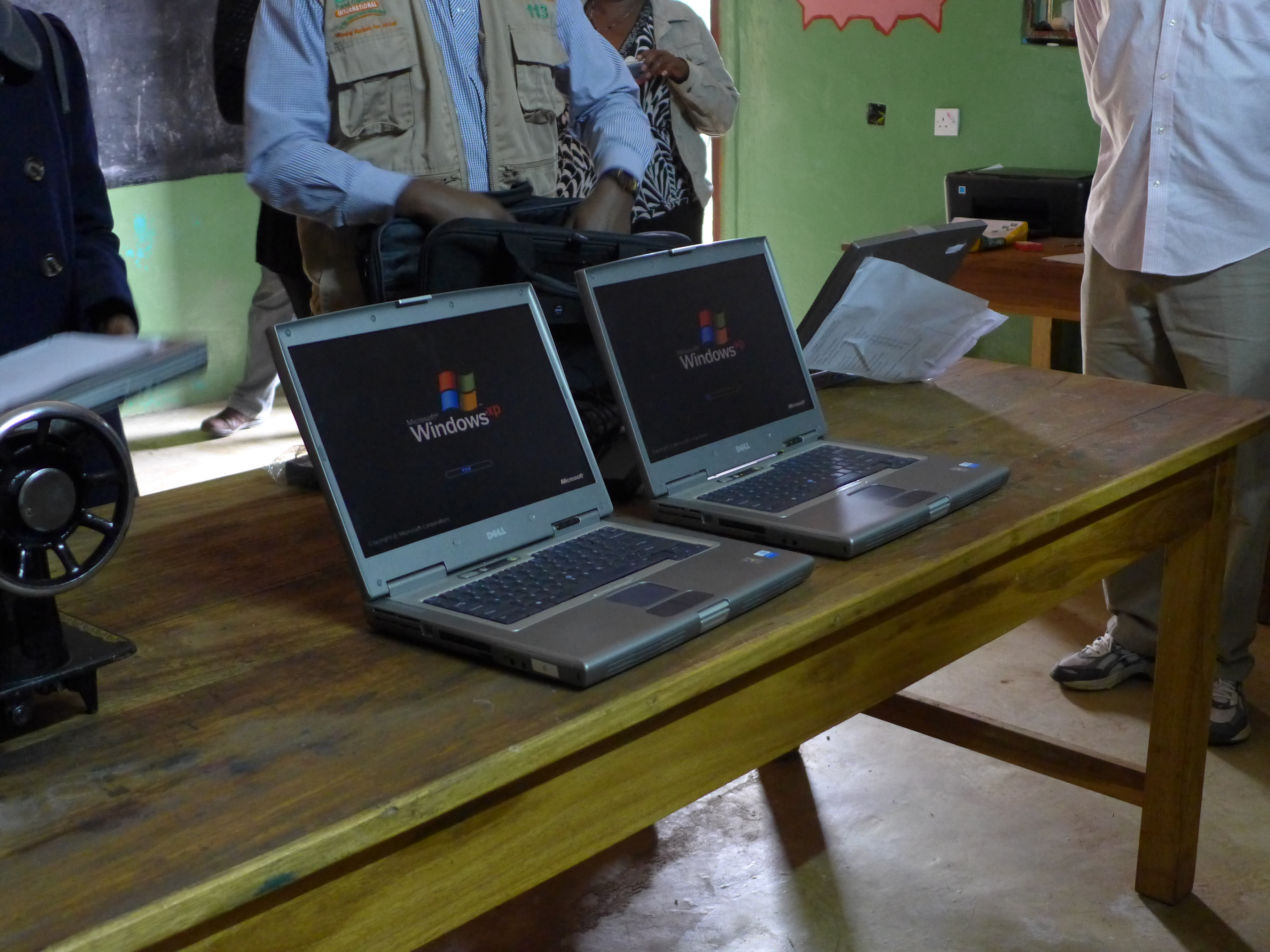
Baitigitu Primary School is about 15 kilometers on a very bumpy road outside the town of Nkubu. The red dust was on everything, including the tall banana trees aligning the road.  One wonders how they survive with such a heavy coating.  We were welcomed by the children and the Assistant Headmaster, Mwende, who immediately escorted us to the computer room.  Over time, different organizations have contributed computers and expertise.  Most of the computers in this room were still functional.  Through the generosity of others, Kinoti presented Mwende with six computers, which had been cleaned and loaded with up to date software.  A high school student from the neighborhood was utilizing one of the computers.


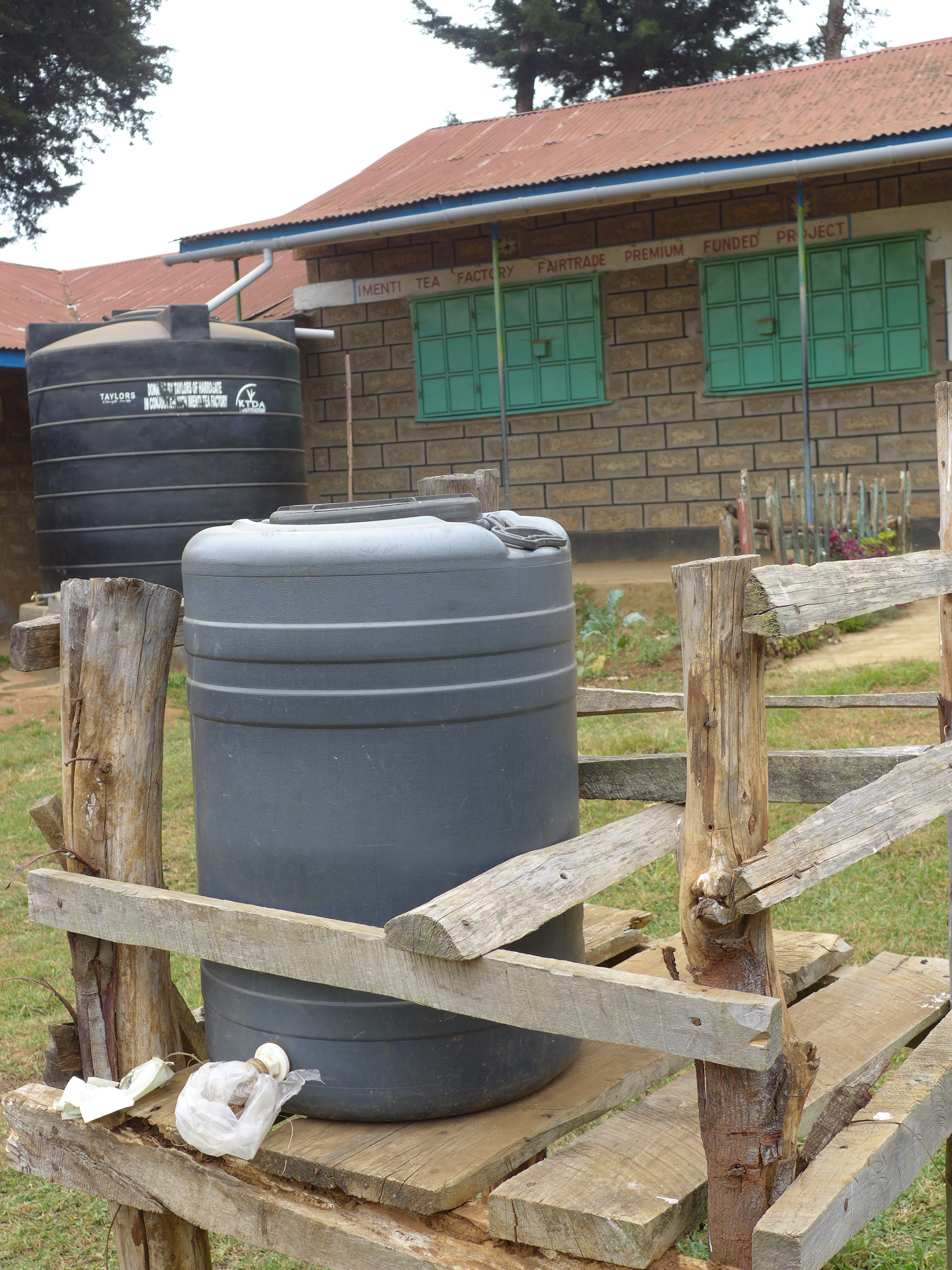
One of many handwashing stations

One of many handwashing stations


Storage tank for rain water

Storage tank for rain water


Water, toilet facilities, and sanitation are huge needs in Africa.  Especially important is the ability to wash hands frequently.  Baitigitu had many handwashing stations spread over the compound within easy reach of the children.  It is Kenya’s winter and many of the children were coughing, whether it was from illness or the persistent dust might be debatable.  I know I was personally affected by the dust and coughed frequently.  During Kinoti’s last visit, he suggested that they capture and store rainfall from the roof and use it for irrigating the nearby garden.  He was gratified that they took his advice.

The Library

The Library

The Reading Room

The Reading Room

Closed stacks

Closed stacks


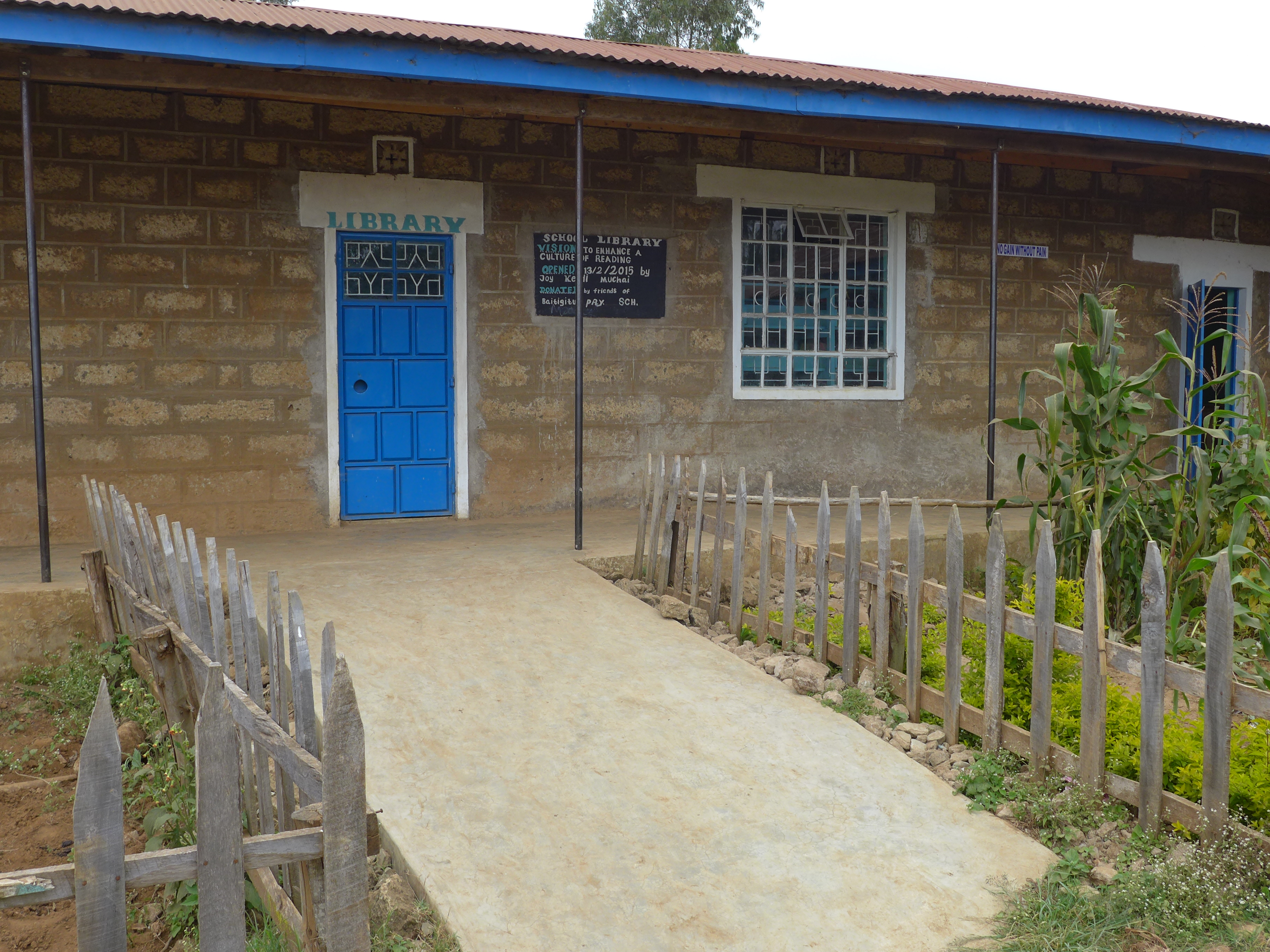
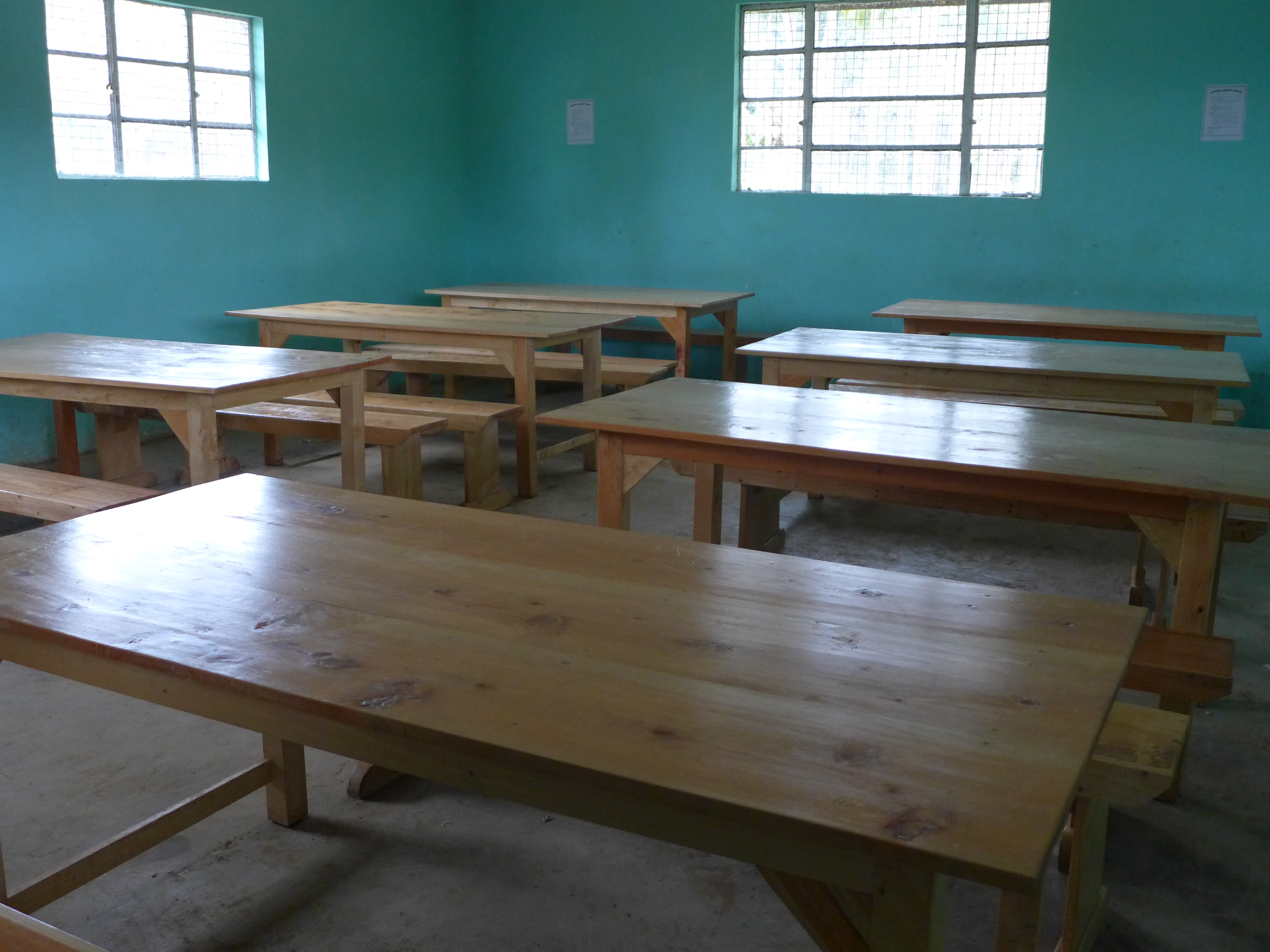
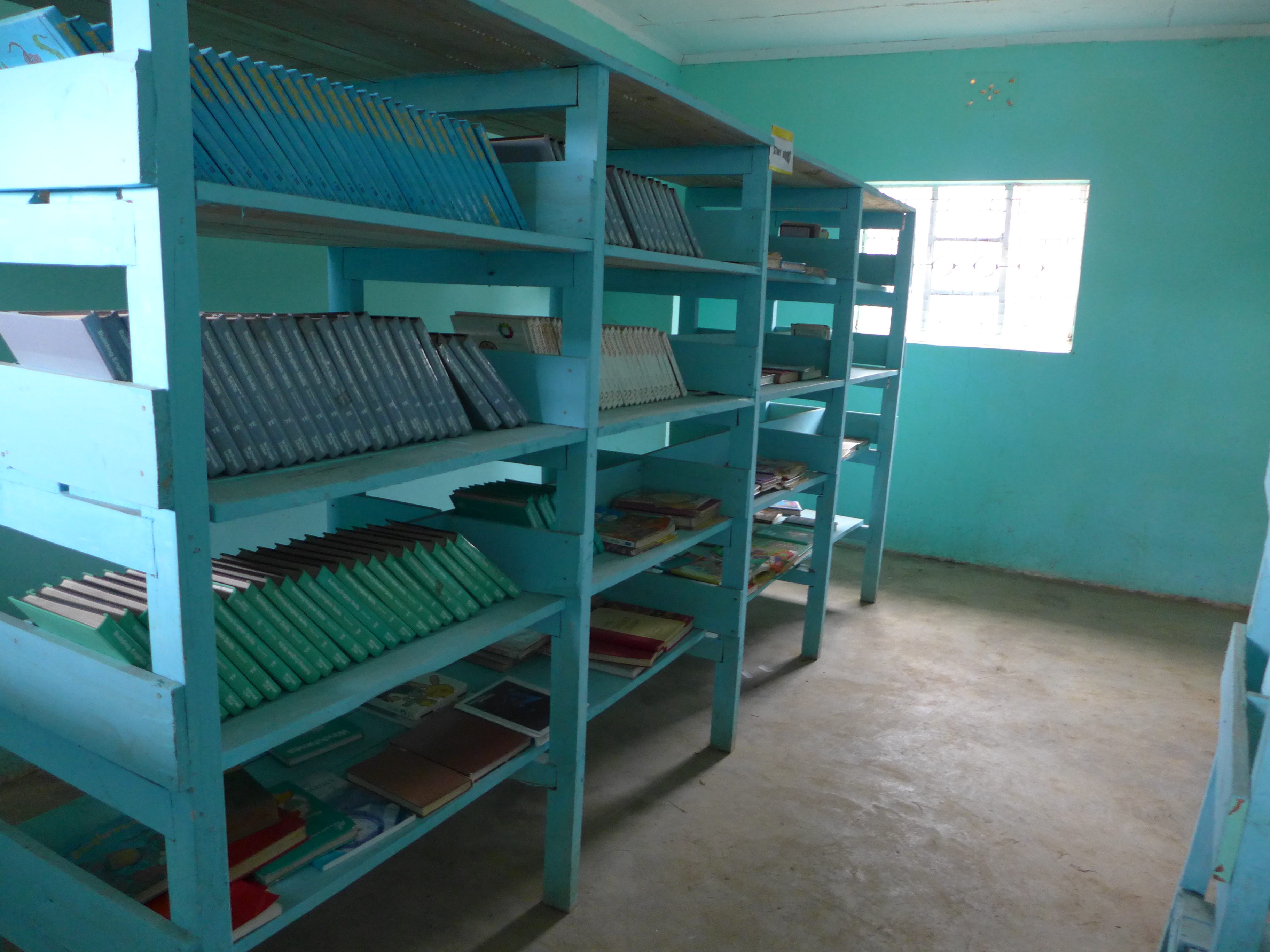
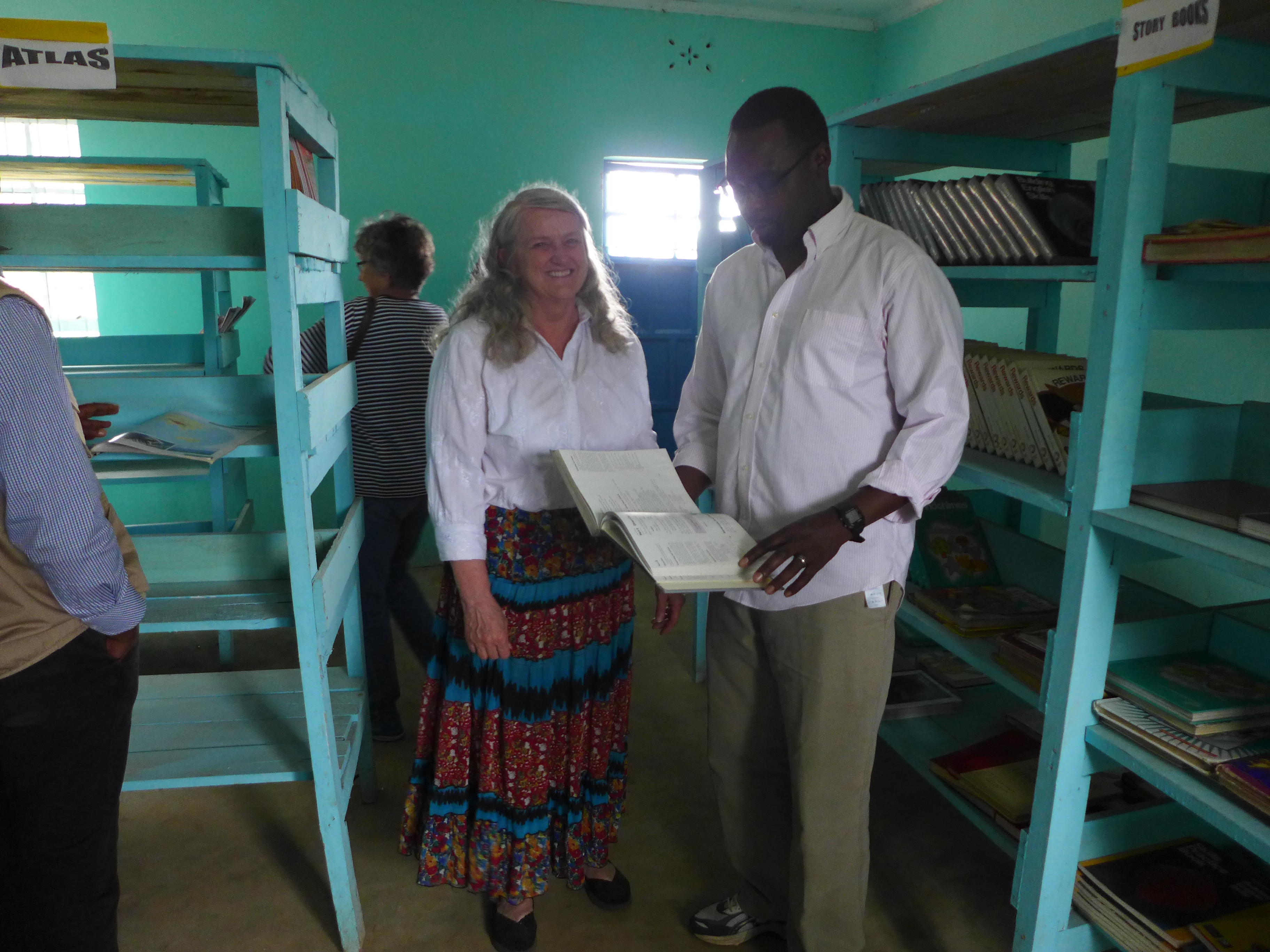
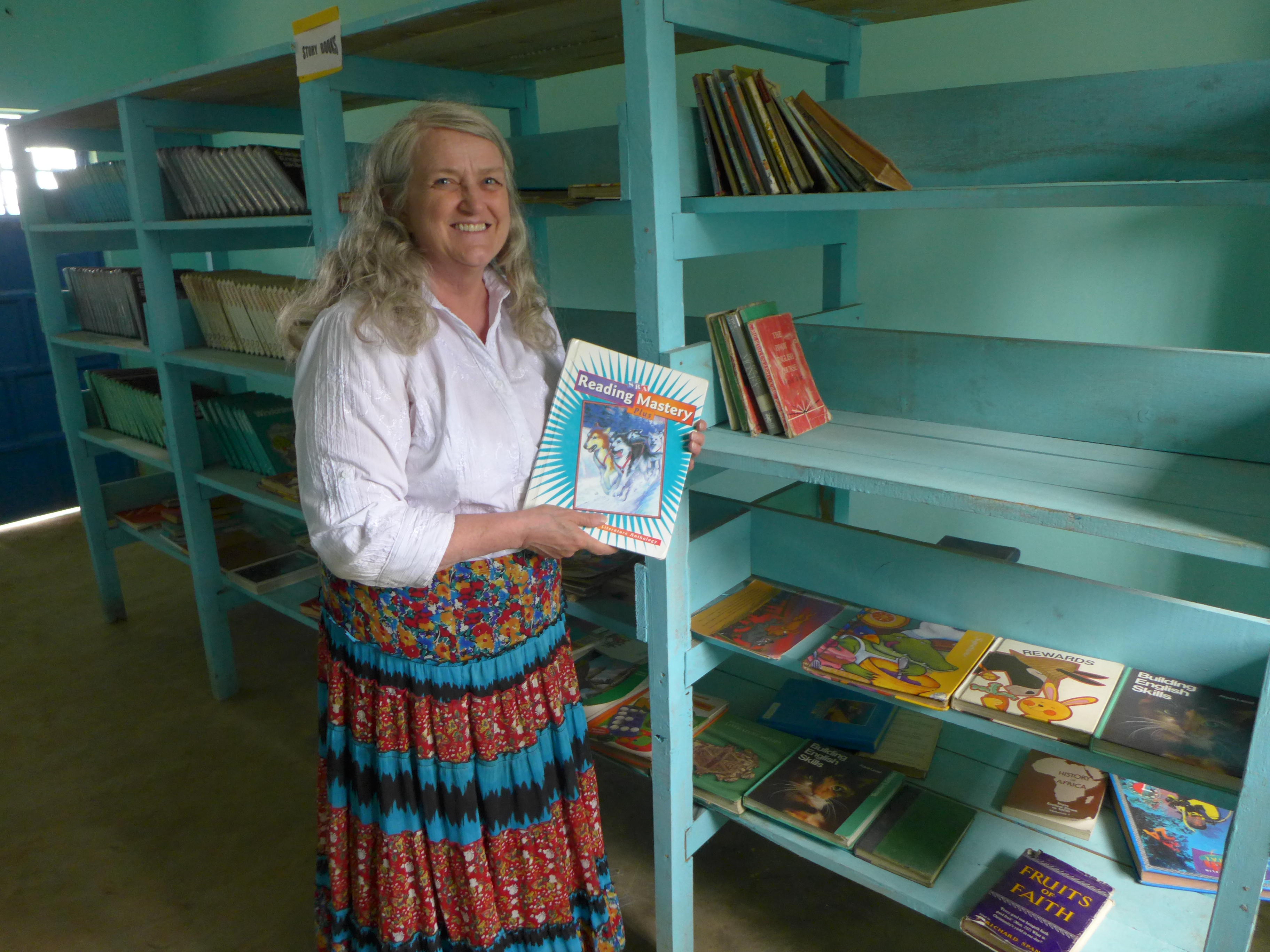
Baitigitu had a small but well maintained library, with a collection of about 500-1000 books.  It was organized by a 3rd grade student from Dallas, Joy Kendi Muchai, the daughter of a Kenyan doctor, who was also a graduate of the school. She had asked about their options for reading books and when she discovered they had none, took it upon herself to fundraise and collect books.  It does have closed stacks, but there are sturdy tables in the reading room to read the books that are fetched for them by staff.


Janet and Kinoti in the Library

Janet and Kinoti in the Library

Books

Books

Janet in the stacks

Janet in the stacks


The shelving in the library was also sturdy with ample space for growth.  The books were organized by general categories, similar to what might be found in a bookstore, and reflected the curriculum.  The shelf for dictionaries was visibly empty.  One of our future projects might be to put together a reading list of relevant books, and purchase them through an entity like Better World Books, which ships to Africa for free.


New soccer ball

New soccer ball

P1010781

Feeding program

Special Ed

Special Ed


The students, girls included, were quick to take advantage of the new soccer ball.  Since it was lunch time, many students availed themselves of a lunch of maize and beans that was served nearby.  Special needs students had their own classroom, expertly taught by a teacher.  She is working with them to develop skills such as jewelry making, but is having difficulty finding a market for the items.  Perhaps, this could be a project by the local Rotary club.  Much of her focus on students is to teach them survival skills because they are frequently taken advantage of by others.

Farewell assembly

Farewell assembly

Kinoti and son Wega speak to the assembly

Kinoti and son Wega speak to the assembly

Kinoti's wife Victoria describes her journey from Kenya to teaching in the US

Kinoti’s wife Victoria describes her journey from Kenya to teaching in the US


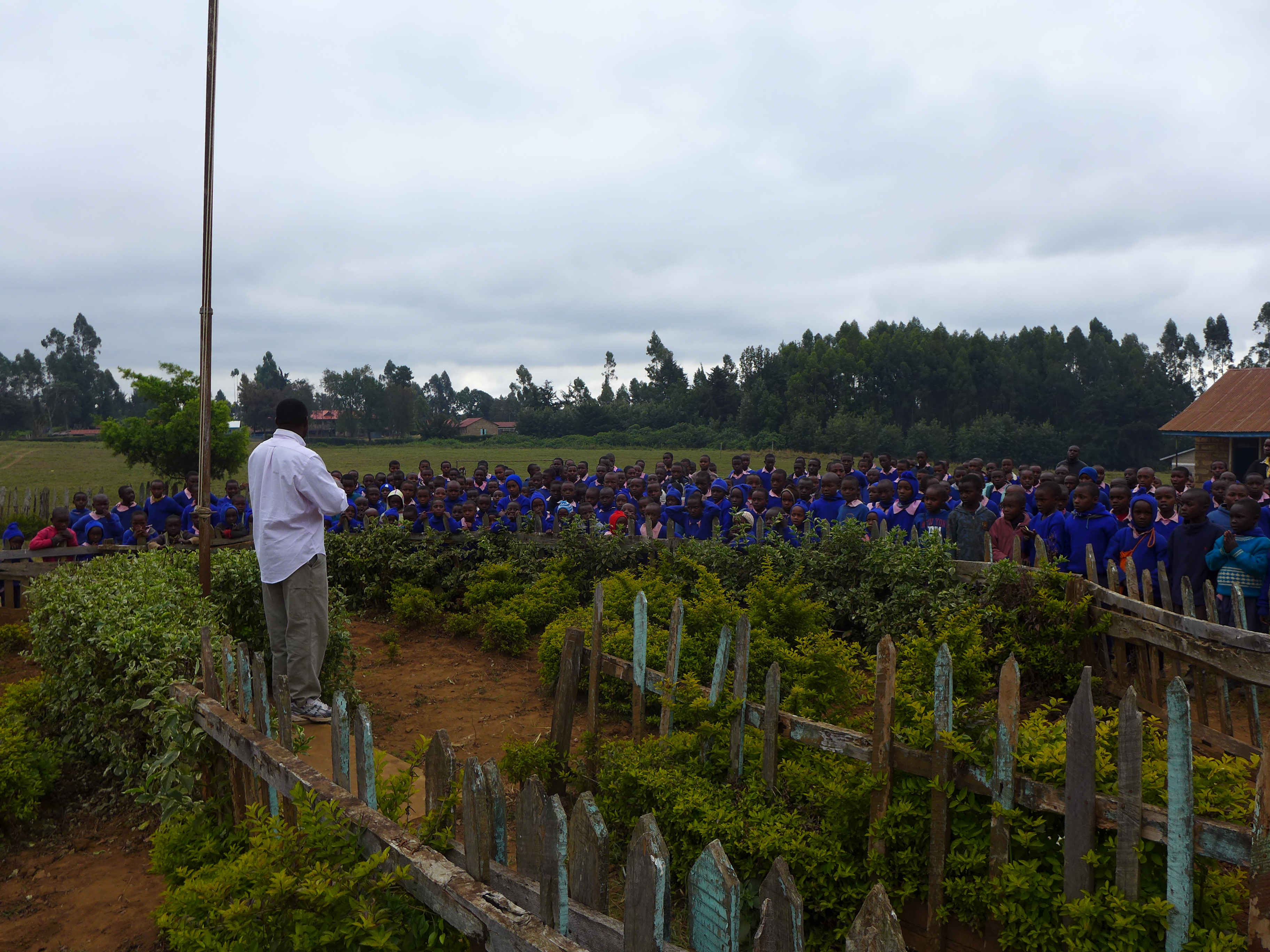
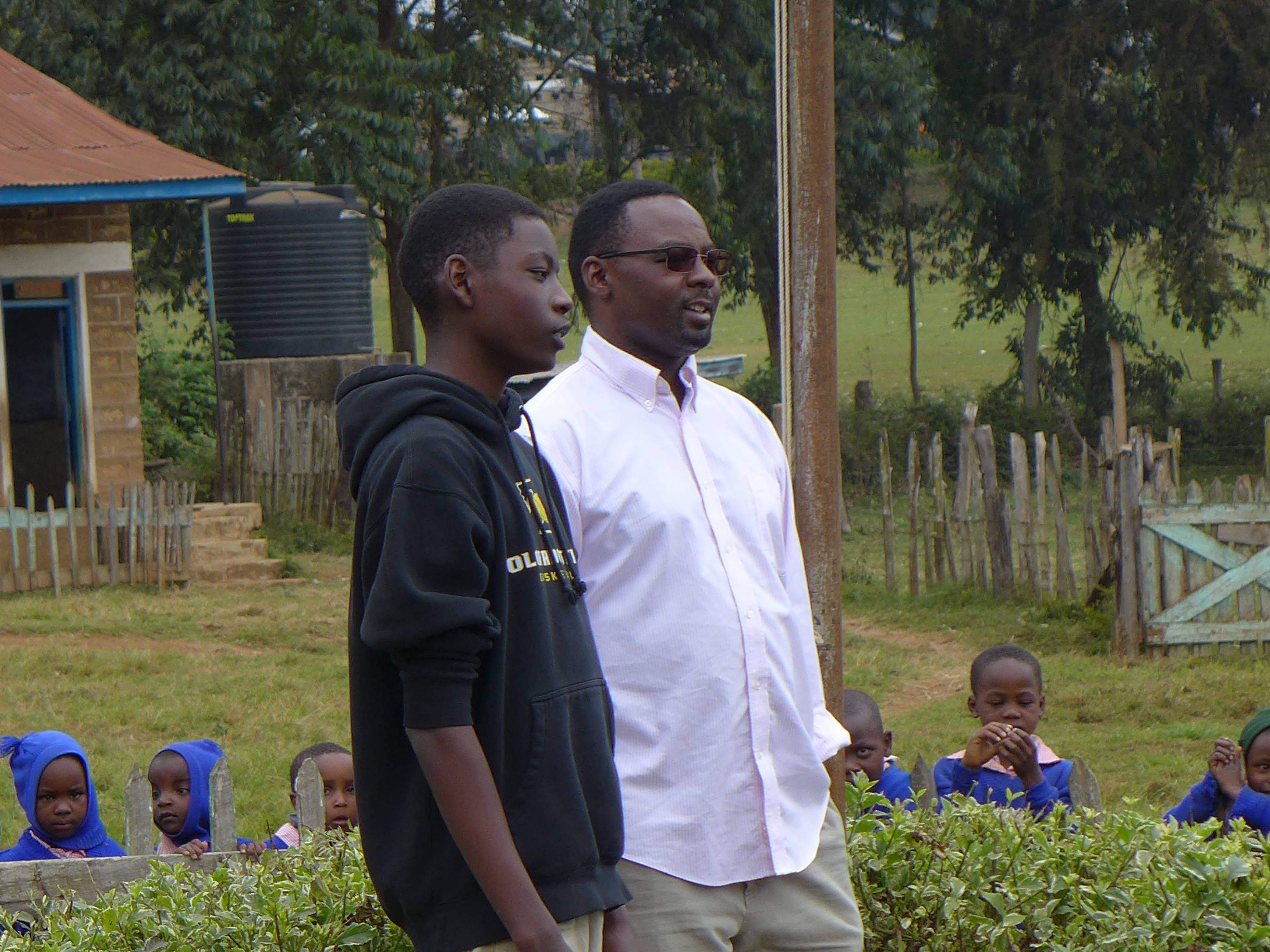
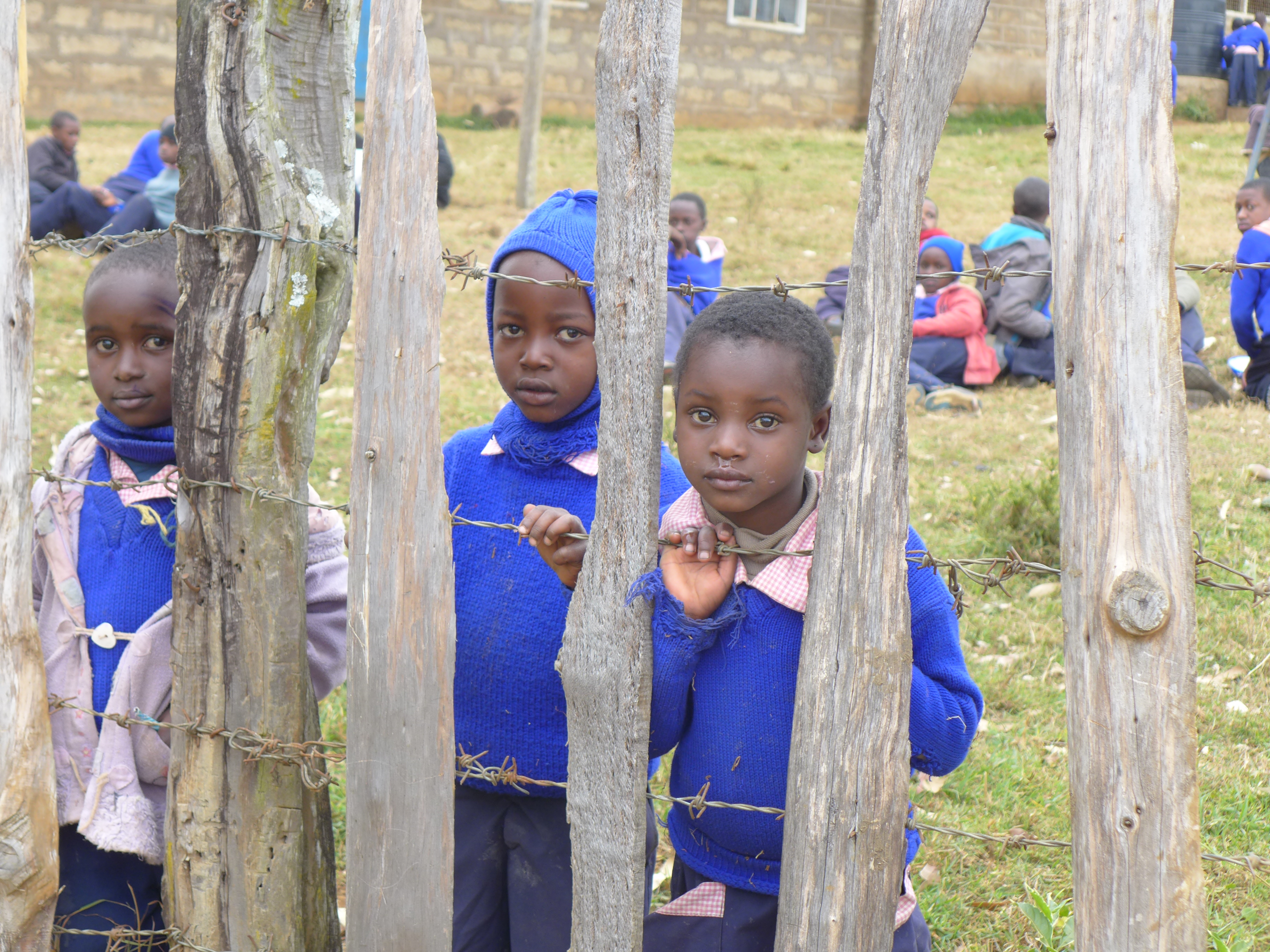
At both primary schools, we were met by an assembly of students as we departed.  Kinoti, his son Wega, and Kinoti’s wife Victoria spoke to the assembly encouraging them to study hard, stay in school, and dream for the future.  It was especially relevant since this was Kinoti’s home school.


Distributing pencils and a soccer ball

Distributing pencils and a soccer ball

Presenting books

Presenting books

Presenting books to student body president

Presenting books to student body president

More books

More books

Student body president with all of the loot

Student body president with all of the loot


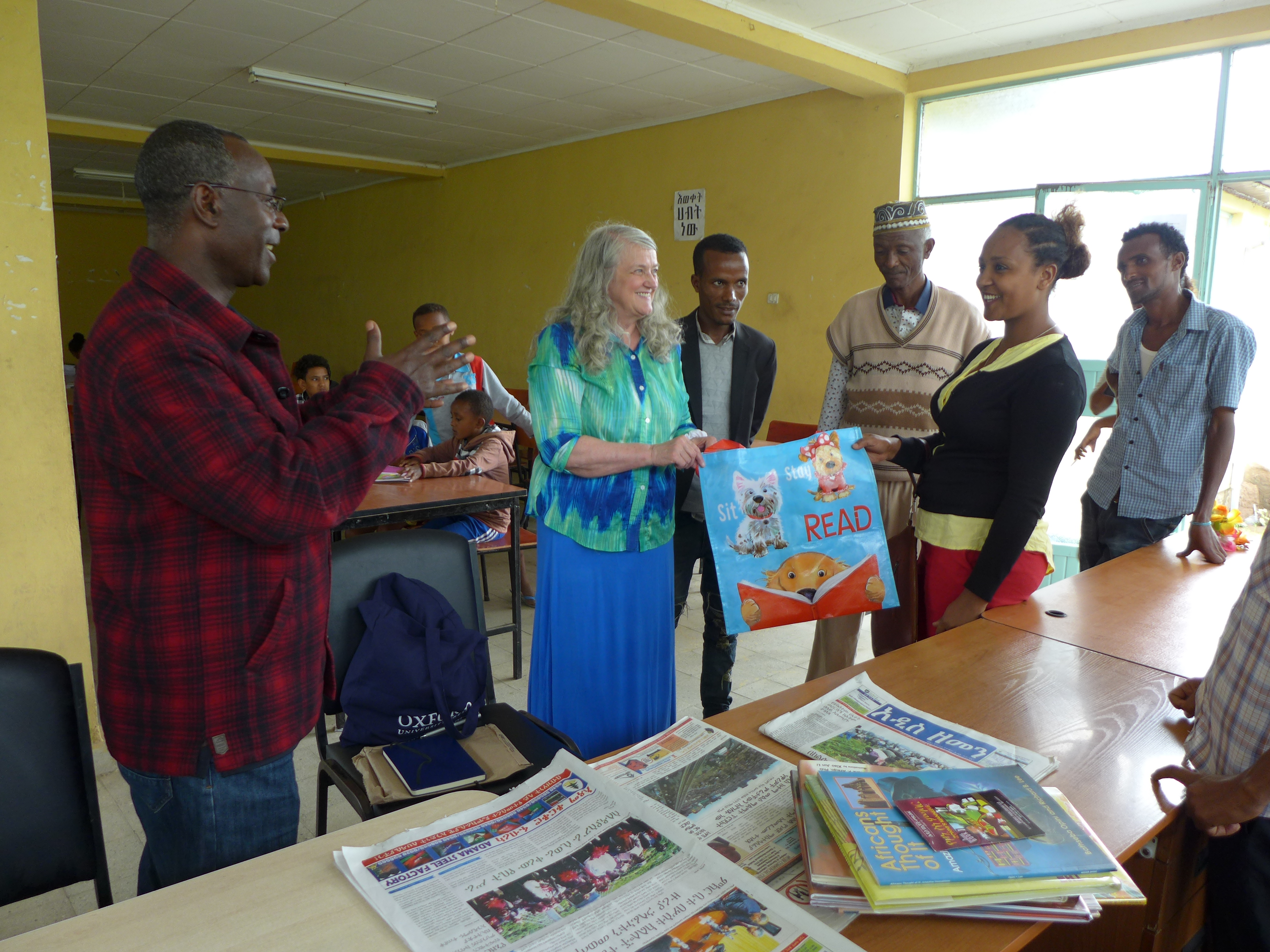
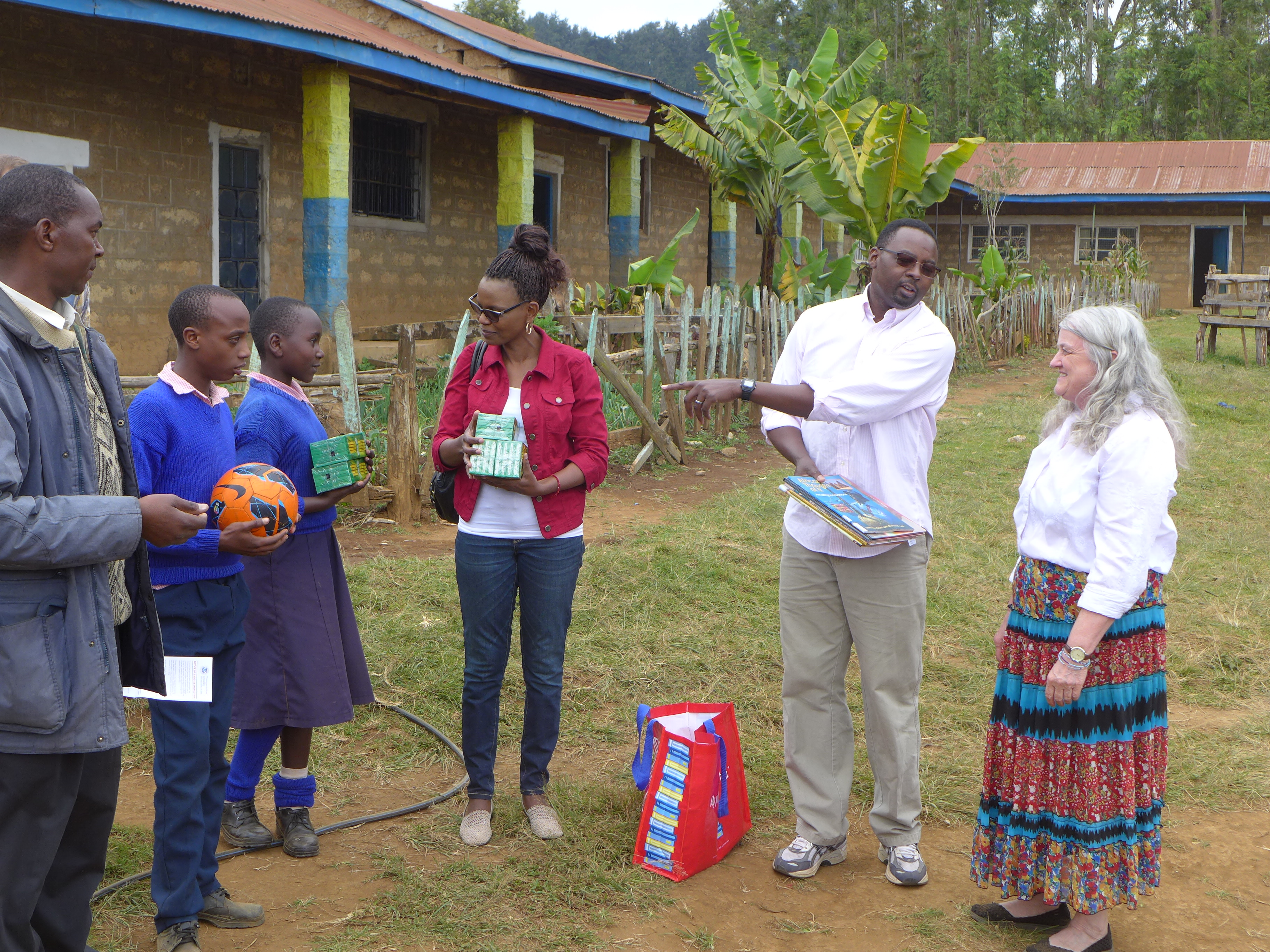
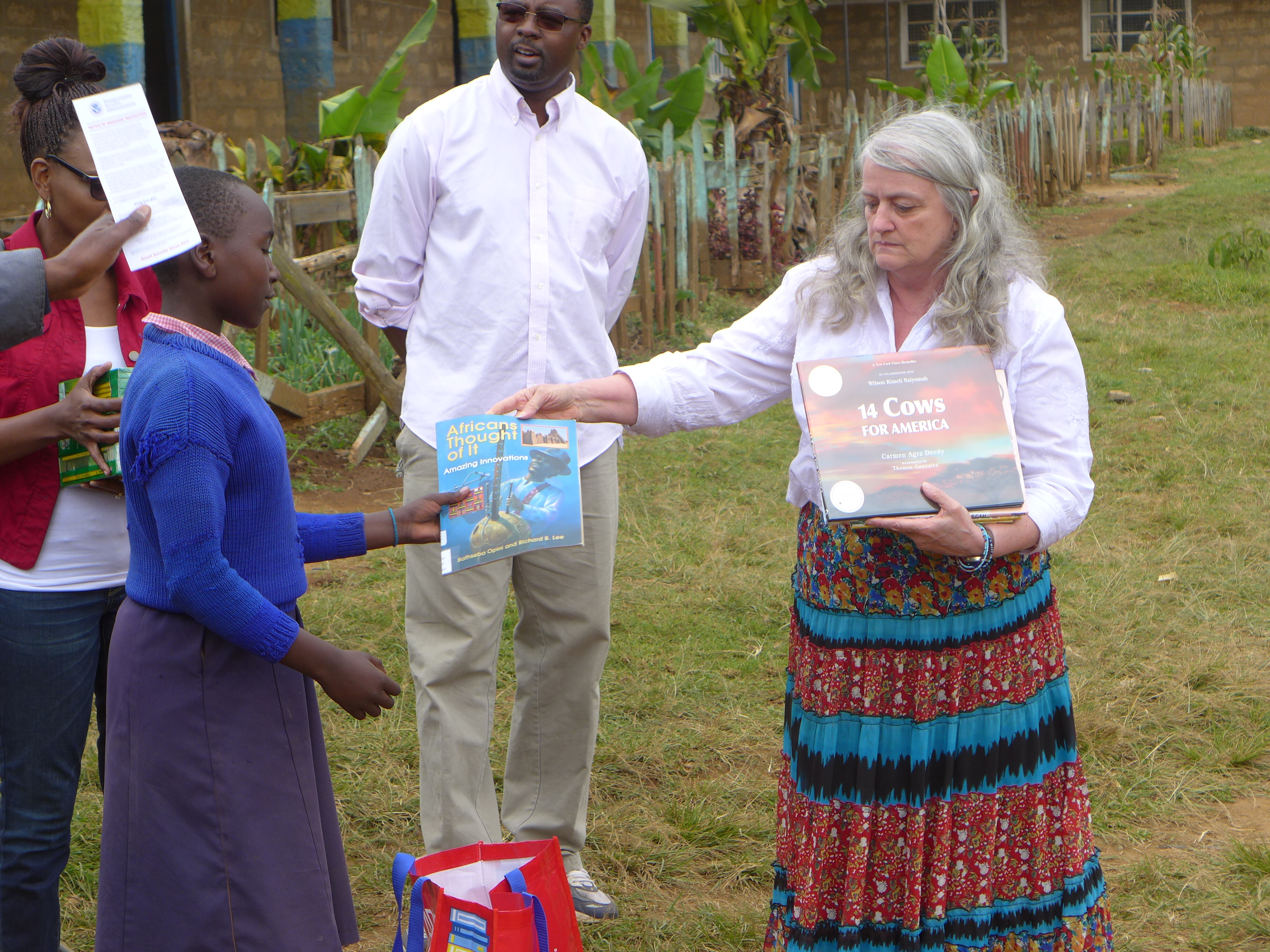
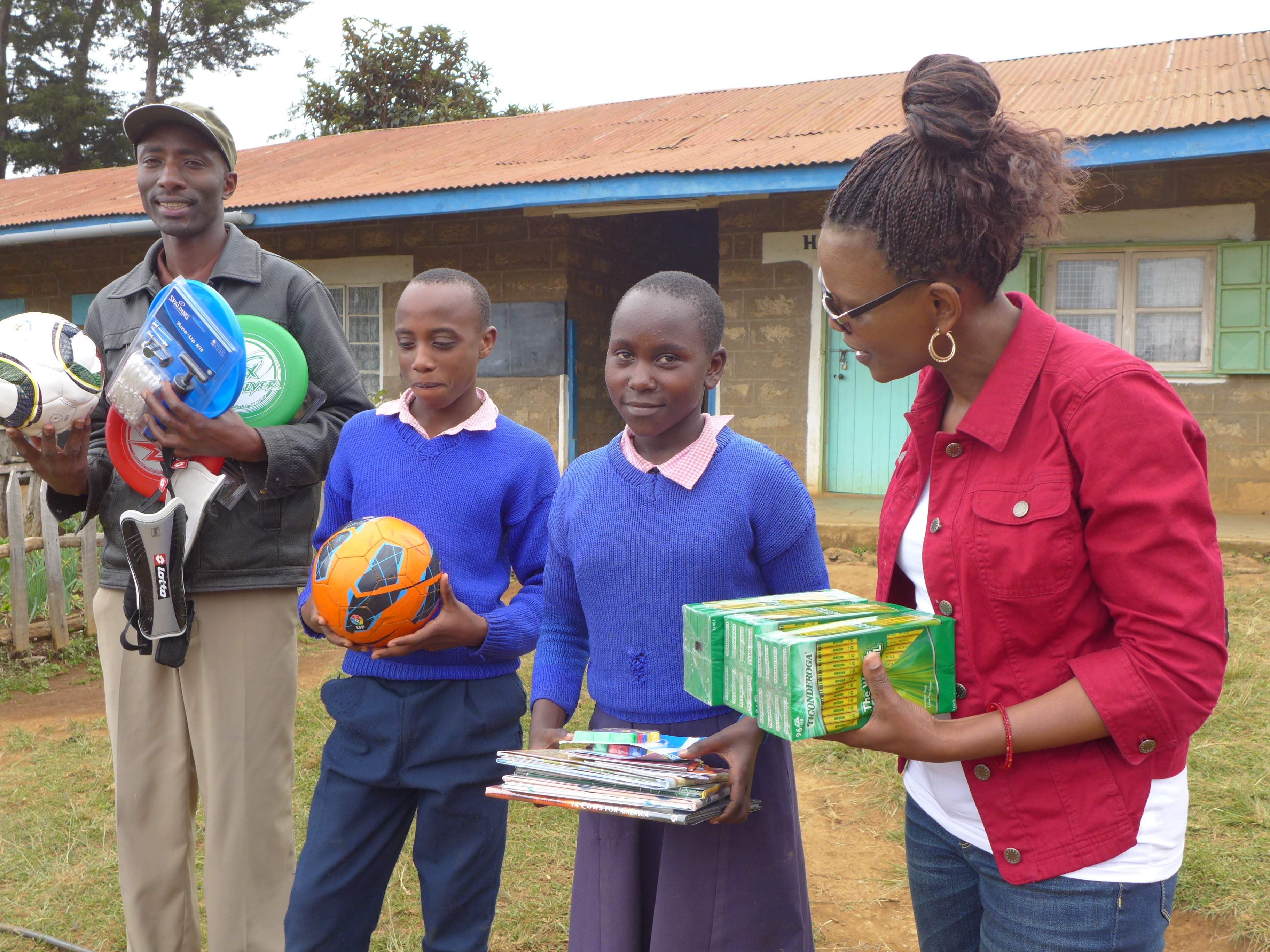
In addition to the soccer ball, we presented the school pencils and pens furnished by the Westminster (CO) Rotary, and a number of African-themed books, including two specifically about Kenya.  The special ed teacher received the large, colorful book bag.


P1010868

Kinoti takes a seat at a desk in his former classroom

At the end, Kinoti visited his seventh grade classroom, now serving one of the lower grades.  It may have been nostalgic for him, but it was an inspiration for the students.  Although this desk seems full of books, most students share their basic texts on up to a 5 to 1 ratio.  There is still much work to be done.


Final goodbye

Final goodbye

As we departed, we took a look at the adjoining greenhouse, this one actually functional and growing a variety of plants.  Kinoti took the opportunity to plant one more tree, an avocado, for the future.

It was good to be back in Africa, to visit a school similar to one in which I taught so many years ago.  Now on to Ethiopia!


Presenting at La Salle University/Universidad La Salle in Mexico City

13639526_680639638752885_5985

Tacos and enchiladas – yes, food, that’s what we all think about when we think of México. But, there is so much more to that beautiful country including great institutions of learning and libraries.

13600222_744007409072989_8591516719985841149_nLike for example, La Salle University where library personnel are doing an amazing job serving the information needs of their students and faculty.


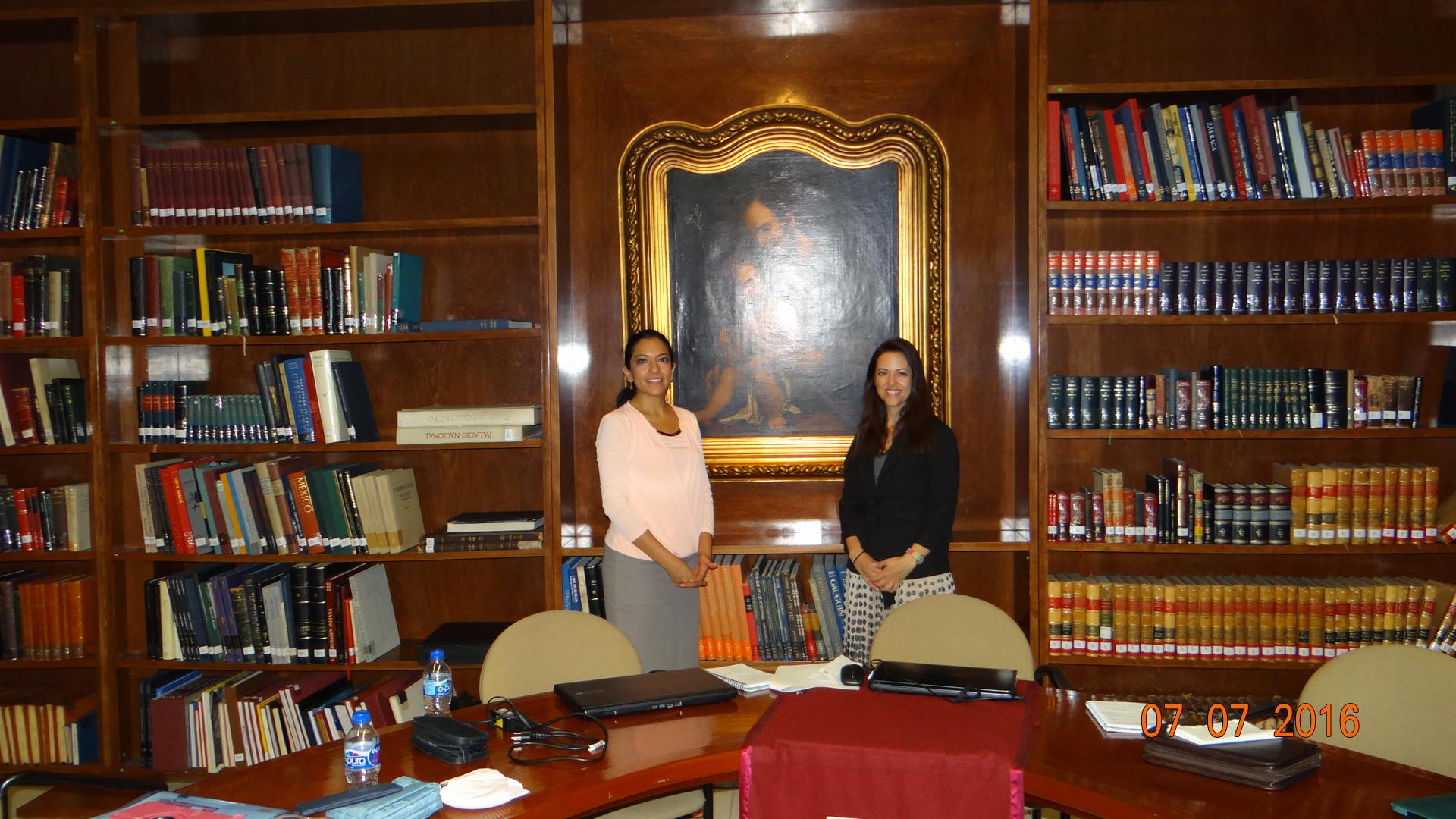
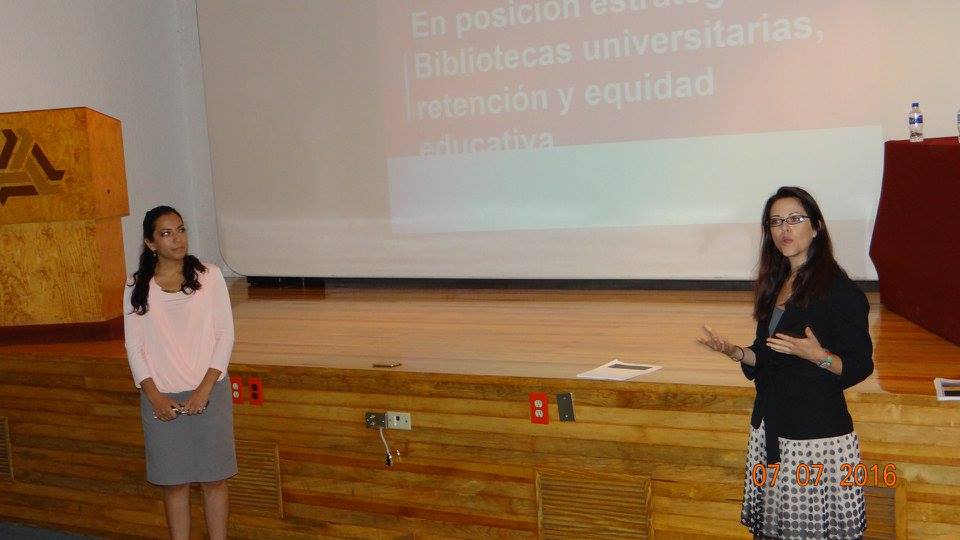
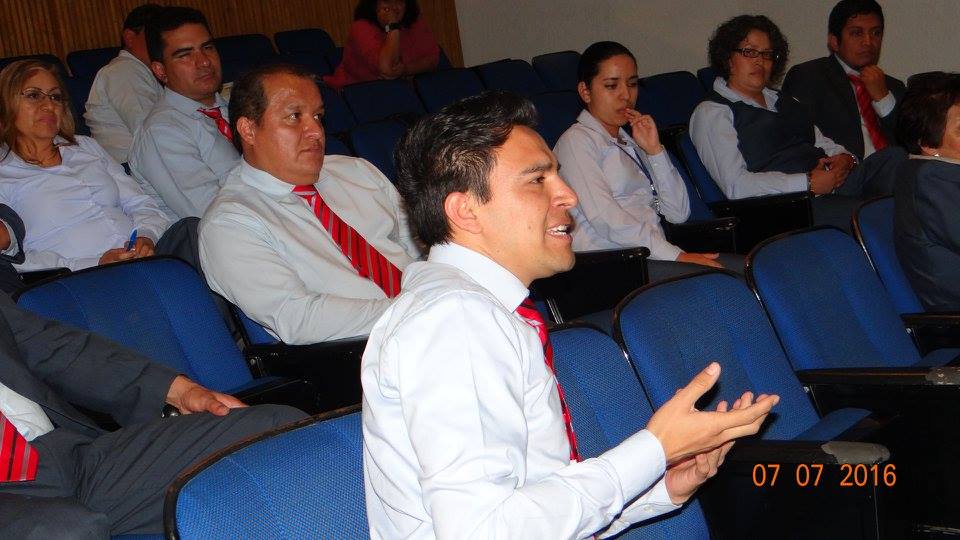
13606858_744006279073102_3802741727002554674_nRecently they invited Jimena Sagàs (Colorado State University) and Rita Puig (Regis University) to visit and present to their librarians. The presentation was attended by librarians from three institutions, including UNAM (National Autonomous University of Mexico).


13659144_744005769073153_3407112069166533412_nThe core message that Jimena and Rita tried to express was that of the academic library as a pillar of the university and an agent for social justice. A vibrant discussion followed the presentation resulting in an authentic exchange of ideas and best practices.


Some ideas were explored for continued collaboration with our colleagues in La Salle. It is certain that this is the beginning of a valuable international partnership.

13639905_680645045419011_913205113


While in Mexico City, Jimena and Rita stayed in the famous neighborhood of Coyoacán. In addition to boasting as the residence of Frida Kahlo, Coyoacán is also well known for its culinary delights. Therefore, there was no way they could return to the United States before treating their taste buds to deliciously authentic tacos and enchiladas.

Nancy Bolt receives 2016 John Ames Humphry/OCLC/Forest Press Award

Nancy Bolt

Nancy Bolt

CHICAGO — Nancy Bolt has been named the 2016 recipient of the American Library Association (ALA) International Relations Committee’s John Ames Humphry/OCLC/Forest Press Award, given to a librarian or person who has made significant contributions to international librarianship. The award consists of a prize of $1,000 and a certificate to be presented at the International Librarians Reception on Monday, June 27, at the ALA Annual Conference in Orlando. OCLC/Forest Press donated the cash award.

The ALA IRC Humphry Award Subcommittee recognized Bolt’s “undaunted passion” in making its selection, noting that her “work with local, national and international audiences has been significant and she has made a great contribution to the field of librarianship and international cooperation.” Currently president of the library consulting firm Nancy Bolt & Associates, her professional career has included stints with the Colorado State Library, the Maryland Department of Education and the National Endowment for the Humanities.

In 1996, Bolt, then assistant commissioner of education for libraries for the Colorado State Library, hosted Iska Mahailova, from the Bulgarian National Library, as part of an ALA Fellows Program. The visit launched a partnership between two countries that has continued to the present. After coordinating a series of library visits and lecture tours in Bulgaria, Bolt founded the Bulgaria/Colorado Library Partnership Project, which at its height paired 29 libraries in Colorado, Iowa and Maryland with counterparts in Bulgaria. Several of these partnerships remain active, including those between the Aurora Public Library (CO) and a library in Silestra, Bulgaria, and between the Eagle (CO) Library District and a library in Veliko Turnovo, Bulgaria. Funding from the project gave librarians from Bulgaria the opportunity to visit the U.S. and attend a major library conference.

This next stage of this partnership involved the creation of the American/Bulgarian Library Exchange (ABLE), which aimed, in part, to help Bulgarian libraries establish community information centers and encourage Bulgarian government and community leaders to increase their support of libraries. A major outcome of the project was a $300,000 U.S. Department of State grant to facilitate travel by U.S. and Bulgarian librarians and train librarians in Bulgaria.

In 2012, Bolt and a group of fellow members of the Colorado Association of Libraries began working to establish the International Library Cultural Exchange Interest Group within the CAL. Since that time, the interest group has established a grant and an award, received official Interest Group status from the CAL board, presented at the annual conferences of CAL and ALA, produced a brochure and newsletter, and hosted three international receptions at the annual CAL conference.  The interest group has also worked to establish Sister City partnerships and launch the first CAL-sponsored international library tour.

As adjunct professor at Emporia State University (Kansas) School of Library and Information Management, Bolt conducted the 2015 course Current Issues in Global Information Infrastructure: Bulgarian Libraries, Archives, and Special Collections, which included ten-day trip to Bulgaria featuring visits to libraries and cultural sites.

Bolt has also contributed to the International Resources and Exchange (IREX ) Project, funded by Bill and Melinda Gates Foundation to establish evaluative criteria for library computer centers in Romania and Ukraine. She is co-author of “Community Based Librarianship; A Manual and Planning Tools,” published in both English and Bulgarian. Her professional service includes serving and chairing the International Relations Committee and the International Relations Round Table, and chairing several IFLA committees, including the Strategic Planning Committee, Government Libraries Section and the IFLA Division 2 Coordinating Board.

Two Colorado Universities Receive Grants to Promote Cultural Understanding

The Colorado Association of Libraries and the International Library and Cultural Exchange Interest Group is pleased to announce that University Archives at Colorado State University-Pueblo and the University Library at the  University of Colorado at Boulder have both received grants of $1500 for programs that enhance cultural understanding.

The CSU-Pueblo Archive’s project will support an exhibit and public presentation relating to La Cucaracha, a project focusing on the Chicano Movement in the San Luis Valley.  The traveling exhibit and presentation will include enlargements of newspaper articles, excerpts from oral history interviews, and artifacts highlighting issues such as bi-lingual education, land grant  disputes, discrimination in Pueblo schools, the student movement at CU-Boulder and CSU-Pueblo, and access to health care for Hispanic populations in Pueblo.  The exhibit will be on display at the CSU-Pueblo library and then travel throughout the state.  A panel discussion about La Cucaracha will be hosted by CSU-

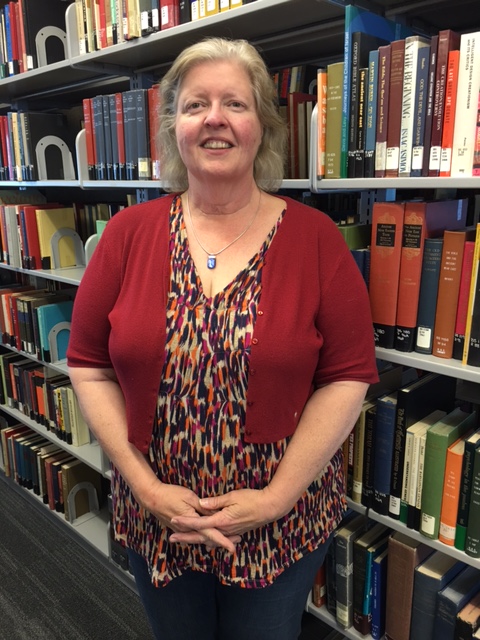
Beverly Allen

Beverly Allen

Pueblo, including people interviewed for the project and Project Director, Jose Ortega, will take place during Hispanic Heritage Month. University Archivist, Beverly Allen, said “This grant will help further the Archives mission to preserve the ethnic heritage of Southern Colorado and to educate Colorado citizens about a little known, but important, part of history.”


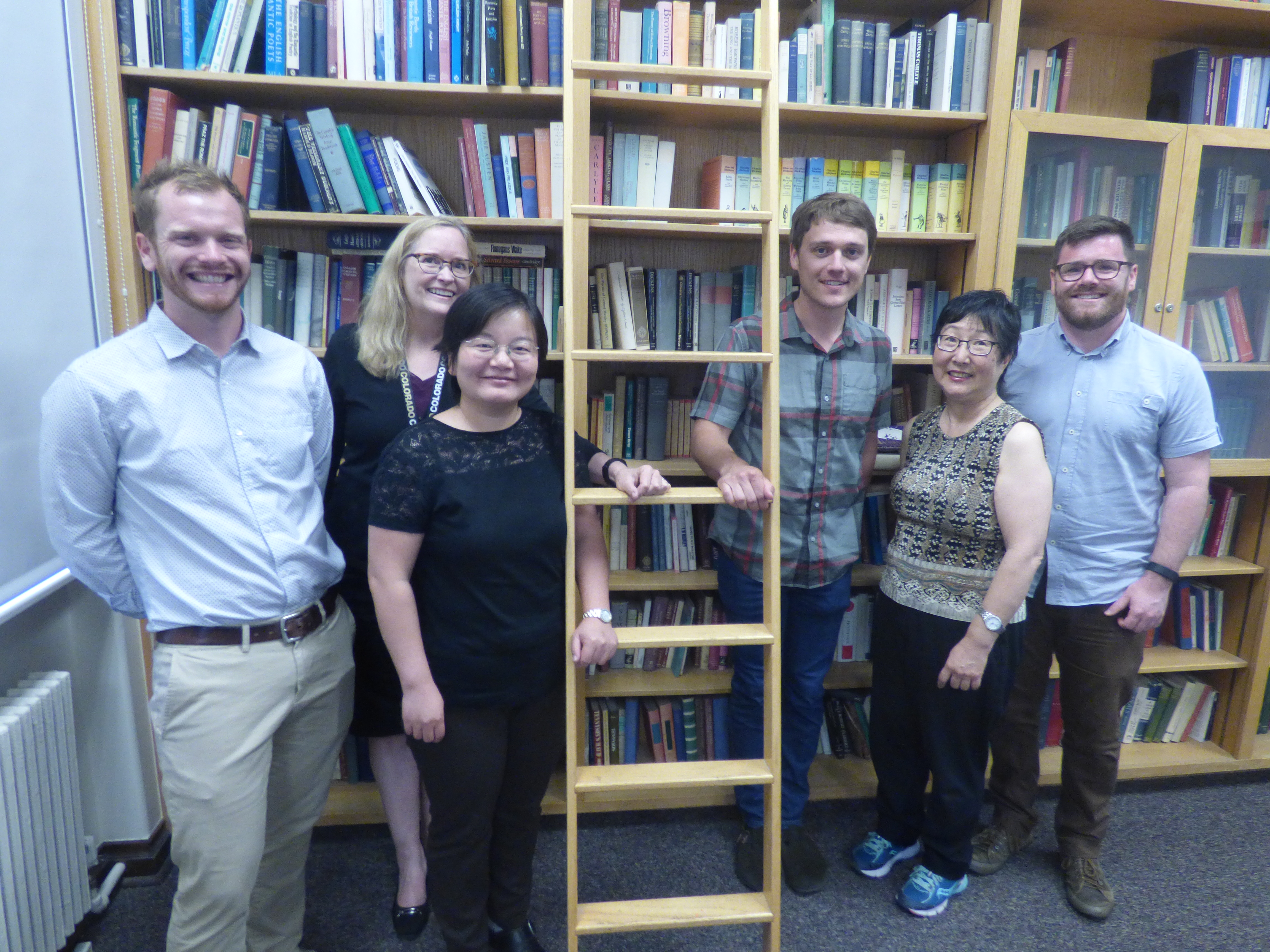
The University of Colorado at Boulder project seeks to strengthen existing relationships and form new partnerships with international students and student organizations. In the fall of 2015, CU Boulder had a total of 2446 students from over 100 countries.  The library recognizes a need to promote intercultural understanding and inclusivity by creating programs that foster student engagement, belonging, and participation to embrace the

Philip White, Xiang Li, Beth Dalton, Benjamin Hall, Carol Siu, Mark Locy

Philip White, Xiang Li, Beth Dalton, Benjamin Hall, Carol Siu, Mark Locy

evolving culture at CU.  The university library will be working with the Office of International Education, the Office of Diversity Affairs, the International Student and Scholar Services, and the Cultural Unity and Engagement Services, and the Cultural Unity and Engagement Center.   The project will include activities such as an international photo contest on “Libraries and Information Landscapes,” an international talent show, and “speed friending.”  Beth Dalton, Outreach and Services Specialist at the library said:   “The University of Colorado Boulder Libraries are grateful to ILCE-IG for its generous grant, which will support new international programming within our library system.”


The Colorado Association of Libraries International Library and Cultural Exchange Interest Group (ILCE-IG) has two main goals: to support individual and library partnerships and activities that enhance cultural understanding and to support cultural programming and activities that celebrate ethnic and immigrant cultures in Colorado. Janet Lee, Chair of the CAL Interest Group said:  “We are pleased to provide these grants to UC-Pueblo and CU-Boulder.  They help us to further our goals and promote the understanding of all the vibrant cultures that live and visit Colorado.”

For further information, contact Kathy Plath at Interest Group <cal.ilceig@gmail.com>

For PDF version of news release, click here

Nancy Bolt named the recipient of the Elizabeth Futas Catalyst for Change Award

Nancy Bolt, 2016 recipient of the Elizabeth Futas Catalyst for Change Award

Nancy Bolt, 2016 recipient of the Elizabeth Futas Catalyst for Change Award

Nancy Bolt named the recipient of the Elizabeth Futas Catalyst for Change Award


From the ALA Press Release:  March 15

CHICAGO – Nancy Bolt, of Nancy Bolt & Associates and retired Colorado State Librarian, is the 2016 recipient of the American Library Association (ALA) Elizabeth Futas Catalyst for Change Award. This award is given biennially to an individual for making positive changes in the profession of librarianship and consists of a 24K gold-framed citation and $1,000 contributed by the Elizabeth Futas Memorial Fund of the American Library Association.

“The jury that selected Nancy Bolt as the recipient of the 2016 Elizabeth Futas Catalyst for Change Award was highly impressed with her wide range of accomplishments and contributions to the profession, all of which underscore her keen ability to bring about innovation and positive change in our field,” said Kevin Reynolds, award jury chair. “She challenges and inspires, and she repeatedly shepherds into reality programs that some might think difficult, if not impossible, to achieve.”

Throughout her distinguished career, she has been a thoughtful and effective leader whose work has been infused with creativity, calculated risk-taking and skilled strategic planning. Woven through all this are her natural talents for mentoring and collaboration. Among the vast array of truly groundbreaking efforts that Bolt has led is the co-creation of the ALA-APA Library Support Staff Certification Program, which provides a practical curriculum that has allowed numerous library support staff to advance in the workplace. Bolt also made significant contributions to the success of the E-Rate program when she chaired the first ALA E-Rate Task Force. Additionally, work that Bolt carried out ultimately contributed to the Bill and Melinda Gates Foundation funding the Broadband Technology Opportunities Projects, which had a profound effect on libraries across the country.

As Colorado State Librarian, Bolt reorganized and improved the regional library system in the face of significant budget cuts. She also championed the Colorado Library Card, which centered on collaboration between public, academic and school libraries throughout the state. Knowing there would be great benefit to libraries and library users in Colorado, she succeeded in establishing the program despite initial hurdles. These examples, as with all her work, illustrate how she keeps the needs of library users in focus while bringing about change to improve their experiences and access to information.

“Thanks to her tireless efforts, Nancy’s reach truly has been global,” Reynolds reported. “Her extensive work with libraries in Bulgaria is a significant example. For almost a decade, she has helped librarians there improve services and resources for the public after the dissolution of the Soviet Union left them in dire need.” Reynolds added, “As one letter of support noted, in Bulgaria, ‘Nancy is a national hero.’”

She has held numerous prominent leadership positions in state, national, and international organizations. These include several roles in the Colorado Library Association, as well as president of PLA, president of ASCLA, service as an ALA Executive Board member, ALA Council service, and numerous roles in IFLA, including as a member of the IFLA Governing Board.  She has also authored a large number of influential publications. In all her work, we see her signature tireless effort to guide positive change thoughtfully and carefully.

Members of the 2016 Elizabeth Futas Catalyst for Change Award Jury are: Liz Bishoff, The Bishoff Group, LLC, Evergreen, Colorado; Karen E. Downing, University of Michigan, Ann Arbor, Michigan; Phyllis D. Fisher, Copiague, New York; J. Kevin Reynolds, Chair, Wofford College, Spartanburg, South Carolina; and Ann K. Symons, Douglas, Alaska.  The Futas Award will be presented on Sunday, June 26, at the ALA Annual Conference in Orlando, Florida.


Grants Available to Promote International Librarianship and Cultural Understanding

Grants Available to Promote International Librarianship and Cultural Understanding

The Colorado Association of Libraries (CAL) International Library and Cultural Exchange Interest Group (ILCE-IG) is offering two grants of $1500 each to promote international librarianship and cultural understanding.   The deadline for the grant proposals is May 15, 2016 with the award announced in July, 2015.

There are two overarching purposes of the grants:   Support individual and library partnerships and activities that enhance cultural understanding and support cultural programming and activities that celebrate ethnic and immigrant cultures in Colorado

Individuals and all types of libraries that are members of CAL are eligible to apply for these funds. Projects are encouraged that:

  • support collaborations between a library in Colorado and one in another country designed to increase cultural awareness, understanding, and exchange
  • A Colorado library event designed to celebrate ethnic and immigrant cultures
  • A Colorado individual’s efforts to establish or help maintain a library in a country with underdeveloped libraries

Two grants are available for an amount up to $1,500 per grant.   ILCE-IG prefers, but does not require, that one grant be made to support international librarianship and one to support cultural understanding among different groups in a library’s service area.

Application instructions and an application form are available at https://ilceig.wordpress.com/grants-awards/.  Grant applications and any questions should be sent to Kathy Plath at Cal.ilceig@gmail.com. The deadline for grant application is midnight, May 15, 2016.  Grants will be awarded on July 1, 2016.   Grants may begin on August 1, 2016 and must be completed by September 1, 2017.


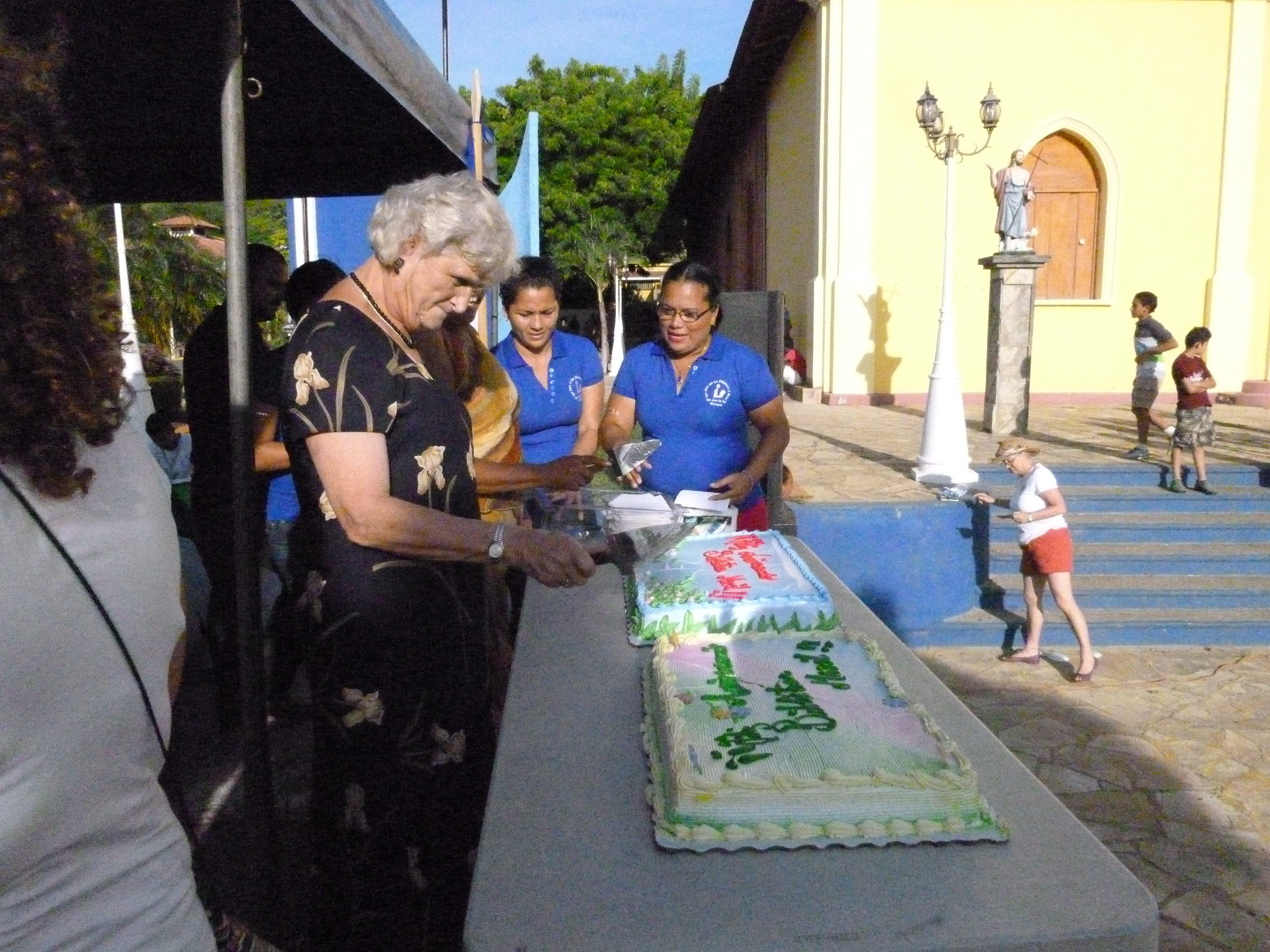
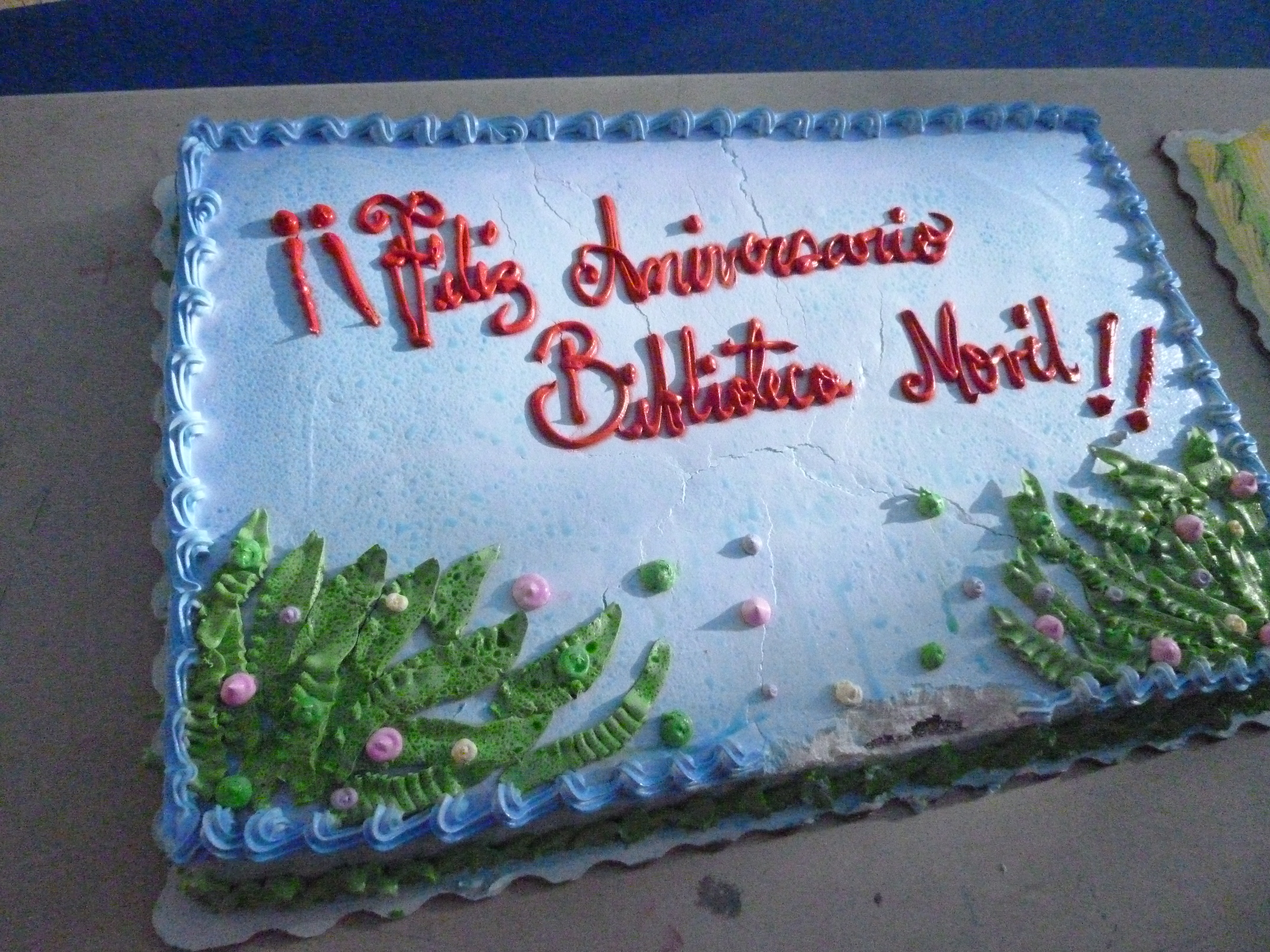
Poems in Celebration of the 14th anniversary of the Biblioteca Movil in San Juan del Sur Nicaragua


In celebration of the 14th anniversary celebration of the San Juan del Sur Biblioteca Movil

In celebration of the 14th anniversary celebration of the San Juan del Sur Biblioteca Movil


Biblioteca Móvil,

“Gracias”


Es hermoso pensar

Que un día como hoy tú naciste,

Es hermoso imaginar,

Que este cuento si existe,


Muchos te imaginan,

Como un lugar aburrido,

Yo te veo como la casa de mi mejor amigo,

Donde la fantasía puede jugar,

Y el amor y la sabiduría nos van a visitar,

Hoy,

Es por eso que te quiero, felicitar,

Y las gracias infinitamente dar

Gracias…,


Porque con tus bellos consejos

Llenos de sabiduría,

Transmites conocimiento,

Y lecciones valiosas en la vida,

Gracias por haberme acogido estos

Catorce años,

Y llenado mi ser de mucho entusiasmo,


Po la lectura

Que nace de un hermoso ser

Que te vio a ti nacer,

Y convertirte en una señorita

¡Biblioteca Móvil Felicidades!

Ya eres una señorita (14 años).


Coralia Elizabeth Coronado Amador

Colegio: INEMYR


Biblioteca Móvil,

Thank you, 

It is beautiful to think

That a day like this you were born

It is beautiful to imagine

That this story does exist


Many imagine you

Like a boring place

I see you as a place -my best friend

Where fantasy can play,

And where love and wisdom will visit us today


That is why I want to congratulate you

And infinite thanks give,

Thank you…,


Because with your beautiful advice

Full of wisdom,

You transmit knowledge,

And valuable life lessons,

Thank you for accepting me these fourteen years,

And filling my being with much enthusiasm,

For reading,

That is born of a beautiful being

That saw you be born

And see you turn into a young lady

Congratulations Mobile Library!

You are now a young lady (14 years of age).


Feliz Aniversario

Feliz Aniversario

Biblioteca Móvil

Visitan diferentes centros de estudios,

 regalándonos su tiempo, enseñanzas y alegrías,

a todos los niños y niñas que a diario,

salimos de nuestras casas para alimentar nuestras almas y vidas.

Gracias por compartir sus libros, libros que leemos

con tanto entusiasmo, libros que nos trasladan

 a mundos desconocidos,

 libros que nos hacen vivir historias tan maravillosas,

 que nos hacen reír, sonar y a veces hasta llorar.

Biblioteca Móvil, bienvenida seas siempre.

Muchas bendiciones de parte de todos los alumnos y padres

Gracias por incluirnos en sus planes,

Gracias por todo lo que nos comparten para seguir

Siempre en la búsqueda del saber.


Mobile Library

They visit different learning topics,

Giving us the gift of time, teachings and joy to all the children who

Leave their homes daily to feed our lives and souls

Thank you for sharing your books

Books that we read eagerly with enthusiasm

Books that take us to unknown worlds

Books that allow us to live marvelous stories

Stories that make us laugh, dream, and even cry at times

Mobile Library, you are always welcome in our hearts

On behalf of all your students and their families:

Thank you for including us in your plans

And for all that you share with us on

The everlasting journey of knowledge

-Ana Katiuska Martinez Reyes, 2nd Place

Click on link to see the colorful original poem:   Nicaragua poetry contest winner

Johannesburg and Cape Town, South Africa: Reflections of an Emporia Student

Johannesburg and Cape Town, South Africa: Reflections of an Emporia Student

by Beth Denker, Emporia State University, SLIM, 2015

In November 2015, twelve Emporia State University students and two professors travelled to Johannesburg and Cape Town, South Africa for a Masters in Library Science class on the Impact of Libraries and Archives in South Africa. The trip included several library and archives visits and multiple cultural activities. Readings and discussion boards were completed for the class prior to the trip with the focus being the history and current state of libraries in South Africa. Additional components of political and cultural readings provided context to prepare us for this experience. The trip started in Johannesburg and Pretoria and ended in Cape Town. This blog post contains some short reflections from this trip.

At the National Library of South Africa (NLSA) in Pretoria, we were graciously welcomed and treated to formal presentations that detailed many of their initiatives. It was great to hear how they work to benefit library services in South Africa and their initiatives are modern and informed in library theories. They highlighted access to the internet and grant funding received from the Gates Foundation to get internet access at more of the libraries in South Africa. They are also working to print more books in some of the eleven official languages of South Africa at the Centre for the Book. They took suggestions from their communities on what books were classic to their tribes or community and then they selected books, worked to get copyright permission, worked with translators and the families of the authors to produce satisfactory translations, and printed the translated books. We also received a tour of the NLSA building that included the various library areas and services they offer in addition to back areas where we saw some fascinating digitization and preservation projects.

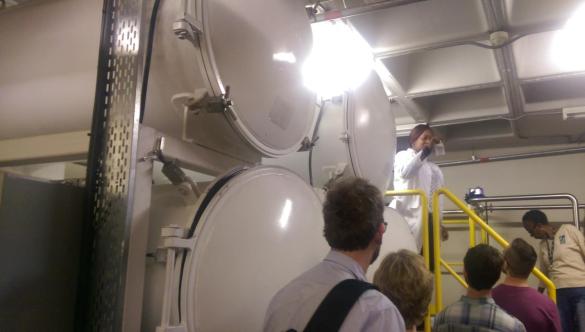
Deacidification equipmentDeacidification equipment for book preservation at NLSA.

The Library and Information Association of South Africa (LIASA) has offices in a building on the NLSA campus. The current LIASA President, Segametsi Molawa, spent time with us at NLSA and spoke with us about how LIASA supports librarians in South Africa and the challenges they face. She is a great advocate for librarianship, LIASA, and International Federation of Library Associations and Institutions (IFLA). We were given a tour of that building and met the staff. They had gift bags for us, as did NLSA. NLSA provided a light lunch with tea at the end of the tours.

We were welcomed into the Innovation Studio at the Rosa Parks Library in Soweto. This library is a project of the U.S. Embassy and serves the local community. The room is newly remodeled and includes a 3-D printer and several computer workstations with specialized software. The focus is on entrepreneurship and building skills such as graphic design, web design, and software expertise in young South Africans. Unemployment in South Africa is very high, so these skills are one way that young people in Soweto might create their own jobs and start businesses that will eventually contribute to the community and economy. The librarians there clearly care about providing access to the resources that make it possible to learn these skills. The Innovation Studio also provides a great meeting space for workshops they have been sponsoring.

At Constitution Hill, the use of art and personal narratives was effective to allow us to relate to what prisoners experienced at this prison. The level of human rights abuses and degradation were appalling and really drove home why apartheid was such a terrible time period. We were also able to go into the Constitutional Court building and courtroom. Our guide talked about the design being inclusive of all in the country but allowing each group to maintain their identity. There were also themes of transparency and building from the past, and all of this was in such stark contrast to what we just saw documented from the prison.

The Johannesburg Public Library visit had many comparisons and contrasts to public libraries here in the United States. They are trying to do so much with so little and doing their best. Materials are scarce, so they hold onto everything they can. The African Studies room was newly opened and it was quite a beautiful room with a lot of resources available. I liked their signage as it did not just list the Dewey Decimal call number range, but also some subject headings that would guide users in browsing. In the music area, the librarian pointed out that they host music lessons on Saturdays and there was a beautiful piano. The newspapers and periodicals room was really busy with users, as were all of the computers in the library. This is a great library for the community and offers many services which are sorely needed.

Dutch BibleDutch bible from the 16th century stored in the sublevels at the Johannesburg Public Library.
At the Apartheid Museum, there was a special exhibit called “Ahmed Timol: A Quest for Justice”. This exhibit highlighted how police during that time were killing people reporting the deaths as suicides. When you are an oppressed people and those that are in power are committing heinous acts, you have no recourse to try to get resolution until power changes hands. Even now, there are many people in South Africa who have not had their questions answered regarding what happened to their loved ones.

We met with representatives of the non-profit Room to Read. It is inspiring that they get so much buy-in from the communities and schools to support the program before they implement it in a community. They spend time training and mentoring teachers to be effective teacher librarians. In the US, it might be easy to take for granted all of the support systems that are in place to encourage literacy in young children. It is remarkable what it takes to start this support structure where there has been no support in the past.

The Cape Town Public Library was a contrast to the Johannesburg Public Library, so I was glad we visited both. They took considerable time to talk about how they function, their challenges with governmental support, what they offer, and the other 205 libraries in their province. They discussed how they prioritize where to spend grant funds, but when buildings are falling apart, the money does not go nearly as far as you think it might. It was interesting to hear about how they advocate for the library to elected government officials. I loved the art library area with displays and art on the walls and the gallery above where they are planning on having art exhibitions. This library was also incredibly busy. We visited the American Corners Library within the Central Branch of the Cape Town Public Library. They were closed for a remodel and were set to re-open in a few weeks. This project was geared towards study abroad and entrepreneurship skills. They have test study books (e.g., LSAT, SAT), an iPad bar, a great makerspace with an audio booth, and a meeting room.

The experience in the prison at Robben Island was much different for me than Constitution Hill. Former prisoners give the tour of the prison and they speak from their own experience. This makes it easier to connect with on a personal level, but I wondered how traumatizing it might be to start working at the place where you were a prisoner. I was struck by how the people stuck to solidarity to enact change and how that is still happening in many ways in South Africa. Our guide spoke about how prisoners planned for the future government and constitution at Robben Island and how they always worked towards a consensus. This set up an atmosphere of inclusiveness from the beginning. Nelson Mandela and many of the other prisoners made conscious decisions to defy the government or commit acts that they knew could get them thrown in jail and possibly even killed. They were willing to sacrifice years of their own freedom to try to create a better world for future generations, with no assurance that things would eventually change.

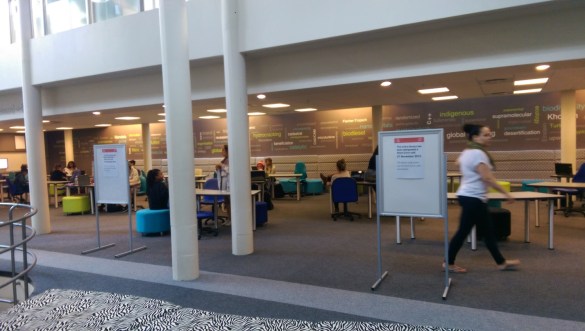
At the University of Cape Town Library, they were in the midst of finals. There had been protests about a raise in tuition a few weeks earlier so I was surprised that the student population seemed to be fairly affluent, but many of the students were protesting because it would be unaffordable for some. This main library was quite nice and fairly recently remodeled. There are eight other branches on campus that focus on specific subject areas, plus the Archives. Much thought had been put into various areas and uses of this library. There was a lot of cool art on display and I was impressed by all of the types of study areas (desks, carrels, slanted desks, a room filled with desktops for computer work, other areas with computers that were more private, group work areas, comfy chairs, individual rooms that were first come-first served, a business corner with dedicated computers for specific databases). There were elevators and ramps in all areas of the building to provide easy access and two large 24/7 study areas. All students have to badge in during library and non-library hours and security guards are on duty. The issue of security with metal detectors for entry and exit was common at all of the libraries we went to, and for many of them you had to show ID to gain access. This library is on scale with many other large university libraries that are state schools here in the United States.

University of Cape Town LibraryStudents preparing for finals at the University of Cape Town Library.

We visited the University of Cape Town Archives. This visit was added while we were there and was not scheduled, so they were very kind in accommodating our group. They have a lovely reading room with two archivists and it was quite busy with researchers. A third archivist gave the tour and showed us fun items in the archives, but if they had had more warning that we were coming they may have prepared a different type of presentation. The archives had a rack system for their shelving units, which is a great way to gain additional storage.

At each of the libraries, they spent a considerable amount of time giving us tours and presentations and answering our questions. They were such gracious hosts, offering us tea at each visit. The hospitality was so welcoming, and it is good to remember that even modest refreshments are such a thoughtful gesture for when weary travelers may visit our libraries.